

Meta Ads Terms Update (Oct 30, 2026): What Agencies and Freelancers Must Do
Meta's new ad terms start October 30, 2026. A 30-minute checklist for agencies and freelancers: AI creative licence, AI labels, India's ASCI rules, client accounts, iGaming and the Feb 2027 spend-disclosure rule.
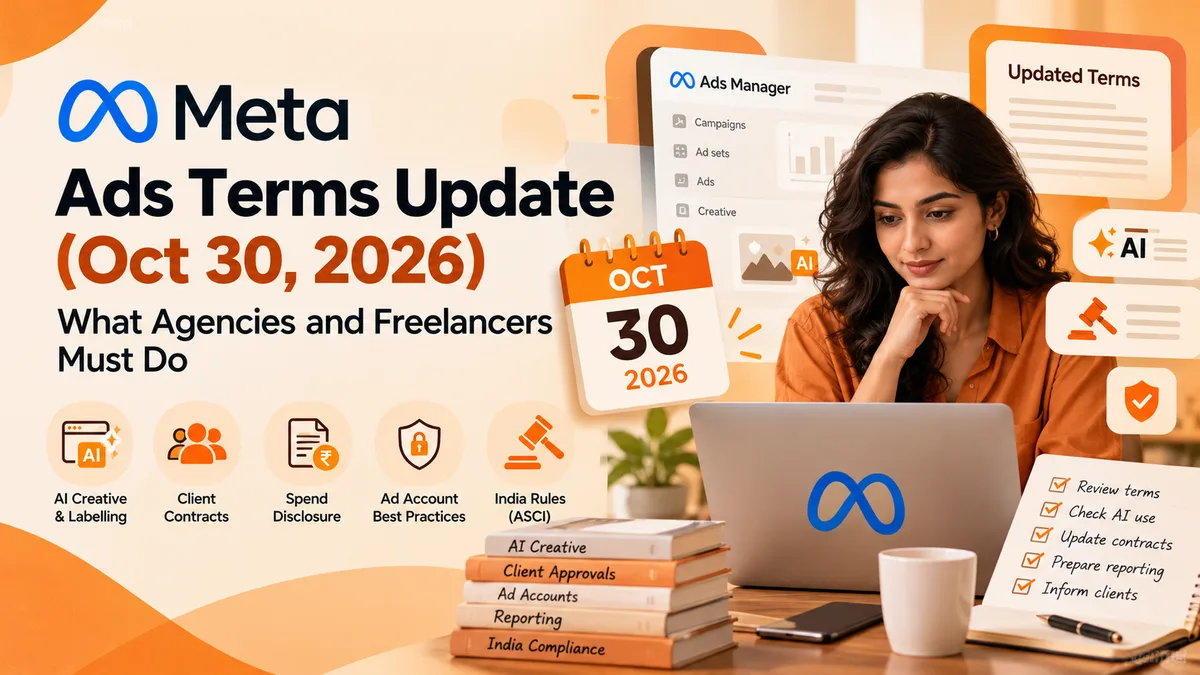
Short answer: The Meta ads terms update puts new Commercial Terms and Self-Serve Ad Terms into effect on October 30, 2026. There is nothing to sign: if you keep running ads after that date, you've said yes. If you run Meta ads for clients, a few quick checks now (AI creative, who has access, how you invoice) save you from awkward client questions later.
I'm a marketer, not a lawyer. For contract wording, ask one.
The banner everyone clicked past
Meet Neha, a made-up freelancer in Pune who runs Meta ads for six D2C brands from one laptop. One Tuesday she opens Ads Manager, sees a banner about "updated terms", dismisses it and gets back to her ROAS dashboard.
Three weeks later a client asks: "Did we agree to AI editing our ads? And who's responsible if it goes wrong?" Neha has no answer, and she doesn't love that.
This post is the 30-minute homework Neha skipped. (She's a composite character, not a real client.)
What changes in Meta's ad terms on October 30, 2026?
Meta's policy pages and industry coverage point to three things:
- The Self-Serve Ad Terms are absorbing the Ad Creative Generative AI Terms. That's the rulebook for Meta's AI tools that make ad images, video and text.
- The Product Catalog Terms are folding into the Meta Commercial Terms.
- Staying means agreeing. Keep advertising after October 30 and you've accepted.
One honest note: I couldn't find a plain-language list of every edit from Meta, so don't trust any "here's exactly what changed" article, mine included, until you've skimmed the old and new text yourself.
Want the brand-owner version first? Read The Banner Everyone Clicked Past and Meta Ads Terms Are Changing on October 30, 2026. This post is for the person running the account on someone else's behalf.
What do Meta's terms actually say, in plain English?
Here are the lines I could read on Meta's own pages, translated. I can't tell which lines are brand new and which were already there, which is exactly why dated copies of the terms are worth keeping.
| What the terms say | In plain English | What to do |
|---|---|---|
| Updates and acceptance | Meta can change the Self-Serve Ad Terms, and continued use counts as accepting the change | Screenshot the notice and save dated copies |
| Meta runs tests | Meta tests its ad tools and systems, which can affect campaign performance, targeting, pricing, reporting and delivery | Keep a dated log of odd jumps in results |
| Size and placement | Meta decides the size, placement and positioning of your ads | Don't promise clients exact placements |
| AI inputs | Using Meta's Ad Creative AI tools gives Meta a permanent, worldwide, free licence to use what you put in | Ask the client before uploading their material |
| AI improvement | Meta may use ad content and how you use the AI tools to improve its services, including its AI models | Tell clients their ad content may help train Meta's AI |
| Agency uploads | Meta's licence covers content uploaded by you or someone acting for you, naming an agency as an example | Get the client's okay to upload their photos and videos |
| Who you're dealing with | Outside the US and Canada, Meta Platforms Ireland Limited provides the self-serve ad tools | Handy when a client asks who exactly they're agreeing with |
Why do Meta's new ad terms matter for agencies and freelancers?
1. Your uploads count. Meta's Commercial Terms say the permission you give Meta covers content you upload, or someone acts on your behalf to upload, and they even name an agency placing an ad as the example. So the photos and videos you upload for clients are in the picture.
2. What you feed Meta's AI tools may stick around. Meta's AI creative terms describe a permanent, worldwide, free licence for Meta to use what you put in, and it carries on after you stop using the tools. Translation: don't drop a client's secret launch photos into an AI tool without asking them first.
3. Whose account is it? My reading, not Meta's wording: if you work inside the client's own ad account, the client is the one agreeing to the terms. If you run ads through your own account or credit line, that's you. Many freelancers do both, so check client by client.
What should agencies and freelancers do? The 30-minute checklist
Before October 30
- Screenshot the terms. Save dated copies of the Self-Serve Ad Terms, Commercial Terms and Ad Creative Generative AI Terms. Future you will thank present you.
- Make a one-page "who owns what" sheet. Client, who owns the ad account, who pays Meta, and whether you work in their account or yours.
- List your AI tricks. Advantage+ creative, image-to-video, AI backgrounds, AI text variations. Note which creatives are AI-made and which are shot or designed by a human.
- Label realistic AI. India's IT Amendment Rules, 2026 have applied since February 20, 2026 and require clear labels on AI content that looks real. If an ad shows a lifelike AI person or scene, label it and keep the source file. ASCI's new AI-ad guidelines go further (see below).
- Ask before you feed secrets to an AI tool. Unreleased products, price lists, customer data: get the client's okay first.
- One client, one ad account. Meta's Advertising Standards say clients you manage should sit in separate ad accounts. One client's policy strike shouldn't freeze everyone else's ads.
- Tidy up who can see ad data. Share it only with people acting on your behalf; you stay responsible for the tools and freelancers you add. Remove old logins.
- Split media spend and your fee on invoices. More on why below.
- Send a five-line heads-up to clients. The date, what the update is about, what you've checked, anything you need from them, and a promise to flag anything that affects their campaigns.
After October 30
- Screenshot the notice. Date it. If a client asks "did we agree to this?", you have the answer.
- Watch your numbers for a month. Meta's Self-Serve Ad Terms say it runs tests that can affect performance, targeting, pricing and delivery. Log any odd jump in CPM, reach or ad rejections, with dates. If costs move, my breakdown of Instagram ads cost in India gives you a baseline.
- Refresh your proposal template. Add a simple line on who approves AI-made creative before it goes live. Run the wording past a lawyer.
- Set a monthly reminder. Meta can change these terms again, and staying means agreeing again.
Copy-paste message for your clients
Subject: Quick heads-up: Meta's ad terms change on Oct 30 Hi [Name], Meta updates its advertising terms on October 30, 2026. There's nothing for you to sign, but carrying on with Meta ads counts as accepting them. I've checked how we use AI creative, who has access to your account, and how we report spend. Two quick asks: are you okay with us using Meta's AI creative tools on your ads, and is there anything on your website that shouldn't be public? I'll flag anything that affects your campaigns. [Your name]
One more thing to double-check: some analysts say the update widens Meta's rights to crawl websites and use the content to train its AI. I couldn't confirm the new wording, so if a client has members-only pages or secret price lists, read the updated text before you reassure them.
Does Meta label AI ads, and do you have to disclose AI use?
Mostly, Meta labels for you. According to several 2026 trade explainers, hand-filed disclosure is clearly required only for social issue, electoral and political ads. Check Meta's Help Center for your ad category before you tell a client anything.
What triggers Meta's "AI info" label
- Using Meta's own generative tools in Ads Manager (Background Generation, Image Generation, Add Animation) to significantly change an image or video.
- Since June 2026, Meta also spots many third-party AI tools through signals such as C2PA metadata in the file.
- Minor edits like cropping or colour correction don't count.
Where viewers see it. Usually behind the three-dot menu under "About this ad". Where local rules require AI transparency, advertisers may get an option to self-disclose, and the label then sits next to the Sponsored tag.
Don't scrub metadata. One analysis of the updated terms says advertisers may not remove AI watermarks or authentication data from ads (a secondary reading, so confirm it in the terms). Design as if viewers can see the label: a synthetic testimonial with an AI tag attached works against itself, and in India it's also on ASCI's banned list.
Myth check: you'll see posts claiming Meta mandates AI disclosure on every ad worldwide since March 2026. The sources disagree, which is the best reason to read Meta's own Help Center page. For the tools I actually trust for creative, see AI tools for digital marketing: what I actually use.
What do India's new ASCI AI-ad rules mean for your Meta ads?
If you run Meta ads for Indian clients, this matters as much as Meta's own terms. On September 29, 2026, the Advertising Standards Council of India (ASCI) published its final guidelines on labelling AI-generated ("synthetically generated") content in ads. They take effect three months after publication, so around late December 2026. ASCI is a self-regulatory body, but its code is widely treated as essential for Indian advertisers.
| Bucket | Examples | What to do |
|---|---|---|
| Banned, even with a label | Fake endorsements or testimonials; synthetic visuals that exaggerate results; non-existent places shown as real; using someone's likeness without consent; unlicensed copyrighted work | Don't make it. A label won't save it |
| Label required | AI influencers or ambassadors; a real person's face or voice recreated (with consent); fabricated events or settings; demos of products that don't exist yet; AI sound effects central to a feature; paid AI product suggestions ("Sponsored by [Brand]") | Add a clear label such as "Audio/Video created using AI" or "enhanced using AI". Platform labels are allowed |
| No label needed | Colour correction, lighting, noise reduction, minor blemish removal; decorative backgrounds; obviously fantastical effects; AI-written ad copy; subtitles and translations | Carry on |
- Using ChatGPT or another tool to write ad copy needs no label. Realistic AI people, voices and demos do.
- A label doesn't fix a misleading ad. Responsibility stays with the advertiser, and AI-made ads are still judged against the full ASCI Code.
- Meta's automatic "AI info" label may help, since ASCI allows platform-provided labels, but check whether your ad falls in the "label required" bucket.
Why does this matter more in 2026? Meta's AI is starting to act inside ad accounts
At Advertising Week New York on October 6, 2026, Meta said its AI business assistant is gaining memory and creative insights, and that it has begun testing agentic actions: setting up campaigns and changing targeting and budgets from a chat prompt. Meta also expanded its Ads MCP server so agencies can work with outside AI tools. Meta claims advertisers using the assistant see 5% more conversions at the same cost per conversion, though that's Meta's own figure.
When software changes a budget, someone has to answer "who approved that?" One analysis reads the updated terms as making the advertiser responsible for changes made by automated processes and Meta's AI. That is a secondary reading, but it's a sensible way to plan.
A simple guardrail for agencies and freelancers
- Keep a human sign-off for budget and targeting changes, even when an AI suggests them.
- Check Ads Manager's change history weekly. It's your record of who or what changed what.
- Note in client reports which changes were AI-suggested and which were yours.
- Tell clients which AI features you use. That one sentence prevents most awkward conversations.
What happens after October 30? The February 3, 2027 spend-disclosure rule
Plot twist: October 30 isn't the only date on the calendar. In April 2026, Meta updated its Developer Policies for ad-buying solutions. From February 3, 2027, if an end advertiser asks, an agency or ad-buying platform has to show:
- how much was spent on Meta for them, separate from your fees, plus your fee structure, and
- the campaign setup and results, using Meta's own terms for the metrics.
It only kicks in when a client asks, and it's aimed at agencies, resellers and platforms that buy ads for clients. A solo freelancer running ads inside the client's own account on the client's own card is probably in a different spot (my reading), but clean spend-versus-fee reporting protects you either way. Think of it as the "where did my ₹1 lakh go?" test. Pass it with one export, not a week of digging. It's the same reporting discipline behind why a 3x ROAS can still mean failing sales.
Key dates to put in your calendar
| Date | What happens | Who it affects |
|---|---|---|
| Feb 20, 2026 | India's IT Amendment Rules on AI-generated content take effect | Platforms and uploaders in India |
| June 2026 | Meta starts spotting third-party AI tools for its "AI info" label (per trade explainers) | Every advertiser using AI creative |
| Sep 29, 2026 | ASCI publishes its final AI-ad labelling guidelines | Advertisers in India |
| Oct 6, 2026 | Meta announces assistant and agentic tests at Advertising Week | Agencies and media buyers |
| Oct 30, 2026 | Updated Meta Commercial Terms and Self-Serve Ad Terms take effect | Everyone running Meta ads |
| About Dec 29, 2026 | ASCI guidelines take effect | Advertisers in India |
| Feb 3, 2027 | Meta's spend-disclosure rule for ad-buying solutions starts | Agencies, resellers and ad platforms |
Why is Meta tightening its ad rules? Real examples
The 2024 warm-up. In October 2024, Meta announced Platform Terms and Developer Policy updates that took effect on February 3, 2025, including clearer transparency rules for ad-buying solutions. The 2027 spend-disclosure rule is the next chapter of the same story.
The scam-ads lawsuit. On April 21, 2026, the Consumer Federation of America filed a class action alleging Meta profited from fraudulent ads. Press coverage says the complaint also points at reseller structures that earn commissions. These are allegations, not findings, but they show the pressure on intermediaries to show their numbers.
India's AI labels. Since February 20, 2026, India expects clear labels on realistic AI content. Meta folding AI creative rules into its ad terms means "I didn't know it was AI" is a thin excuse for an agency.
Neha, take two. Before October 30 she logs her AI use, gets one client's written okay, labels a lifelike AI model in a skincare video, and adds a "media spend" line to her invoices. In March a client asks what was spent on Meta versus her fee. She sends one export in ten minutes. Same freelancer, much better week.
Do Meta's new terms hit normal brands and iGaming advertisers differently?
Everyone accepts the same October 30 terms, but iGaming advertisers play on a harder level because Meta already treats gambling ads separately. For a normal brand, a slip usually costs an ad or some delivery. For an iGaming advertiser, it can cost Meta's permission to advertise at all.
| Topic | Normal brand (D2C, education, real estate) | iGaming and gambling advertiser |
|---|---|---|
| Permission to run ads | Normal ad rules; most brands just run | Prior written permission for online gambling ads, plus proof of a licence or lawful status in each country targeted |
| Landing pages | Reviewed under normal rules | Permission also covers pages that promote gambling, even affiliate or aggregator pages |
| Targeting | Normal targeting rules | No targeting of people under 18 |
| Free-to-play games | Not applicable | Social casino and free-to-play games can run without permission but still follow the gambling policy |
| AI creative | Mostly about approvals and labels | Riskier: AI copy that oversells winnings or bonuses can break gambling ad rules, so read every variation (my advice) |
| India | AI-labelling rules apply | Real-money games and advertising them are banned under the Promotion and Regulation of Online Gaming Act, 2025 |
Real example: Meta's permission doesn't beat local law. In May 2025, Meta told real-money gaming advertisers in India they needed its written permission and couldn't target under-18s. About three months later, Parliament passed the Online Gaming Act, banning online money games and advertising them, with reported penalties of up to two years in prison and a ₹50 lakh fine for advertising banned games. More context in are betting apps banned in India?
Normal brands: add this
- Run the checklist above. Your biggest exposures are AI creative, client data and who has access.
- Ask your agency whether your ads share an ad account or Business Manager with restricted-category clients like gambling.
iGaming advertisers: add this
- Confirm Meta's written permission is current and covers every country you target.
- Keep your licence papers and the permission record next to your dated copy of the terms.
- Have compliance approve AI-generated copy, images and video before launch.
- Audit affiliate and aggregator landing pages. They need permission too.
- Keep iGaming in its own ad accounts, so a gambling policy strike never freezes a normal brand's ads.
- Don't aim real-money gaming ads at Indian audiences.
More in my posts Digital Marketing for iGaming Businesses in 2026 and AI in iGaming.
Myths about the Meta terms update, busted
- "I must sign something by October 30." No. Continued use counts as acceptance.
- "Meta makes me tick an AI box on every ad." Sources disagree, but hand-filed disclosure is clearly required only for political, electoral and social issue ads.
- "An AI label makes any ad safe." Not in India. Fake testimonials, deepfakes and exaggerated results stay banned with or without a label.
- "AI-written ad copy needs a label." Under ASCI's guidelines, it doesn't.
- "This only matters to big brands." Meta's Commercial Terms name agencies placing ads, and the 2027 spend-disclosure rule targets agencies and resellers.
- "Meta's permission means I can run real-money gaming ads in India." No. India's Online Gaming Act bans them.
Key takeaways
- The date: October 30, 2026. Staying means agreeing, and there's nothing to sign.
- Know whose account it is, which AI tools you use and what you've told clients.
- Meta labels most AI ads itself with an "AI info" tag. Don't strip AI metadata from files.
- In India, ASCI's AI-ad guidelines start around late December 2026. Realistic AI people and demos need a label; AI-written copy doesn't.
- Ask before you feed client material into Meta's AI tools. Meta gets a permanent licence to what you put in.
- One client, one ad account. Keep ad data on a need-to-know basis.
- Keep a human sign-off on budget and targeting changes as Meta's AI starts to act in accounts.
- Split media spend from your fee now. The disclosure rule starts February 3, 2027.
- iGaming gets extra scrutiny: written permission, no under-18 targeting, and in India a ban on real-money gaming ads.
- Save dated copies of the terms. They can change.
Running Meta ads for clients and want a second pair of eyes before October 30? Let's make your brand more interesting.
Sources and official links
- Meta Self-Serve Ad Terms
- Meta Commercial Terms
- Meta Ad Creative Generative AI Terms
- Meta Advertising Standards
- Meta Online Gambling and Games policy
- PPC Land: Meta Developer Policy 10.5 and 10.6.a, spend disclosure from February 2027
- Exchange4media: ASCI guidelines on labelling AI-generated ad content (Sep 29, 2026)
FAQs
When do Meta's new ad terms take effect?+
October 30, 2026. The updates cover the Meta Commercial Terms and the Self-Serve Ad Terms, which are absorbing the Product Catalog Terms and the Ad Creative Generative AI Terms.
Do I have to sign anything?+
No. Meta's terms say continued use after an update counts as acceptance, so if you keep running ads after October 30, you've accepted.
Do freelancers need to do anything different from agencies?+
The checklist is the same, but the risk differs. Freelancers working inside clients' own accounts mostly need to record AI use, protect client data and tidy their contracts. Agencies that buy media for clients should also prepare for Meta's spend-disclosure rule from February 3, 2027.
Who is responsible for AI-generated ads, the client or the agency?+
Meta's Advertising Standards put responsibility for following the rules on the advertiser, and some analysts read the update as spelling this out for AI content. What's between you and your client is set by your contract, so write down who creates, who approves and who is accountable.
Does Meta take ownership of my ad creative?+
The documents I reviewed describe a licence, not ownership, including a permanent licence over what you put into Meta's AI creative tools. Read the sections on outputs and responsibility in the Ad Creative Generative AI Terms yourself before deciding what to feed in.
Does India require labels on AI ads?+
India's IT Amendment Rules, 2026, in force since February 20, 2026, require prominent labels on AI content that looks real, and platforms must collect declarations from uploaders. Label lifelike AI people, voices and scenes in client ads and keep the source files.
Does Meta allow iGaming ads?+
Only with Meta's prior written permission for online gambling, with proof of licensing and no targeting of under-18s. In India, real-money gaming and its advertising are banned by law, whatever Meta allows.
Do I have to label AI-generated ads on Meta?+
Meta applies an "AI info" label automatically when its own generative tools are used, and since June 2026 it also detects many third-party tools, according to trade explainers. Hand-filed disclosure is clearly required only for political, electoral and social issue ads. Check Meta's Help Center for your category, and don't remove AI metadata from files.
Do India's ASCI AI rules apply to Meta ads?+
ASCI's guidelines on AI-generated ad content, published on September 29, 2026 and effective three months later, are written for advertising in India. They don't single out Meta, so treat your Meta ads for Indian audiences the same way. Fake testimonials and deepfakes are banned even with a label; synthetic influencers and realistic AI demos need a label; AI-written ad copy does not.
Keep reading
- Performance MarketingWhatsApp Business API / Marketing Guide (2026): What Changed Two Days Ago7 min read
- iGamingInfluencers in iGaming vs. Mainstream Brands: What Nobody's Telling You8 min read
- Performance MarketingMeta Ads Terms Are Changing on October 30, 2026: What Advertisers Need to Know10 min read
Written by Likita
Digital marketing, creative strategy, content & AI — Asia, UAE & Europe.