

WhatsApp Business API / Marketing Guide (2026): What Changed Two Days Ago
WhatsApp service messages became billable on Oct 1, 2026. The real 2026 WhatsApp Business API guide for India — per-message pricing, Cloud API, tier limits, BSP markups and a case study.
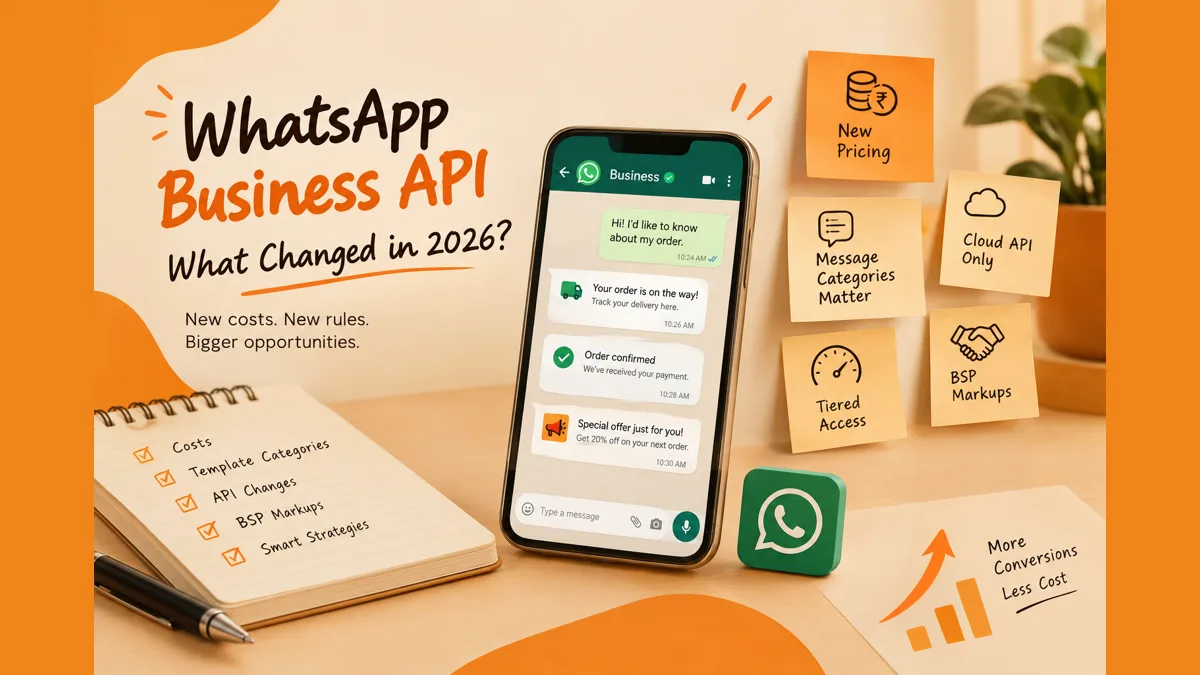
Quick answer: In 2026, WhatsApp Business API in India runs only on Cloud API through a Business Solution Provider (BSP). Marketing messages cost about ₹0.86 each, utility and authentication about ₹0.115, and from October 1, 2026 service replies are billable too after roughly 1,000 free per number per month. New numbers start at Tier 1 (1,000 unique recipients a day), and BSP markups can change your real cost by up to 30%.
If you're reading this in early October 2026, there's a good chance your WhatsApp marketing costs just quietly went up — and most businesses haven't noticed yet. On October 1, 2026, Meta made customer-service replies on WhatsApp chargeable for the first time. For years, any reply inside the 24-hour service window was completely free. Now, after a free allowance of roughly 1,000 service messages per number per month, each one costs ₹0.115. If your support team handles high message volumes, that change alone can turn what used to be a zero-cost conversation into a real monthly line item — and almost no guide written before this week accounts for it.
That's the state of WhatsApp marketing in India right now: a channel every Indian business already knows works, with a pricing and compliance layer that keeps shifting underneath it. Here's the actual 2026 picture.
Why WhatsApp Marketing in India Isn't Optional Anymore
India has 500-900 million WhatsApp users, expected to cross a billion by the end of 2026 — the largest WhatsApp market on earth. Business messages on WhatsApp open at roughly 98%, and conversational commerce on the platform is converting at 45-60% in some studies, a figure traditional channels simply can't touch — which is why WhatsApp beats email on opens. Click-to-WhatsApp ads specifically deliver 94% higher conversion rates and 92% lower cost-per-lead compared to traditional landing-page campaigns, according to a Forrester study commissioned by Meta.
None of that is new information if you've been paying attention to this channel. What's changed is the infrastructure and cost layer around it — and that's where most businesses are now behind.
WhatsApp Business API Pricing in India (2026)
| Message type | Approx. cost per message (India) | Notes |
|---|---|---|
| Marketing | ₹0.86 (~₹1.02 with 18% GST) | Offers, promotions, re-engagement |
| Utility | ₹0.115 | Order confirmations, shipping, delivery updates |
| Authentication | ₹0.115 | OTPs and login codes |
| Service (24-hour window) | ₹0.115 after ~1,000 free/month | Billable from October 1, 2026 |
These are Meta's base rates. Your BSP adds its own markup on top — more on that below.
The Insight Almost Nobody's Factoring In: "Reclassify Ruthlessly"
Here's a genuinely underused cost-saving move: a utility message costs roughly 85% less than a marketing message in India — about ₹0.115 versus ₹0.86. The category isn't about who's sending the message, it's about what the message actually contains. An order confirmation, a shipping update, or a delivery notification is a utility message, even if it comes from your marketing number, as long as it carries no promotional content. A huge number of businesses default to tagging everything as "marketing" out of habit or caution, quietly paying 7-8x more than they need to for messages that qualify as utility.
If you're running meaningful WhatsApp volume and haven't audited your template categories recently, this single fix often pays for the audit itself many times over.
Three WhatsApp Business API Changes Most Guides Haven't Caught Up To
1. On-premise WhatsApp API was fully deprecated in October 2025. If your business set up its WhatsApp API integration a couple of years ago on the self-hosted, on-premise model, that infrastructure is no longer supported. Cloud API, accessed through a Business Solution Provider (BSP), is now the only path forward for new and existing deployments alike.
2. New API numbers start capped, not unlimited. A newly set-up WhatsApp Business API number begins at "Tier 1" — a maximum of 1,000 unique recipients per day — regardless of how big your actual customer list is. Scaling requires moving through Meta's tier system over time, which matters enormously for launch planning: budget the ramp-up, don't assume day-one full-volume access.
3. BSP markups can make "the same" pricing wildly different. Meta's per-message rate is public and identical everywhere. What isn't identical is what your BSP (the platform connecting you to that API — Interakt, AiSensy, Gupshup, WATI, and others) adds on top: anywhere from ₹0.05-0.30 per message, or a flat monthly platform fee. Two vendors can both honestly claim "official Meta pricing" and still differ by 30% once their markup is included. Always ask for the full combined rate, not just Meta's base number.
Real Example: Ispahani Tea
Ispahani Tea, an FMCG brand with roots dating back to 1964, noticed something most legacy brands would have missed: despite maintaining a full website, the majority of customer queries, product discussions, and actual purchases were already happening informally over regular WhatsApp. Rather than fighting that behavior, the brand leaned into it — integrating the WhatsApp Business API through BSP platform Interakt to turn that organic conversational demand into a structured, guided buying journey.
The result: conversion rates rose from 5-10% before the API integration to 40-50% after it — a four-to-eight-fold improvement, driven not by bigger ad budgets but by meeting customers on the channel they were already choosing. It's a clean example of a principle worth remembering: sometimes the highest-leverage marketing move isn't acquiring a new channel, it's formalizing the one your customers already prefer — the same thinking behind good e-commerce marketing in India.
WhatsApp Marketing Tips That Actually Move Numbers
- Audit your template categories quarterly. As your catalog and messaging evolve, messages that used to need "marketing" tags might now qualify as utility, and vice versa — don't set it once and forget it.
- Use Click-to-WhatsApp ads as your primary lead-gen test, not a secondary channel. Given the 94% conversion lift and 92% lower cost-per-lead versus landing pages, this deserves budget parity with your standard lead-form campaigns, not an afterthought allocation.
- Respect Meta's one-marketing-template-per-user-per-24-hours limit as a floor, not a target — brands that push right up against it consistently see faster opt-out growth than ones that pace sends more deliberately.
- Plan your Tier 1 → Tier 2+ ramp before launch, not during it. If you're expecting to message more than 1,000 unique recipients on day one, build that timeline into your campaign plan now.
- Budget for the October 2026 service-message shift explicitly. If your support volume is meaningful, model what your free 1,000-message allowance actually covers versus your real monthly support traffic — the gap is now a real cost, not a rounding error.
What To Do vs. What To Avoid
Do:
- Get the full, combined per-message rate (Meta's fee plus your BSP's markup) in writing before committing to a provider
- Migrate off any on-premise API setup immediately if you haven't already — it's no longer supported
- Treat utility-vs-marketing classification as an ongoing cost-optimization task, not a one-time setup decision
Avoid:
- Assuming service-window replies are still unconditionally free after October 1, 2026 — they aren't, past your monthly allowance
- Comparing BSP quotes on Meta's base rate alone — the markup is where real cost differences hide
- Launching a campaign assuming unlimited day-one reach on a brand-new API number — Tier 1's 1,000-recipient cap is real
The iGaming Angle: Why WhatsApp Matters Even More in Restricted Industries
Here's where the same economics get amplified. iGaming and betting brands in India can't lean on Google Search ads in most states, and Meta restricts gambling promotions aggressively — which means paid acquisition is a leaky bucket before you even start. That's exactly why iGaming marketing lives on owned channels, and WhatsApp is the biggest one of them. Deposit confirmations, withdrawal updates, match-day re-engagement — the utility layer runs on WhatsApp Business API, and the utility-vs-marketing classification I described above matters twice as much when you're sending at volume, because opt-outs and poor template quality scores hit restricted industries harder than anyone else.
The broader lesson applies to any regulated category: when paid channels shrink, the conversational channel your customers already use becomes the moat. I break down the full organic playbook in my guide to casino SEO in 2026 — WhatsApp retention is the retention half of that same strategy.
The Real Takeaway
WhatsApp marketing in India isn't a question of whether to use it anymore, it's a question of whether you're using it on the current rules. The October 2026 service-message change, the full on-premise deprecation, and the 85% cost gap between misclassified and correctly classified messages are all things a guide written even six months ago wouldn't mention. Brands like Ispahani Tea aren't winning on WhatsApp because they found a secret tactic, they're winning because they treated it as the real primary channel it already is for Indian customers, and kept their setup current with how Meta actually prices and structures it today.
If you want your WhatsApp setup audited against the 2026 rules, let's make your brand more interesting.
FAQs
What changed in WhatsApp Business API pricing on October 1, 2026?+
Service messages, replies sent within the 24-hour customer-service window, became billable for the first time after a free allowance of roughly 1,000 messages per number per month, at approximately ₹0.115 per message. Previously, all service-window replies were completely free.
How much does a WhatsApp marketing message cost in India in 2026?+
Meta's rate for a marketing message delivered to an Indian number is approximately ₹0.86 (around ₹1.02 with 18% GST), while utility and authentication messages cost roughly ₹0.115, about 85% less, making correct message classification a meaningful cost factor.
Is on-premise WhatsApp Business API still supported in India?+
No. Meta fully deprecated the on-premise WhatsApp Business API in October 2025. Cloud API, accessed through a Business Solution Provider, is now the only supported option for new and existing deployments.
How many people can I message when I first set up WhatsApp Business API?+
New API numbers start at Tier 1, capped at 1,000 unique recipients per day, regardless of total customer list size. Reaching a larger audience requires scaling through Meta's tier system over time.
Keep reading
- Performance MarketingMeta Ads Terms Are Changing on October 30, 2026: What Advertisers Need to Know10 min read
- Performance MarketingThe Banner Everyone Clicked Past: Meta's October 30, 2026 Terms Update9 min read
- Performance MarketingWhat Is Performance Marketing? A 2026-27 Guide for Indian Businesses8 min read
Written by Likita
Digital marketing, creative strategy, content & AI — Asia, UAE & Europe.