

AI Tools for Digital Marketing: What I Actually Use (And What's Hype)
61% of marketers regret an AI tool purchase. My honest breakdown of the best AI tools for digital marketing in 2026 — the AI SEO, content, automation and video tools I actually use, and the overhyped AI marketing tools I'd skip.
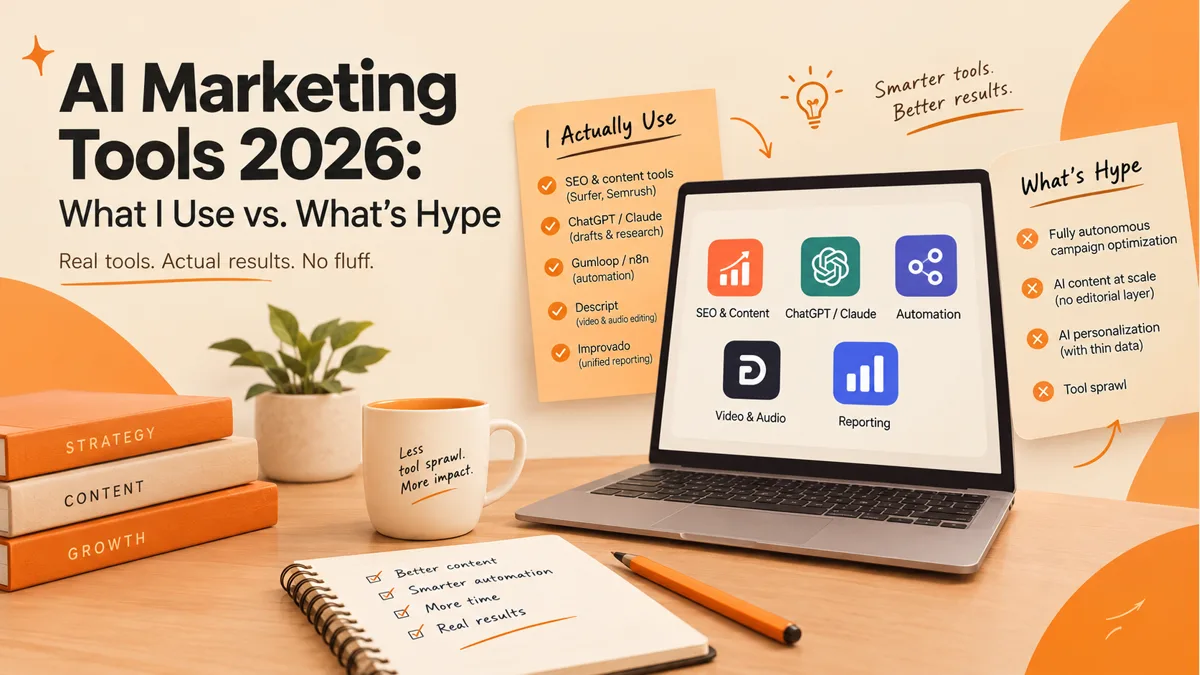
Quick answer: The AI tools for digital marketing that actually earn their place in 2026 are the ones that replace a real manual task — an SEO/content tool (Surfer SEO, Semrush AI), a general AI model for drafts (ChatGPT, Claude), a workflow automation tool (Gumloop, n8n), and a video editor (Descript). The hype is in fully autonomous ad optimization, AI content at scale with no editing, personalization on thin data, and tool sprawl.
I got asked in a client call last week, "What's your AI stack?" I laughed, because the honest answer isn't a shiny list of 20 logos — it's four or five tools I actually open every week, and a graveyard of subscriptions I tried once and quietly cancelled. That gap between the AI tools marketers talk about and the ones they actually use daily is bigger than most people admit.
And the data backs up why that gap exists. Global AI marketing spend hit $57.99 billion in 2026 — and 61% of marketers reported buyer's remorse on an AI tool purchase in the last 18 months. That's not a small miss. That's a majority of the industry paying for tools that didn't deliver. So here's my honest, specific answer: what I actually use, what I've dropped, and what I think is pure hype dressed up as innovation. (If you're wondering whether these tools will make marketers redundant, I covered that separately in will AI replace digital marketers?)
The Best AI Marketing Tools I Actually Use in 2026, By Job
For SEO and content structure (AI SEO tools) — I lean on tools built for that job specifically, not a general chatbot alone. Purpose-built SEO platforms — Surfer SEO and Semrush's AI content tools are the two most widely used examples right now — analyze what's actually ranking for a target keyword and score content against it, saving real research time, especially when building out a topic cluster rather than one page. The output still needs a human rewrite pass, but the structural groundwork is genuinely faster — the same topic-cluster thinking behind any content marketing strategy that works in 2026.
For first drafts and research (AI content generation tools) — a general-purpose AI model, used as a starting point, never a finished product. Tools like ChatGPT or Claude fall here. This is where most of my time savings actually come from: compressing hours of competitor research, campaign brief drafting, and first-pass copy into minutes. I've said this before and it's still true — I don't hand off judgment calls, but I happily hand off the blank page.
For workflow automation (AI automation for marketing) — this is the most underrated category, and almost nobody outside agencies talks about it. Tools like Gumloop and n8n let you connect an AI model directly into your existing workflow — pulling campaign data, triggering a report, formatting it, without writing code. n8n, run self-hosted, has been noted to cost 10-20x less than Zapier for equivalent automations, which matters a lot for a solo operation or small agency. If you're still manually copying campaign numbers into a weekly report, this is the single highest-ROI AI investment you're not making yet.
For video and audio editing — this genuinely surprised me. Descript is the clearest example: it lets you edit video by editing its transcript (delete a sentence, the matching video clip disappears), cutting editing time by roughly 40-60% in independent testing. For a channel like YouTube Ads where creative testing volume matters — and where YouTube Ads cost in India rewards fresh creatives — this is one of the few AI categories where the time saved is immediate and obvious, not theoretical.
For unified reporting across ad platforms — worth it only past a certain account size. Tools like Improvado pull Google Ads, Meta Ads, and YouTube Ads data into one dashboard. Once you're managing all three simultaneously for a client, that's genuinely useful. Below that scale, it's often more setup overhead than the manual alternative.
Overhyped AI Tools in 2026: What I Think Is Hype
"Fully autonomous campaign optimization." Any tool pitching itself as a hands-off system that manages your ad spend without oversight is the one category I'd actively warn clients away from — especially in a compliance-sensitive vertical like iGaming, where a fully automated system doesn't know it's about to trigger a policy violation until the account's already suspended (I broke down how that plays out in iGaming PPC under Google's 2026 gambling ad rules). Automation should flag decisions for a human, not make the final call alone, in any regulated category.
Generic "AI content at scale" tools with no editorial layer. The tools promising hundreds of blog posts a month sound efficient until you remember Google's own algorithm is now actively penalizing exactly this kind of output — thin, interchangeable AI content is one of the clearest ranking-decline patterns of 2026. Volume without a real editorial pass isn't a shortcut, it's a liability with a delay timer on it.
AI "personalization engines" that promise deep customer insight from thin data. A lot of these tools oversell what they can actually infer from limited behavioral data, especially for smaller accounts that don't have the traffic volume to make the personalization statistically meaningful in the first place. It's a genuinely powerful category at enterprise scale; at small-to-mid scale, it's often paying for a feature you don't have enough data to use well.
Tool sprawl itself. This is less about any single bad tool and more about a pattern: 26% of marketers now cite overlapping AI tools as an actual barrier to getting value from AI, not a lack of tools. The highest-leverage move most teams could make right now isn't adding another AI subscription — it's cutting two or three overlapping ones and actually mastering what's left.
The Honest Filter I Use Before Adding Any AI Tool
Before I add anything new to my stack, I ask one question: does this replace a task I'm currently doing manually, or does it just make an existing task feel slightly faster? The first is worth paying for. The second is usually a subscription I'll forget to cancel in eight months.
The Full Tool List at a Glance
Here's the whole post in one table — the exact tools I use, what each one replaces, and my verdict. Screenshot this section; it's the takeaway.
| Tool | What it replaces | My verdict |
|---|---|---|
| Surfer SEO | Manual competitor and SERP research for content | Worth it — still needs a human rewrite pass |
| Semrush (AI content tools) | Keyword and topic-cluster research | Worth it — best alongside Surfer, not instead of it |
| ChatGPT / Claude | The blank page: first drafts, research, briefs | Worth it — starting point only, never the finished product |
| Gumloop / n8n | Manually copying campaign data into reports | Worth it — n8n self-hosted costs 10-20x less than Zapier |
| Descript | Video and audio editing | Worth it — cuts editing time by roughly 40-60% |
| Improvado | Pulling Google, Meta and YouTube Ads data into one dashboard | Only past a certain account size — skip below that scale |
| "Fully autonomous" ad optimizers | Nothing you should let them | Skip — especially in regulated categories like iGaming |
| AI content-at-scale tools | Nothing that survives a Google update | Skip — thin AI content is a ranking liability in 2026 |
| AI personalization engines | Manual audience segmentation | Skip until you have enterprise-level traffic to train them |
The Real Takeaway
The AI marketing tool landscape in 2026 isn't short on options, it's short on discipline. My actual stack is small on purpose: a content/SEO tool, a general AI model for drafts, a workflow automation tool, and a video editing tool — each replacing a specific task I used to do by hand. Everything I've dropped promised to do more and ended up doing less. If a tool isn't replacing a real bottleneck you can name, it's not a strategy — it's a subscription.
Want a lean AI-assisted marketing setup that cuts the noise and keeps a human on the decisions that matter? Let's make your brand more interesting.
FAQs
What are the best AI tools for digital marketing in 2026?+
The best AI tools for digital marketing are the ones that replace a specific manual task. My working stack: Surfer SEO or Semrush's AI tools for SEO and content structure, ChatGPT or Claude for first drafts and research, Gumloop or n8n for workflow automation, Descript for video and audio editing, and Improvado for unified reporting once you manage Google, Meta and YouTube Ads together.
What's the biggest mistake marketers make when adopting AI tools?+
Buying tools based on hype rather than a specific, existing time-sink. 61% of marketers reported buyer's remorse on an AI tool purchase in the last 18 months, and overlapping, redundant tools are now cited as a bigger barrier to AI value than lack of access to tools.
Are fully automated AI ad optimization tools safe to use?+
Not without human oversight, especially in regulated industries. Fully autonomous systems can make compliance-risking decisions, such as triggering a gambling advertising policy violation, faster than a human would catch them, making them a genuine liability in verticals like iGaming.
Is AI content generation still effective for SEO in 2026?+
Only with a genuine human editorial pass. Google's ranking algorithms increasingly penalize thin, interchangeable AI-generated content, so volume without real editing has become a ranking risk rather than a growth shortcut.
Which AI marketing tools are worth it for a small business or solo marketer?+
Start with a general AI model like ChatGPT or Claude for drafts, and a low-cost automation tool like self-hosted n8n, which has been noted to cost 10-20x less than Zapier for equivalent automations. Skip unified reporting platforms and personalization engines until you have the account size and traffic to use them well.
How much is being spent on AI marketing tools globally in 2026?+
Global AI marketing spend reached $57.99 billion in 2026, though a majority of marketers report experiencing buyer's remorse on at least one AI tool purchase within the past 18 months.
Keep reading
Written by Likita
Digital marketing, creative strategy, content & AI — Asia, UAE & Europe.