

The Banner Everyone Clicked Past: Meta's October 30, 2026 Terms Update
Meta updates its ad terms on October 30, 2026, folding AI creative rules into the Self-Serve Ad Terms. What changes, who it affects, the AI label explained, India's new labelling rules and an advertiser checklist.
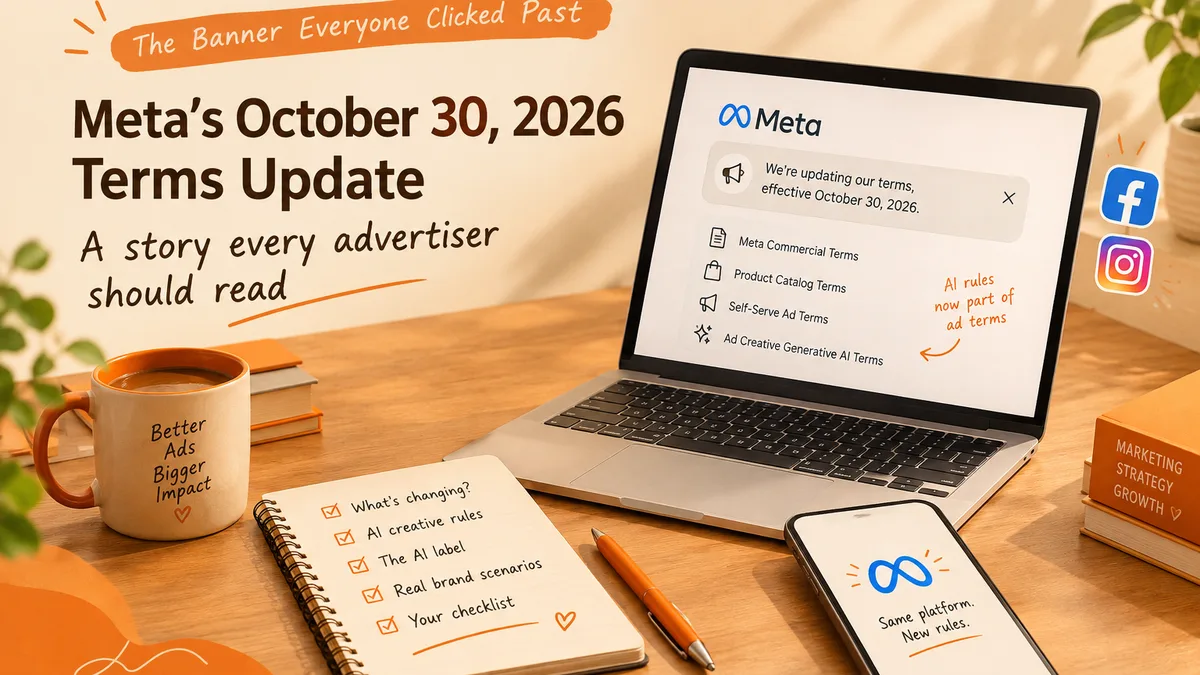
Short answer: Meta has announced updates to its Meta Commercial Terms, Product Catalog Terms, Self-Serve Ad Terms and Ad Creative Generative AI Terms, effective October 30, 2026. Meta states that the Self-Serve Ad Terms are being updated to incorporate the Ad Creative Generative AI Terms. If you run Facebook and Instagram ads, create ads with AI, or sell through a catalog, this is worth 30 minutes of your time.
Meera's Monday Morning
Let me tell you about Meera. She isn't a real client. She's a composite of situations I see often in my work with brands across India and the UAE. Meera runs a home décor brand out of Mumbai. She sells through Instagram, spends a healthy budget on Meta ads, and loves a shortcut. Her team uses AI to swap product backgrounds ("a sunlit Bandra living room!"), generate festive variations, and polish model photos before Diwali.
One Monday morning, she opens Ads Manager and sees a thin grey banner: "We're updating our terms, effective October 30, 2026." She clicks the little "x". Of course she does. So did you, probably. Here's what Meera didn't know, and what this post is about: that banner is Meta changing the rulebook for the exact things she does every day.
What Is Actually Changing on October 30, 2026?
The banner names four documents:
| Document | What it covers |
|---|---|
| Meta Commercial Terms | The general agreement for businesses using Meta products |
| Product Catalog Terms | The rules for catalogs behind Advantage+ catalog ads and Shops |
| Self-Serve Ad Terms | The agreement for anyone buying ads through Ads Manager or the Marketing API |
| Ad Creative Generative AI Terms | The rules for Meta's AI tools that create or edit ad creatives |
The one change Meta has spelled out is the merge: the AI creative terms are being folded into the Self-Serve Ad Terms. In plain English, AI rules stop being a side document and become part of the core ad agreement. A note on honesty: I haven't found a published line-by-line summary of the changes to the Commercial and Catalog Terms. Everything about those two is my analysis below. I'll update this post once the new terms are live on October 30.
Meera's AI Shortcut Meets the Fine Print
Meera uses Meta's AI features inside Ads Manager. So what do the AI terms say today? You keep the rights you have in the inputs you provide, and Meta keeps the rights it has in the outputs the AI generates. Meta grants you the right to use that output anywhere on Meta's own products. You also agree not to put personal information into the inputs.
Read that again as an agency or business owner. Meta keeps rights in the output, but you can use it on Meta's platforms. That's fine for running ads. It's less clear if your client contract promises "full ownership of all creatives," or if you want to reuse an AI-generated image on a website or a hoarding.
There's also a subtle point that most people miss: the AI creative tools are governed by these ad-specific terms, while Meta's AI products used outside the ad interfaces fall under Meta's separate AI terms of service. Where you generate something matters. Making an image inside Ads Manager is not the same legal setting as playing with Meta AI elsewhere.
The "AI Info" Label Meera Never Noticed
Months before this terms update, Meera's ads quietly started carrying something new. Meta automatically applies an "AI info" label to ads made or significantly edited with its generative tools such as Background Generation, Image Generation, or Add Animation. It also labels ads when it detects third-party AI tools like Photoshop or DALL-E, using industry-standard metadata such as C2PA. The label lives in the "About this ad" menu behind the three-dot icon.
Two practical consequences. First, detection depends on metadata. Whether a third-party tool's output gets flagged can depend on whether that tool writes C2PA information into the file. If metadata is lost when you resize or re-export, labelling can be unpredictable. Your workflow now matters. Second, a label isn't a penalty. It's a disclosure. Commentators note that honest, well-made AI ads can normalise it, though be careful with claims about performance. I haven't seen Meta publish data either way.
Three Advertisers, Three Different Problems
- The skincare brand. It uses AI backgrounds and retouches model photos. Check: is the AI use visible or detectable, and do the retouched images exaggerate results? Skincare was already sensitive on before-and-after claims.
- The real estate developer. It uses AI to "virtually stage" empty flats. Check: does the final ad show what a buyer will really get? An AI-staged flat that looks nothing like the handover isn't just a trust problem. Under Meta's terms, you alone answer for your ad content — the same responsibility that applies to real estate advertising rules in India.
- The agency with ten client accounts. It makes creatives with several AI tools and uploads them everywhere. Check: who is the advertiser of record on each account, and does your contract say who owns AI-generated assets?
Deep Insights Most Articles Will Miss
These are my analysis. The sources are linked at the end.
1. The merge turns "creative tips" into "account terms." When AI rules sit inside the Self-Serve Ad Terms, AI use becomes part of the agreement behind your whole ad account. And those terms are blunt. Meta may reject or remove any ad for any reason, and you are solely responsible for the order, ad content, targeting decisions and placements. AI doesn't dilute that responsibility. It concentrates it on you.
2. Meta already reads your landing pages. The current Self-Serve terms say that by placing an order, you grant Meta the right to access, index, cache, analyse or crawl your domains and pages for developing and improving ad products, research and training. If catalogs and AI product features are expanding, your website content and product data are part of the same ecosystem. Clean, accurate, original product pages aren't just good SEO. They're good compliance.
3. Meta can test things that affect your results. Older versions of the terms already say Meta runs tests on ad systems that may affect campaign performance. The wording covers testing of things like formatting, relevance, pricing, reporting, targeting and delivery. Insight: if your numbers wobble around a terms or product change, log it. Don't assume it's your creative.
4. India is the missing piece of the story. On February 10, 2026, India's IT ministry notified amendments bringing "synthetically generated information", including deepfakes and other AI-generated content, into platform due-diligence rules. These include mandatory labelling and provenance requirements. Reports describe platforms having to embed metadata so AI content can be traced, and users having to declare AI-generated uploads. Analysts differ on how far the definition reaches. One explainer says it covers audio and visual material, not text-only content. Check the notification itself. My reading: platforms facing legal exposure in India tighten their own ad terms and enforcement. Advertisers feel it second, but they feel it.
5. This is cross-platform, not just Meta. Google is introducing controls that let advertisers identify AI-created or edited assets across its ad products, while Meta expands its "AI info" labels. The direction is clear: AI provenance is becoming campaign data. Advertisers who keep a simple record of what's AI-made will be ready for all of it.
6. Watch the data you feed AI and audiences. Archived copies of Meta's Commercial Terms restrict sending sensitive information, such as health, financial or biometric data, except where a product's terms allow it. Check the current wording, but if you work in health, finance or education, keep customer data out of AI prompts and uploads altogether. The AI terms already say not to share personal information as input.
7. Catalog advertisers: your product data is now a compliance asset. The Product Catalog Terms are changing too, but I don't have the details. What I'd do now: make sure every product image and description is accurate, owned or licensed, and note which images were AI-edited.
Meera's Checklist (and Yours)
Meera spent one afternoon on this. Here's what she did:
- Read the updated terms when they go live. Headings first, then the AI and catalog sections.
- Audited her creatives, marking everything made with Meta's AI or a third-party tool.
- Kept a simple log of asset, tool and client. A spreadsheet is enough.
- Removed personal data from AI prompts: no names, phone numbers or lead lists.
- Updated her client paperwork with a line about AI-generated assets and ownership.
- Cleaned her catalog: accurate images, accurate prices, original content.
- Made sure the account admin accepted the terms instead of letting a notice sit unread.
FAQ
When do Meta's new ad terms take effect? October 30, 2026.
Which terms are changing? Meta Commercial Terms, Product Catalog Terms, Self-Serve Ad Terms and Ad Creative Generative AI Terms. The merger of the AI terms into the Self-Serve Ad Terms is the change Meta has stated explicitly.
Do I have to label my AI ads myself? Meta applies "AI info" labels automatically in many cases, for its own tools and for detected third-party tools. Rules differ by region and content type, and political and social-issue ads are stricter. Check Meta's current ad policies and local law.
Will my ads stop on October 30 if I do nothing? I haven't seen Meta say that. But platforms usually expect acceptance of updated terms, so have your admin check Ads Manager for pending notices.
Who owns AI-generated creatives made in Meta's ad tools? Under the current terms, Meta keeps rights in the output and grants you the right to use it on Meta's platforms. Check the updated wording, and ask a lawyer for contract questions. This post isn't legal advice.
The Ending Meera Wishes She'd Written Herself
Terms updates feel like paperwork. But paperwork decides whether your ad account is a business asset or a liability. The advertisers who sail through will be the ones who read the update, keep a record of their AI use and fix their contracts before something gets rejected.
I'll update this post after October 30 with exactly what changed. If you'd like help auditing your Meta ad account before then, get in touch with Digitale by Likita. And if you're advertising on WhatsApp, read how the WhatsApp Business API pricing changed on October 1 — Meta's rulebook shifted there too.
Read the Sources Yourself
Meta's own documents: the [Ad Creative Generative AI Terms](https://www.facebook.com/legal/terms/ad_creative_generative_ai_terms) carry the October 30 notice, and the [Self-Serve Ad Terms](https://www.facebook.com/legal/self_service_ads_terms) are the document absorbing them. For the Commercial Terms and Product Catalog Terms, search "Meta Commercial Terms" and "Meta Product Catalog Terms" on facebook.com/legal — I couldn't verify a direct link for them.
AI labels in Meta ads: [Social Media Today on Meta's updated AI ad disclosures](https://socialmediatoday.com/news/meta-adds-updated-disclosure-tags-for-ai-generated-ads/824658) and [Marketing Dive's syndicated version](https://marketingdive.com/news/sociable-meta-adds-updated-disclosure-tags-for-ai-generated-ads/824833). Google's matching move: [TechWyse on Google and Meta's AI ad disclosure controls](https://www.techwyse.com/news/industry-news/google-meta-ai-ad-disclosure-labels).
India's AI-labelling rules: [Business Today on the February 10, 2026 notification](https://www.businesstoday.in/amp/technology/story/govt-tightens-rules-on-ai-generated-content-mandates-labels-and-faster-takedowns-515505-2026-02-10), the [Hogan Lovells legal analysis](https://www.hoganlovells.com/en/publications/india-introduces-mandatory-labelling-for-ai-and-3hour-takedown-for-illegal-content), and the [iPleaders explainer on what counts as synthetic content](https://blog.ipleaders.in/it-rules-2026/).
FAQs
When do Meta's new ad terms take effect?+
October 30, 2026.
Which Meta terms are changing?+
Meta Commercial Terms, Product Catalog Terms, Self-Serve Ad Terms and Ad Creative Generative AI Terms. The merger of the AI creative terms into the Self-Serve Ad Terms is the change Meta has stated explicitly.
Do I have to label my AI ads myself?+
Meta applies an "AI info" label automatically in many cases, both for its own generative tools and for detected third-party tools like Photoshop or DALL-E. Rules differ by region and content type, and political and social-issue ads are stricter. Check Meta's current ad policies and local law.
Will my ads stop on October 30 if I do nothing?+
There's no announcement that ads will stop. But platforms usually expect acceptance of updated terms, so have your account admin check Ads Manager for pending notices before the deadline.
Who owns AI-generated creatives made in Meta's ad tools?+
Under the current terms, you keep the rights you have in the inputs you provide, Meta keeps the rights it has in the outputs the AI generates, and Meta grants you the right to use that output anywhere on Meta's own products. Check the updated wording on October 30, and ask a lawyer for contract questions — this isn't legal advice.
Keep reading
- Performance MarketingMeta Ads Terms Are Changing on October 30, 2026: What Advertisers Need to Know10 min read
- iGamingInfluencers in iGaming vs. Mainstream Brands: What Nobody's Telling You8 min read
- Performance MarketingWhatsApp Business API / Marketing Guide (2026): What Changed Two Days Ago7 min read
Written by Likita
Digital marketing, creative strategy, content & AI — Asia, UAE & Europe.