

Influencers in iGaming vs. Mainstream Brands: What Nobody's Telling You
Betting ads rose 34% right after India's gaming ban, not down. What ASCI's latest data reveals about influencer marketing — and what it means for every brand.
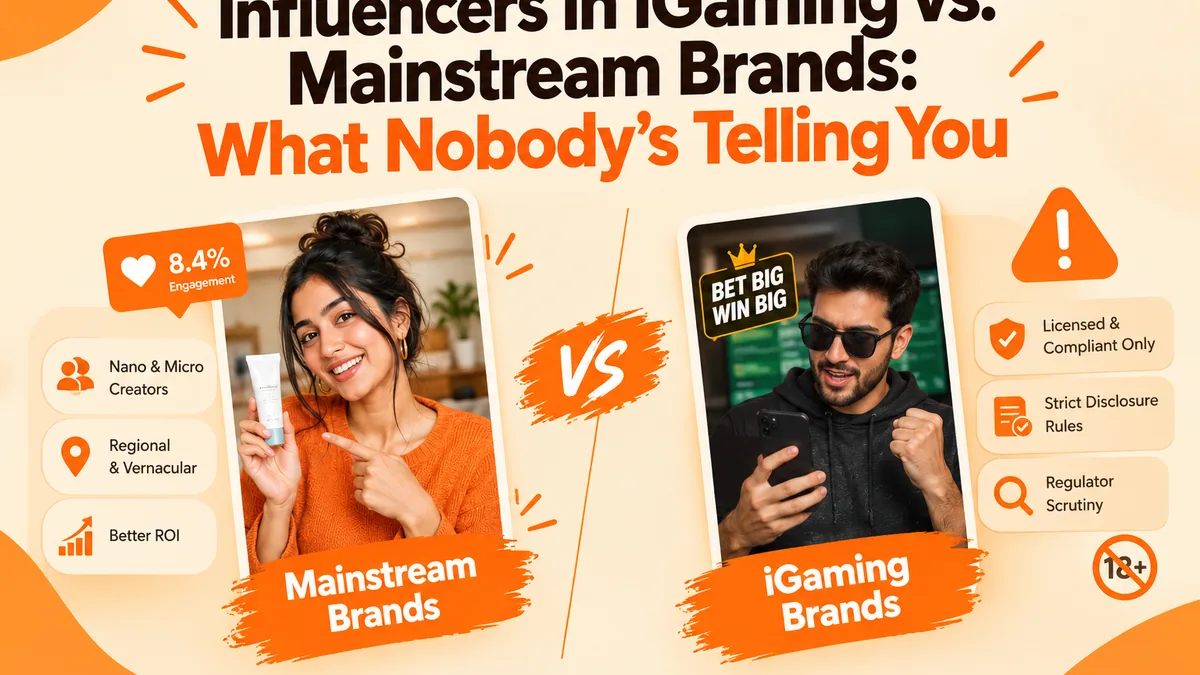
A few months ago, I sat in on a conversation between two brand teams — one launching a skincare line, one running acquisition for an offshore betting platform. Both wanted the same thing from influencer marketing: reach, trust, conversions. Only one of them was walking into a regulatory minefield without realizing it.
That gap — between how "normal" brands and iGaming brands should actually be running influencer campaigns — is something almost nobody is talking about clearly. So here's my take, built from working both sides.
The Part Everyone Already Knows
For mainstream brands, the shift is well documented by now: smaller creators are outperforming celebrities. Nano and micro influencers (1K–100K followers) are consistently delivering 3.5–10% engagement, compared to 0.5–3% for macro and mega influencers. Regional, vernacular creators are growing even faster than metro-based English/Hindi ones. If you're running influencer marketing for a D2C brand, an FMCG launch, or a local service business, that's the playbook — and most agencies now know it. I've broken down the numbers behind why smaller creators are beating celebrities in 2026.
That's not where the real insight is anymore. The real insight is in what almost nobody is watching closely: what's actually happening to influencer marketing in iGaming right now, and it should worry anyone running or considering it.
The Data Nobody's Talking About
Here's what most marketers — even ones in the industry — don't realize: influencer-led betting promotion in India didn't shrink after the government banned real-money gaming advertising through PROGA in August 2025. It got worse, and influencers became the primary vehicle for it.
ASCI's own FY26 report is blunt about this. Of 1,609 influencer advertisements it reviewed for the year, 97.3% required modification — and 54% of all influencer violations were tied to categories where advertising is flatly illegal, offshore betting chief among them. In just the April–December 2025 window, ASCI identified 854 individual influencers actively promoting offshore betting content — some accounts dedicated entirely to it. Offshore operators are reportedly running promotions through 60+ domains simultaneously, so when one gets taken down, the campaign simply resurfaces under another, with the same influencer relationships intact.
This isn't a compliance footnote — it's the single largest category of advertising violation in the country right now, ahead of alcohol, healthcare, and financial products combined.
Why does this matter if you're not running illegal offshore campaigns yourself? Because it's reshaping how platforms, regulators, and even legitimate creators now view any gambling-adjacent influencer content. A licensed fantasy sports brand doing everything correctly is now operating in an environment where regulators are actively hunting influencer accounts in the same content category. The bar for "clearly compliant" content has gone up, even for the operators doing it right.
There's also a global signal worth watching: Kenya's betting regulator has already gone further than India — in 2025 it banned celebrity and influencer endorsements for betting outright, requiring pre-approval of all ads. That's not a hypothetical for iGaming marketers anymore. It's a preview of where regulators elsewhere may be headed if self-regulation like ASCI's continues finding this scale of violation.
Worth noting: gaming creators aren't off-limits for brands — the money is shifting toward esports and gaming culture instead. See esports marketing in India 2026: where the gaming money is moving.
The Insight That Actually Surprised Me
Here's the part I didn't expect when I dug into the numbers: the ban didn't just fail to stop offshore betting ads — it accelerated them. In the eight months before PROGA took effect, ASCI tracked an average of 594 offshore betting ads a month. In the four months right after the ban, that number jumped to 795 a month — a rise, not a drop, immediately after the strictest law India has passed on this. Operators didn't retreat; they adapted faster than enforcement could keep up.
Even more specific, and genuinely useful if you're running or auditing any campaign in this space: the ban worked unevenly by platform. Ad volumes dropped noticeably on YouTube and X after PROGA, but sponsored ads on Meta platforms stayed persistently high — Meta's ad library and Instagram remained the primary home for these promotions even a full year later. If you're a legitimate brand running Meta influencer campaigns anywhere near this category, that's exactly the platform regulators are watching hardest.
There's a seasonal pattern too, worth knowing if you're planning content calendars: flagged betting ads dipped in the months right after PROGA, then surged again in June–July 2026, tracking almost exactly with cricket season. Enforcement isn't steady — it spikes around major sporting events, which is also, unsurprisingly, when offshore operators push hardest.
And the tactics themselves have gotten harder to spot. ASCI's report flags offshore operators increasingly using content framed as "pro tips" or "how to win," surrogate brand advertising, anonymous community pages, and — most concerning — early instances of deepfake content, to make illegal platforms look legitimate. This isn't lazy, obvious gambling spam anymore. It's built to look like organic advice content, which is exactly why it's landing on influencer accounts instead of obvious banner ads.
My Actual Take, for Both Sides
For mainstream brands: the opportunity is in going smaller and more regional before your competitors catch up to the data. Most brands still over-invest in macro/celebrity reach out of habit, not evidence. The brands winning right now are the ones building portfolios of 15–25 nano and micro creators rather than betting everything on one big name.
For iGaming brands: influencer marketing isn't dead, but "find a big creator and pay them to post" is now actively dangerous. This is exactly the kind of strategic and regulatory distinction that separates an iGaming marketing strategist from a general digital marketer. What actually holds up:
- Work only with licensed, compliant operators and platforms — a creator promoting an offshore or unlicensed brand is now a real target for regulatory action, not a marketing risk you can wait out
- Choose creators who understand disclosure requirements, not just ones with reach — 97.3% of flagged influencer ads needed modification largely due to disclosure and compliance gaps, not creativity
- Build long-term, transparent partnerships rather than one-off paid shoutouts — a creator with a clean, consistent track record is safer for your brand and more credible to their audience
- Treat every campaign as if it will be reviewed by a regulator, because in this category, increasingly, it will be
- Be extra cautious with Meta/Instagram specifically — it's the platform where enforcement data shows the most persistent violations, meaning it's also getting the closest regulatory attention
- Avoid content styled as "tips" or "advice" for betting-adjacent categories — that exact framing is now a known red flag pattern regulators are trained to catch
The thing I'd tell any brand right now: the strategy that wins in influencer marketing isn't "more reach" — it's "more trust that survives scrutiny." For mainstream brands, that means smaller, more genuine creators. For iGaming brands, it means creators and campaigns that can hold up when a regulator, not just an algorithm, is watching. If an account or campaign is already under scrutiny, start with why gambling ads get rejected and how to recover.
The Real Takeaway
Influencer marketing isn't one playbook anymore — it's two. For mainstream brands, the winning move is going smaller, more regional, more genuine. For iGaming brands, the winning move is going more compliant, more transparent, and far more careful about who you partner with — because the data shows enforcement isn't slowing this down, it's chasing it. Brands that don't realize these are now different games are the ones most likely to get burned — either by wasted budget, or by a regulator. That compliance-first approach is the through-line of my iGaming marketing practice; see also how I connect influencer strategy with the wider digital marketing system in 2026.
Planning an influencer campaign that needs to earn trust and survive scrutiny? Let's make your brand more interesting.
Planning an influencer campaign? Let's talk →FAQs
Is influencer marketing still legal for gambling and betting brands in India?+
Only for licensed, compliant operators following disclosure rules. Offshore and illegal betting promotion through influencers is a major enforcement target — ASCI identified 854 influencers promoting such content between April–December 2025 alone.
Why did influencer-led betting ads increase after India's online gaming ban?+
Domestic real-money gaming companies largely stopped advertising after the Promotion and Regulation of Online Gaming Act (PROGA) took effect in August 2025, but offshore operators outside Indian jurisdiction continued targeting Indian consumers through influencers and shifting domains to avoid takedowns.
What percentage of influencer ads in India actually comply with advertising rules?+
Very few, currently. ASCI found that 97.3% of influencer advertisements it reviewed in FY26 required modification, with over half of all violations tied to categories where advertising is disallowed by law.
Should mainstream brands worry about the same influencer regulations as iGaming brands?+
Not to the same degree, but disclosure and compliance scrutiny is rising across categories, not just betting. Building transparent, long-term creator relationships is a safer strategy regardless of industry.
Did India's online gaming ban actually reduce betting advertisements?+
No, it did the opposite in the short term. Offshore betting ads rose from an average of 594 per month before the ban to 795 per month in the four months after it took effect, showing operators adapted faster than enforcement could respond.
Keep reading
- Performance MarketingMeta Ads Terms Are Changing on October 30, 2026: What Advertisers Need to Know10 min read
- Performance MarketingThe Banner Everyone Clicked Past: Meta's October 30, 2026 Terms Update9 min read
- Performance MarketingWhatsApp Business API / Marketing Guide (2026): What Changed Two Days Ago7 min read
Written by Likita
Digital marketing, creative strategy, content & AI — Asia, UAE & Europe.