

iGaming Marketing That Doesn't Get Your Ad Account Suspended
iGaming marketing specialist guide for 2026: how casino, sportsbook and fantasy sports brands grow through paid ads, iGaming SEO and affiliates — without getting suspended.
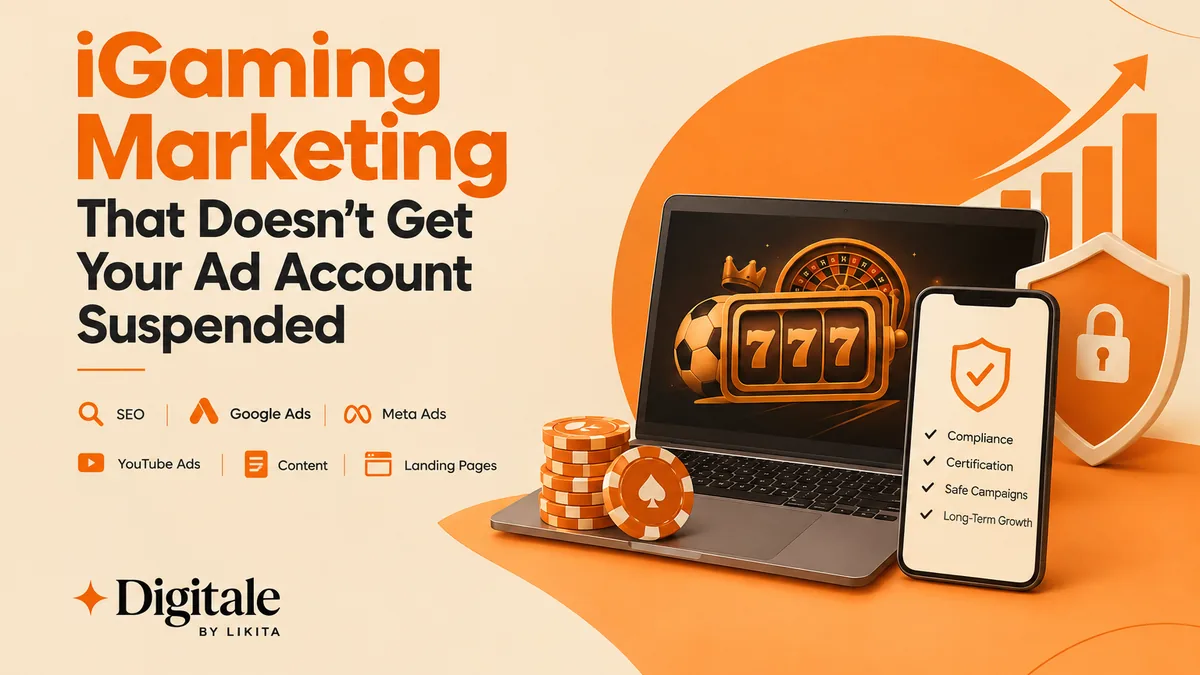
iGaming marketing is the practice of growing online casino, sportsbook and fantasy sports brands under advertising restrictions most industries never face. Paid ads are the exception, not the default. Compliance is a growth lever, not a legal footnote. And authority is built through iGaming SEO, affiliate partnerships and compliant content — which is exactly what separates an iGaming marketing specialist from a generalist agency learning on your budget.
I've Spent 5+ Years Inside an Industry Most Marketers Are Guessing Their Way Through. If you've landed here searching for an iGaming marketing specialist, an iGaming digital marketing consultant in India, or someone who actually understands performance marketing for casino, sportsbook, or fantasy sports brands — you've found the right person. I'm Likita, and I run Digitale by Likita, a solo performance marketing practice built on over a decade of experience: 5+ years in traditional advertising across FMCG, real estate, education, automobile, and electronics, and 5+ years specifically inside iGaming, working with brands across Asia and Europe.
I want to be direct about why that distinction matters, because it's the thing most agencies pitching "iGaming marketing services" don't actually have.
Why iGaming Marketing Isn't "Regular" Digital Marketing
Most digital marketers treat iGaming as a niche version of what they already do — swap the product, keep the playbook. That approach fails fast in this industry, and I've watched it happen more times than I can count. Here's what five years inside iGaming has actually taught me:
Paid advertising is the exception, not the default. In almost every other industry, PPC is the reliable growth lever and SEO is the long game. In iGaming, it's flipped. Google's gambling advertising policy has tightened repeatedly through 2026 alone — certification requirements expanded again as recently as September 2026, as I break down in how iGaming PPC actually works when Google restricts your ads — which means any strategy built assuming paid ads will always be available is a strategy waiting to collapse. I build campaigns for iGaming clients around this reality from day one, not as a contingency plan.
Compliance isn't a legal footnote — it's a growth lever. I've seen brands treat certification and disclosure requirements as boxes to check once. That mindset is exactly what gets accounts suspended overnight with no warning. The operators and affiliates I've worked with who hold up best treat compliance as part of the marketing strategy itself, reviewed as often as the creative. This is true across every channel — paid, influencer, and affiliate alike.
Influencer and affiliate marketing carry a different risk profile entirely. iGaming affiliates now drive a larger share of new player acquisition than paid media in most regulated markets, precisely because of how restricted paid advertising is. But influencer marketing in this category is under intense regulatory scrutiny — India's own advertising watchdog found that the vast majority of influencer ads it reviewed required modification, with illegal betting promotion the single largest violation category in the country, as I covered in iGaming influencer marketing versus mainstream brands. And for affiliates specifically, Google's site-reputation-abuse crackdown has quietly killed the old playbook — what still works in affiliate marketing after the crackdown. Knowing how to work with creators and affiliates inside that reality, not around it, is a large part of what I bring to iGaming clients that a generalist agency simply hasn't had to learn.
Cross-market experience changes what "best practice" even means. Working across Asia and Europe means I've seen how differently this industry behaves by jurisdiction — what's compliant advertising in one market is a violation in another. A one-size-fits-all casino marketing strategy doesn't survive contact with iGaming's regulatory patchwork, and I build strategy accordingly rather than adapting a domestic playbook after the fact.
What Does an iGaming Marketing Specialist Actually Do?
An iGaming marketing specialist plans and runs growth for casino, sportsbook and fantasy sports brands inside regulatory and platform restrictions: compliant paid media, iGaming SEO, affiliate program strategy, influencer compliance, landing page optimization, and analytics that survive ad-account risk. In practice, that means every channel I run — Google Ads, Meta Ads, YouTube Ads, SEO, content, and landing pages — is applied specifically to how it behaves differently in a regulated, restricted-advertising industry.
Beyond strategy, I've built and led creative campaign work in this space directly — including a video ad series for a fantasy sports iGaming brand's "Missing NBA? Join 747" campaign, developed from concept through execution. That's the kind of hands-on campaign experience I bring to every client relationship — I'm not handing your account to a junior team member after the pitch.
Which Channels Actually Work for Casino and Sportsbook Marketing in 2026?
For most iGaming brands, the channel mix that survives 2026 looks like this: iGaming SEO and compliant content as the compounding long-term asset, an affiliate program as the biggest acquisition driver, paid ads where and when the jurisdiction allows them, and influencer partnerships managed inside disclosure rules. Here's how each one behaves:
- iGaming SEO — the highest-leverage long-term channel. Because gambling keywords are expensive and ad inventory is restricted, organic rankings for casino, sportsbook and betting-intent terms compound while paid channels stay fragile. It's slower to build, but no suspension can take it away — the full playbook is in how iGaming sites rank when ads are banned.
- Affiliate marketing — in most regulated markets, affiliates drive a bigger share of new depositors than paid media. The economics (CPA, RevShare, Hybrid) are genuinely different, as explained in how iGaming affiliate marketing works.
- Compliant paid media — Google Ads, Meta and YouTube all remain viable with certification, clean landers and jurisdiction targeting, but only for operators set up correctly from day one.
- Influencer partnerships — powerful for trust and reach, but only with compliant disclosure, licensed-operator verification and geo checks baked into every contract.
The full-system view of how these channels fit together is in digital marketing for iGaming in 2026.
Who I Work With
I work remotely with clients across India, UAE, Asia, and Europe — iGaming operators, fantasy sports platforms, and affiliates who need a marketer who already understands the compliance landscape, not one learning it on their budget. If that's you, let's make your brand more interesting.
Why Hire an iGaming Marketing Specialist Instead of a General Agency?
Because the expensive mistakes in this industry are front-loaded. A specialist who has worked inside iGaming already understands platform-specific gambling ad policies, jurisdiction-by-jurisdiction compliance requirements, and the affiliate and influencer risk landscape — avoiding costly mistakes like account suspensions that generalist agencies often learn only after they happen. One suspended ad account, one non-compliant campaign or one mis-structured affiliate deal usually costs more than the entire difference in fees.
See how I connect iGaming with the wider digital marketing system in 2026, or work with me directly — email digitalebylikita@gmail.com or WhatsApp +91 77159 24504.
Talk to an iGaming marketing specialist →FAQs
What is iGaming marketing?+
iGaming marketing is the practice of growing online casino, sportsbook and fantasy sports brands under strict advertising restrictions. It combines compliant paid media, iGaming SEO, affiliate partnerships, influencer compliance and landing page optimization — with compliance treated as part of the growth strategy, not an afterthought.
What makes iGaming marketing different from general digital marketing?+
iGaming operates under strict advertising restrictions on platforms like Google and Meta, requires jurisdiction-specific compliance certification, and relies far more heavily on SEO, affiliate partnerships, and compliant content than paid advertising alone — making it a fundamentally different discipline from mainstream digital marketing.
Why hire an iGaming marketing specialist instead of a general agency?+
A specialist who has worked inside iGaming already understands platform-specific gambling ad policies, jurisdiction-by-jurisdiction compliance requirements, and the affiliate and influencer risk landscape unique to this industry — avoiding costly mistakes like account suspensions that generalist agencies often learn only after they happen.
Which channels work best for casino and sportsbook marketing in 2026?+
iGaming SEO and compliant content as the long-term asset, affiliate programs as the largest acquisition driver, paid ads where the jurisdiction and platform rules allow, and influencer partnerships managed inside disclosure rules. In most regulated markets, affiliates now drive a bigger share of new depositors than paid media.
Is SEO worth it for iGaming brands?+
Yes — it's arguably the highest-leverage channel in the industry. Gambling keywords are expensive and ad inventory is restricted, so organic rankings for casino, sportsbook and betting-intent terms compound over time and can't be taken away by an ad account suspension, unlike paid channels.
Which markets does Digitale by Likita work in?+
Clients across India, UAE, Asia, and Europe, with direct campaign experience spanning fantasy sports, casino, and sportsbook verticals.
Keep reading
Written by Likita
Digital marketing, creative strategy, content & AI — Asia, UAE & Europe.