

Influencer Marketing in 2026: Why the Small Creator Is Beating the Celebrity
Celebrity posts get views. Micro and nano creators get sales. The 2026 data on why small creators are beating big names — and how to use it.
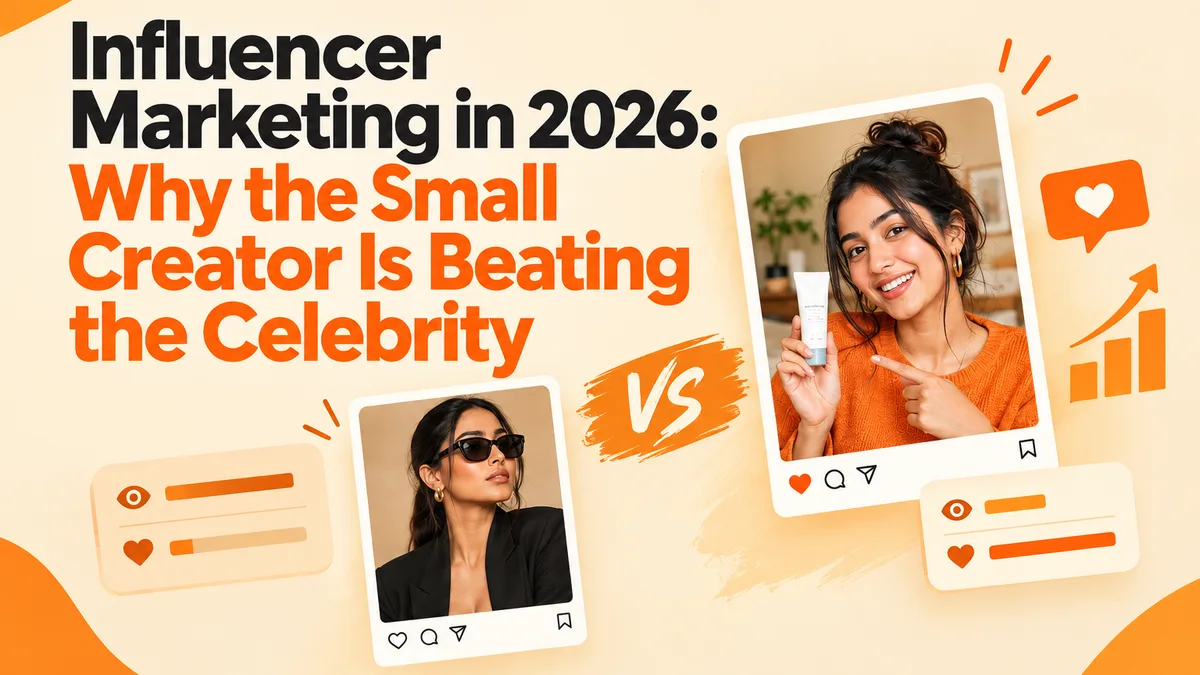
A brand founder once told me she'd spent her entire quarterly budget on one celebrity Instagram post. It got 2 million views. It got almost zero sales. A few months later, she spent a fraction of that on 20 small creators in Tier 2 cities, and her conversion numbers finally moved. Same product, same budget category, completely different result.
That story isn't rare anymore — it's becoming the norm. And the data backing it up is now too big to dismiss as a trend.
The Numbers That Are Rewriting the Playbook
India's influencer marketing industry is on track to cross ₹3,375–5,500 crore in 2026, growing at roughly 18-22% a year. That's not a niche channel anymore — it's a serious line item in most brand budgets. But where that money is going has shifted dramatically.
Two years ago, a typical brand put 70-80% of its creator budget behind a handful of metro-based macro influencers. Today, that same budget is often split across dozens — sometimes hundreds — of regional creators posting in Tamil, Telugu, Marathi, Bengali, and Kannada rather than English or Hindi alone. Brand searches for creators outside India's top eight metros have more than doubled year-on-year, and regional micro-influencers are delivering 2-3x the engagement of metro macro-influencers, at roughly a tenth of the cost per post. This mirrors what I covered in why regional-language content is such a wide-open door — the same demand shift is playing out in creator marketing.
The tier-by-tier data makes the case even clearer:
| Tier | Followers | Typical Engagement | Best For |
|---|---|---|---|
| Nano | 1K–10K | 5–10% | Trust, niche testing, hyperlocal reach |
| Micro | 10K–100K | 3.5–7% | Conversion, best all-round ROI |
| Macro | 100K–1M | 1–3% | Broad reach, brand awareness |
| Mega | 1M+ | 0.5–1.5% | Mass awareness, cultural moments |
Nykaa is one of the clearest real-world proof points — they shifted a significant chunk of budget from celebrity endorsements to over 200 beauty micro-influencers with 10,000-50,000 followers, and the results were strong enough to become an industry case study.
Why This Is Happening, Not Just What's Happening
The old pricing model — pay based on follower count — is now considered outdated, and brands still using it can overpay by 40% or more. What's replaced it is a blend of engagement rate, niche authority, and platform relevance. A beauty micro-creator with 45,000 tightly engaged followers can now reasonably charge more than a lifestyle creator sitting at 180,000 loosely engaged ones.
The trust factor matters just as much as the math. In smaller, tighter online communities, a locally known creator's recommendation often carries more weight than a celebrity's — the audience treats it closer to peer advice than an ad. That's the real reason engagement rates are so much higher at the nano and micro tiers; it's not a discount version of macro influence, it's a fundamentally different kind of trust.
Where Most Brands Still Get It Wrong
The single biggest challenge brands report isn't finding creators — it's measuring ROI. Too many campaigns are still run on a "post and hope" basis, with no clear objective set before outreach even begins. The campaigns that actually perform start with one specific goal — brand awareness, lead generation, or direct sales — because each of those needs a completely different creator tier, content format, and success metric. And even with a goal set, the metric you pick decides everything — I've seen a 3x ROAS campaign that was quietly losing money because nobody looked past the dashboard.
The second common mistake is treating influencer marketing as a one-off transaction instead of a relationship. Short-term, single-post deals tend to read as obvious ads. Longer-term partnerships, where a creator genuinely uses and talks about a product over weeks or months, consistently produce more authentic — and better performing — content.
This is a pattern I've seen play out in iGaming client work too, where influencer partnerships come with an extra layer of scrutiny: many platforms and jurisdictions restrict how gambling and betting products can be promoted by creators, and disclosure requirements are stricter than in most categories. A well-vetted, long-term creator relationship — where the influencer understands the compliance boundaries — consistently outperforms a rushed, one-off paid shoutout that risks getting flagged or taken down. The difference becomes stark in iGaming vs. mainstream influencer marketing, where the same reach-first playbook can become a regulatory risk.
A Simple Framework Worth Following
- Set one clear objective before you contact a single creator — awareness, leads, or sales each need a different plan
- Build a portfolio, not a single bet — a cluster of 15-25 nano/micro creators in your target geography often outperforms one big name
- Go regional if your audience is beyond metro India — vernacular content is seeing measurably higher demand and lower competition right now
- Favor longer partnerships over one-off posts — authenticity compounds over repeated, genuine mentions
- Track performance beyond vanity metrics — views mean little without a tie back to your actual objective
The Real Takeaway
Influencer marketing in 2026 isn't about who has the biggest following — it's about who your audience actually trusts. The brands still chasing follower counts are overpaying for weaker results, while the ones building portfolios of smaller, regionally relevant creators are quietly outperforming them on both cost and conversion. If you want a second pair of eyes on your creator budget, let's make your brand more interesting.
Planning an influencer campaign? Let's talk →FAQs
Are micro-influencers really better than celebrities for marketing in 2026?+
For most performance goals, yes. Micro and nano influencers consistently show higher engagement rates (3.5-10%) than macro or mega influencers (0.5-3%), and their recommendations are trusted more like peer advice than advertising.
How much does influencer marketing cost in India in 2026?+
It varies widely by tier: nano creators typically charge ₹1,000-15,000 per post, micro creators ₹15,000-1,00,000, while macro and mega creators can charge several lakhs per deliverable, with finance and tech niches commanding a premium over lifestyle content.
What's the biggest challenge brands face with influencer marketing?+
Measuring ROI. Many campaigns still launch without a clearly defined objective, which makes it nearly impossible to judge whether the campaign actually worked.
Can iGaming or gambling brands use influencer marketing?+
Yes, but with far more compliance scrutiny than most categories. Many platforms and jurisdictions have specific rules on how gambling products can be promoted and disclosed, making long-term, well-vetted creator relationships safer than one-off paid posts.
Keep reading
Written by Likita
Digital marketing, creative strategy, content & AI — Asia, UAE & Europe.