

YouTube Ads Cost in India (2026): The Real Numbers, Not "It Depends"
Rohan spent ₹50,000 on YouTube ads and got 4 lakh views. He also got three sales. Here's what YouTube ads actually cost in India in 2026 — real CPV, CPM and CPC numbers, and what your budget should buy.
Rohan runs a D2C coffee brand out of Andheri. He'd heard YouTube was cheap in India, so he made one 45-second film, put ₹50,000 behind it, and waited.
Four lakh views later, his dashboard looked incredible. His bank account did not.
The problem wasn't the price. YouTube genuinely is one of the cheapest video markets in the world. The problem was that Rohan bought views when he needed customers, and nobody told him those are two completely different line items on the same invoice.
So let's fix that. Real numbers, real budgets, what's changed in 2026, and where the money quietly leaks.
Quick answer: how much do YouTube ads cost in India?
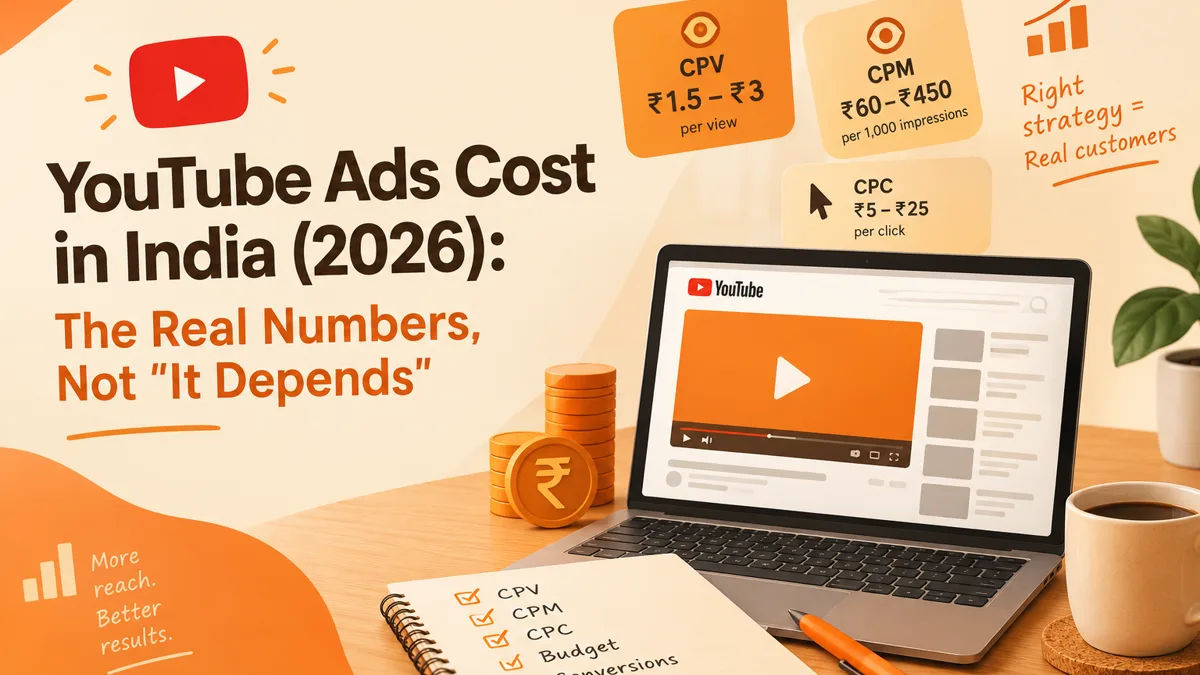
In 2026, YouTube ads in India cost roughly ₹1.5 to ₹3 per view (CPV) and anywhere between ₹60 and ₹450 per 1,000 impressions (CPM), depending on format. Cost per click usually lands between ₹5 and ₹25. A realistic starting budget for a serious test is ₹25,000–₹50,000 a month — though you can technically launch with ₹500 a day.
India remains one of the lowest-cost YouTube markets on the planet. Advertiser CPMs here sit under $1–$1.50 while the US runs closer to $12 and Australia past $30. With roughly 470–500 million YouTube users in the country, you are buying enormous reach for very little money.
Which is exactly why it's so easy to waste.
What you're actually paying for
Three pricing models. Pick the wrong one and your report tells you a lovely story about nothing.
| Model | What it means | India range (2026) | Use it when |
|---|---|---|---|
| CPV (cost per view) | You pay when someone watches 30 seconds, or the whole ad if shorter, or clicks | ₹1.5 – ₹3 | You want engaged viewers, not just eyeballs |
| CPM (cost per 1,000 impressions) | You pay to be seen, watched or not | ₹60 – ₹450 | Launches, awareness, reach at scale |
| CPC (cost per click) | You pay for the click through to your site | ₹5 – ₹25 | Traffic and conversion campaigns |
A quick note on honesty: published India benchmarks disagree with each other. Some sources put Shorts CPM at ₹350–₹450; others put overall India CPM nearer ₹60–₹130. Both can be true depending on targeting, season and who's bidding against you. Treat every published number — including these — as a starting frame, not a quote. Your own account data after two weeks beats any benchmark blog. Including this one.
Cost by ad format
Skippable in-stream — the workhorse. Plays before or during a video, skippable after 5 seconds. You only pay for a real view. Roughly ₹2–₹3 per view in India. Best for anything that has to answer to a number.
YouTube Shorts — vertical, full-screen, swipe-past. Shorts sits inside Demand Gen and Performance Max now. Cheapest impressions on the platform globally, but a billable Shorts view needs about 10 seconds of watch time, so cost per view can look higher than in-stream even when CPM looks lower. Don't compare the two on the same metric.
Non-skippable (15s) — bought on CPM. Higher cost, guaranteed exposure, zero forgiveness for a weak first frame.
Bumper ads (6s) — cheap reach, brilliant for retargeting, useless for explaining anything.
In-feed / Discovery — appears next to search and suggested videos. You pay when someone chooses to click. Lower volume, warmer intent.
Display/overlay — the cheapest inventory, CPMs often ₹100–₹300, and the least likely to move a business number.
What ₹10,000, ₹50,000 and ₹2,00,000 actually buy
₹10,000/month (₹330 a day). Enough to learn, not enough to scale. Expect roughly 3,000–6,000 views. Run one format, one audience, one message. Treat it as tuition, not a campaign. Below ₹300/day the algorithm never gathers enough signal to make a decision worth trusting.
₹50,000/month (₹1,600 a day). The first budget where YouTube starts behaving like a performance channel. Roughly 15,000–30,000 views, enough data to compare two or three creatives properly, and enough spend to build a retargeting pool worth retargeting.
₹2,00,000/month. Now you can run a funnel instead of an ad. Awareness in-stream at the top, Shorts and in-feed in the middle, Demand Gen and Search catching the demand at the bottom. This is the tier where YouTube stops being a cost line and starts lowering your Search CPA — because people who've already seen your face click your search ad differently.
If those ranges feel familiar, they should. Same logic as SEO cost in India and Instagram ads cost in India: the cheapest budget is rarely the cheapest outcome.
Five things that move your cost up or down
Your industry. Finance, insurance, tech and real estate bid against deep pockets — costs climb. Education, FMCG and e-commerce generally enjoy lower CPVs.
How tight your targeting is. Narrow in-market and custom segments cost more per view but waste far less. Broad targeting looks cheap on the dashboard and expensive on the P&L.
Creative, more than anything else. A weak first 5 seconds gets skipped, your view rate drops, and Google charges you more to reach the same people. Creative is a bidding lever in 2026, not a design task.
Season. Diwali, New Year and big sale windows push costs up 20–40%. Plan budgets around it or accept paying a festival premium.
Ad length. Long films need a reason to be long. If your point lands in 15 seconds, a 60-second cut is just a more expensive way to get skipped.
What actually changed in 2026
This is the part most cost guides skip, and it matters more than the rupee figures.
YouTube isn't a mobile buy anymore. Connected TV is now a major surface — in the US, TV screens took the largest share of YouTube budgets. CTV carries higher CPMs but stronger recall. In India, smart TV reach is growing fast enough that "YouTube ads" and "TV ads" are quietly becoming the same conversation.
AI is deciding where your money goes. Demand Gen and Performance Max now bundle in-stream, in-feed, Shorts, Discover and Gmail into one budget, and Google's systems route spend between them. You set goals, guardrails and assets — the machine handles the split. Google has said Demand Gen campaigns that include TV screens deliver around 7% more conversions at the same ROI.
Shoppable CTV arrived. From January 2026, viewers can browse and buy directly from YouTube ads on the big screen. For D2C and retail in India, that's a genuinely new bottom-funnel surface.
Frequency rules tightened. Mid-roll limits now apply across a viewing session, and they behave differently on CTV versus mobile. If you're not segmenting reports by device, your real exposure is invisible to you.
The practical takeaway: the lever you control in 2026 is no longer placement splits. It's inputs — audience signals, conversion data, and creative variants in 16:9, 1:1 and 9:16. Give the system three formats or watch it improvise badly on your behalf.
A note on regulated categories
If you're in iGaming, fantasy sports, finance, crypto, health or anything policy-sensitive, ignore every benchmark above.
Your costs aren't set by the auction. They're set by approval. In restricted categories, a campaign can sit in review for days, get disapproved on a technicality, or be limited to inventory that barely delivers — and your effective cost per outcome quietly triples while your CPV still looks beautiful. I've spent five years in iGaming across Asia and Europe, and the lesson repeats: in a regulated vertical, compliance is your media budget. More on that in digital marketing for iGaming in 2026.
How to spend less without spending less
- Front-load the hook. Your logo at second 1 is a donation. Your problem statement at second 1 is a business.
- Cut three versions, not three ads. Same idea, 6s / 15s / 30s. Let the system pick.
- Exclude what you don't want. Kids' content, gaming channels, irrelevant placements — check your placement report weekly and prune.
- Retarget viewers, don't re-reach strangers. Anyone who watched past 25% is your cheapest future customer.
- Send them somewhere that converts. A great video pointing at a bad landing page is an expensive way to prove your landing page is bad — which is exactly what happened to Kabir's Google Ads.
So what should Rohan have done?
He should have spent his first ₹10,000 finding out which 15 seconds of his film people actually watched, his next ₹20,000 putting that 15 seconds in front of a narrow in-market audience, and the remaining ₹20,000 retargeting the people who watched it — to a page built to sell coffee rather than describe it.
Same budget. Different order. Roughly the difference between 4 lakh views and a business.
If you're planning a YouTube budget for 2026 and want to know what it should realistically return before you spend it — that's the conversation Digitale by Likita is built for. And if you want the bigger picture of where YouTube fits among SEO, paid ads, content and AI this year, my 2026 guide to what a digital marketing specialist actually does maps the whole system.
Planning a YouTube ads budget? Let's talk →FAQs
How much do YouTube ads cost in India per view?+
Typically ₹1.5 to ₹3 per view for skippable in-stream campaigns in 2026, varying by industry, targeting and season.
What is the minimum budget for YouTube ads in India?+
You can technically start at ₹100–₹500 a day. Practically, ₹25,000–₹50,000 a month is where campaigns generate enough data to optimise meaningfully.
Are YouTube ads cheaper than Instagram ads in India?+
Usually cheaper per impression, but they serve different jobs. YouTube is stronger for explaining and persuading; Instagram is stronger for fast visual impulse and Reels-led discovery. Most brands do better running both than arguing about which one wins.
Is YouTube advertising worth it for small businesses in India?+
Yes — if you have a message that needs more than an image to land, and a landing page ready to receive the traffic. If either is missing, fix that first.
How long before YouTube ads show results?+
Early signals in 2–4 weeks; reliable, optimised performance usually by 6–8 weeks as data accumulates.
Keep reading
Written by Likita
Digital marketing, creative strategy, content & AI — Asia, UAE & Europe.