

Click-to-WhatsApp Ads: How to Turn Meta Ads Into Actual Conversations in 2026
How Click-to-WhatsApp ads work in India in 2026 — how to run Meta ads that open WhatsApp, pre-qualify leads, write the first message, and measure cost per customer instead of cost per conversation.
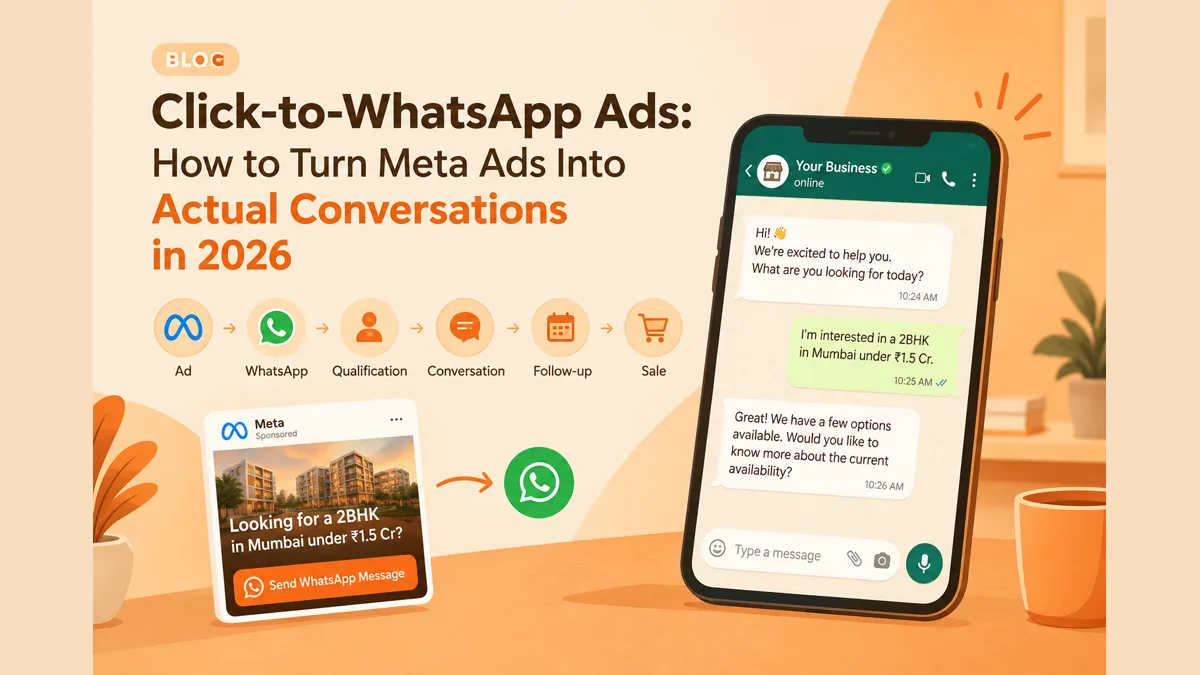
Quick answer: Click-to-WhatsApp ads are Facebook and Instagram ads that open a WhatsApp chat with your business instead of a website. They work best in India for businesses where customers need to talk before they buy — real estate, clinics, salons, education, interiors, D2C. Know the 2026 WhatsApp Business API pricing before you scale. But a WhatsApp conversation isn't a customer. The results come from pre-qualifying in the ad, a sharp first message, fast replies, and measuring cost per customer — not cost per conversation.
You see an ad on Instagram. You like the offer. You tap “Send WhatsApp Message.” And instead of opening a website, filling out a form or waiting for a page to load, you are already chatting with the business.
That is the basic idea behind Click-to-WhatsApp Ads. But here is the part most guides don't talk about: getting someone to start a WhatsApp conversation is not the same as generating a customer.
A business can have 500 WhatsApp conversations and still make very little money if the wrong people are clicking, nobody replies quickly, the first message is poorly written, or the sales team has no idea how to qualify the conversation.
In 2026, the real advantage isn't simply getting people onto WhatsApp. It is building a better journey: Ad → WhatsApp → Qualification → Conversation → Follow-up → Sale. And that is where the strategy gets interesting.
What Are Click-to-WhatsApp Ads?
Click-to-WhatsApp Ads are Facebook and Instagram ads that send people directly into a WhatsApp conversation with your business. Instead of Ad → Website → Landing Page → Form → Sales Team, you create Ad → WhatsApp → Conversation → Sales Team.
The ad can use an image, video, carousel or other Meta-supported format, while the call-to-action takes the user into WhatsApp. Meta Ads Manager handles the advertising side; WhatsApp handles the conversation. That makes them particularly useful where customers usually have questions before buying:
- Real estate, interior designers and automotive
- Education, clinics and salons
- Restaurants, travel companies and local services
- Financial services, D2C products and B2B consultations
The common factor? The customer needs to talk before they buy.
Why Click-to-WhatsApp Ads Are Growing in India
India is an unusually interesting market for conversational advertising. A customer might not want to fill out a form with name, email, phone number, company, requirement and budget. But they may happily send: “Hi, what's the price?”
That tiny difference matters. A form asks the customer to behave like a lead. WhatsApp allows them to behave like a customer. Current 2026 industry guides consistently point to this reduced friction as one of the main reasons Indian advertisers are experimenting with CTWA campaigns.
There's another advantage that doesn't get discussed enough: WhatsApp changes the psychology of the interaction. A landing page feels like research. A WhatsApp conversation feels like asking someone. That matters for businesses where trust is part of the purchase. (If you're still deciding between channels, here's my comparison of email vs WhatsApp marketing in India.)
The Catch: A WhatsApp Lead Is Not Automatically a Good Lead
This is one of the biggest mistakes I see. A business launches a Click-to-WhatsApp campaign, sees 200 conversations and thinks: “Great. We generated 200 leads.” Not necessarily. Your actual funnel looks more like this:
- 1,000 people see your ad
- 100 click
- 60 start a WhatsApp conversation
- 35 respond to qualification questions
- 15 are genuinely interested
- 7 receive a quote, demo or appointment
- 3 become customers
If your reporting only says 60 WhatsApp conversations, it sounds fantastic. But the business acquired 3 customers. That's why I look beyond Cost Per Conversation. The more useful numbers are:
- Cost per conversation and cost per qualified lead
- Conversation-to-qualified-lead rate
- Qualified-lead-to-sale rate
- Cost per customer and customer acquisition cost
- Revenue per conversation
- Response time
The cheapest conversation isn't necessarily the cheapest customer. It's the same trap I wrote about in why a 3x ROAS can still be a sales failure.
How to Run Click-to-WhatsApp Ads That Pre-Qualify the Conversation
Most businesses write “Interested? Message us now!” That's extremely broad — you'll get conversations from everyone. Instead, make the ad itself do some qualification.
| Business | Weak ad | Pre-qualifying ad |
|---|---|---|
| Real estate | Looking for your dream home? Chat with us. | Looking for a 2BHK in Mumbai under ₹1.5 Cr? Message us for current availability. |
| Salon | Book your appointment today! | Looking for a haircut + hair spa this weekend? WhatsApp us for available slots. |
| Interior designer | Transform your home with us. | Renovating a 2BHK or 3BHK in Mumbai? WhatsApp us for a free consultation. |
In the real estate example, the person has already told you location + property type + approximate budget before your salesperson even replies. The lesson: don't optimise only for more conversations. Optimise for more useful conversations.
Your First WhatsApp Message Matters More Than You Think
This is where many campaigns leak money. Someone clicks your ad and receives: “Hi! Thank you for contacting us. How may we assist you today?” Technically fine. Marketing-wise? Weak. You should know why they clicked. Try instead:
- Hi! 👋 Thanks for messaging us. Are you looking for a 2BHK, 3BHK or just exploring options?
- Hey! 👋 Looking for a hair appointment? Tell us what service you're interested in and your preferred day.
- Hi! 👋 Want to know today's offer? Reply with OFFER and we'll send you the details.
The first message should reduce thinking. Don't make the customer work to continue the conversation.
The 5-Second Rule for WhatsApp Leads
A WhatsApp lead is most valuable when the business is ready to respond. Imagine running ads from 10 AM to 10 PM but having nobody available between 2 PM and 5 PM. You're still paying for those conversations. That's not a targeting problem — it's an operations problem. Match your campaign schedule to your team's availability, and consider:
- Instant automated responses and quick replies
- FAQs and basic lead qualification
- Human handoff and sales-team notifications
- Appointment booking and CRM integration
Do You Still Need a Landing Page With Click-to-WhatsApp Ads?
Yes — often. Saying Click-to-WhatsApp replaces your landing page is an oversimplification. I would often use both.
| Use Click-to-WhatsApp when… | Use a landing page when… |
|---|---|
| The customer needs a conversation | The offer needs explanation |
| Price varies by requirement | Customers need pricing information |
| Trust is built through a human | You have testimonials and proof to show |
| You sell locally or book appointments | You want SEO traffic |
| You need to qualify people | Customers aren't ready to talk yet |
My Landing Page Rule: Don't Make Every Click Go to WhatsApp
If someone searches for a performance marketing specialist in Mumbai and lands on a service page, sending them straight to WhatsApp may not be the best experience. They want to understand who you are, what you do, which industries you work with, how your process works and whether you're relevant to their business.
Your landing page should answer those questions — then give an obvious next step: “Let's discuss your campaign on WhatsApp.” That's different from forcing every visitor into a conversation.
- Search traffic: Google Search → Landing Page → Trust → WhatsApp
- Paid social traffic: Instagram/Facebook → WhatsApp → Qualification
Different traffic. Different intent. Different journey. That is landing-page optimisation. It's also why so many campaigns get Google Ads clicks but no customers — the page and the intent don't match.
The 3-Message WhatsApp Qualification Framework
- Message 1 — Identify the need: What are you looking for today?
- Message 2 — Understand the requirement: Got it. What's your approximate budget / location / preferred date / business size?
- Message 3 — Move toward an action: Perfect. Based on that, I can share the available options. Would you like me to send them here?
We're not asking for ten pieces of information. We're having a conversation. Qualification should feel like help, not an application form.
A Real-Life Example: Two Salons, ₹1,000 Each
Salon A runs “💇 Get 20% OFF! Book Now!” The WhatsApp reply is “Hi! How can we help you?” The customer asks the price, the salon asks which service, the customer says haircut, the salon says ₹800, the customer says okay. No booking.
Salon B runs “Need a haircut this weekend? 💇 Message us for available slots + pricing.” WhatsApp opens with “Hey! 👋 Looking for a haircut this weekend? Reply 1 for Saturday or 2 for Sunday.” The customer replies 1. “Great! We have 11 AM, 2 PM and 5 PM available. Which works for you?” Now the conversation is moving toward a transaction.
Same platform. Same type of customer. Completely different funnel. The difference isn't just the ad — it's the system behind the ad.
Click-to-WhatsApp Ads vs Landing Page Ads
| Factor | Click-to-WhatsApp | Landing page |
|---|---|---|
| Friction | Low | Medium |
| Conversation | Immediate | Delayed |
| Best for | Services & consultations | Information & self-serve purchases |
| Qualification | Conversational | Form-based |
| Trust building | Human interaction | Website content |
| Automation | WhatsApp automation | Forms/CRM |
| SEO benefit | Limited directly | Stronger |
| Best CTA | Send Message | Learn More / Book / Buy |
| Tracking | Conversation + sales | Click + form + sales |
Neither is automatically better. The correct choice depends on the customer's buying journey.
The Metric I Watch Instead of Cost Per Click
| Campaign A | Campaign B | |
|---|---|---|
| CPC | ₹10 | ₹18 |
| Clicks | 100 | 100 |
| Conversations | 10 | 30 |
| Customers | 2 | 8 |
Campaign A looks cheaper. Campaign B generated four times the customers. Your reporting should move from CPC → cost per conversation → cost per qualified lead → cost per customer — and ideally revenue ÷ ad spend. A ₹50 conversation that becomes a ₹50,000 customer is worth far more than a ₹5 conversation that goes nowhere.
Don't Optimise Your Ads on the First Conversation Alone
Suppose Creative A costs ₹25 per conversation and Creative B costs ₹40. You might pause B. But after sales follow-up, A turns 100 conversations into 5 customers and B turns 100 into 15. B was producing three times as many customers. That's why you connect Meta Ads → WhatsApp → CRM → Sales instead of treating Ads Manager as the entire business.
What About WhatsApp Automation and Chatbots?
Automation should remove repetitive work, not the human element. Automate FAQs, pricing ranges, location, business hours, brochure delivery, appointment availability and basic qualification. Move to a human when the customer is ready to buy, has an objection, wants to negotiate or needs personalised advice.
The best setup is Automation → Qualification → Human — not an endless chatbot menu. Nobody wants to press 1 for pricing, 2 for location, 3 for offers, 4 for something else, 5 to go back when they could simply ask: “How much is it?” (I cover which automation tools are actually worth it in the AI marketing tools I really use.)
How Much Do Click-to-WhatsApp Ads Cost in India?
There isn't one fixed price. Cost depends on industry, audience, location, competition, creative, offer, seasonality, objective, and the quality of your conversations and sales process. So don't build your strategy around someone's promised “₹X per WhatsApp lead.” The budgets work the same way as regular Meta campaigns — see what Instagram ads actually cost in India.
Instead calculate: Cost per customer = Total ad spend ÷ Number of customers acquired — then compare it against customer value. That's the number your business actually cares about.
How to Improve Click-to-WhatsApp Ad Performance: 10 Checks
- Is the offer obvious? People should understand why they should message you.
- Does the ad pre-qualify? Tell people who the offer is for.
- Is the CTA specific? “Get a quote” can beat “Contact us.”
- Does the first WhatsApp message match the ad? Don't create a disconnect.
- Can someone respond quickly? If not, fix operations before increasing spend.
- Are you asking too many questions? Reduce friction.
- Are you tracking qualified leads? Conversations alone aren't enough.
- Are you tracking sales? Otherwise you don't know which campaigns make money.
- Are your creatives getting repetitive? Test new hooks, angles and formats.
- Are you scaling before finding a winning funnel? More budget doesn't fix a broken funnel.
A Better Click-to-WhatsApp Funnel for Indian Businesses
Here's the system I'd build: Meta ad → clear offer → Click-to-WhatsApp → contextual opening message → instant response → 2–3 qualification questions → human handoff → offer, quote or appointment → follow-up → sale → CRM data → retargeting.
The ad is only the beginning. The money is made in everything that happens after the click.
The Biggest Mistake: Measuring Conversations Instead of Customers
A campaign that generates 1,000 WhatsApp conversations isn't necessarily successful. A campaign that generates 100 conversations and 20 customers might be. So don't ask “How many people messaged us?” Ask: “How many of those conversations became qualified opportunities and customers?” That's the difference between running ads and running performance marketing.
Final Takeaway
Click-to-WhatsApp Ads aren't simply a way to replace your landing page. They shorten the distance between interest and conversation. But Ad → WhatsApp ≠ Conversion. The real funnel is Ad → Conversation → Qualification → Trust → Follow-up → Sale.
You don't need every visitor to buy immediately. You need to give each visitor the right next step. Sometimes that's a landing page. Sometimes it's a WhatsApp conversation. Often it's both.
That's what good performance marketing looks like: not chasing clicks, but designing the journey that happens after them. If you want that journey built for your business, let's make your brand more interesting.
Plan my Click-to-WhatsApp funnel on WhatsApp →FAQs
What are Click-to-WhatsApp ads?+
Click-to-WhatsApp ads are Facebook and Instagram ads that open a WhatsApp conversation with a business when someone clicks the ad, instead of sending them to a website.
How do Click-to-WhatsApp ads work?+
The advertiser creates a Meta campaign in Ads Manager with WhatsApp as the messaging destination. When a person taps the “Send WhatsApp Message” button, WhatsApp opens a chat with the business.
How do I run Click-to-WhatsApp ads for my business?+
Connect a WhatsApp Business number to your Meta business account, create a campaign in Meta Ads Manager with WhatsApp as the destination, write an ad that pre-qualifies (who it's for, what you offer), set a contextual first message, and make sure someone can reply quickly. Then track qualified leads and sales, not just conversations.
Are Click-to-WhatsApp ads good for lead generation?+
They're particularly useful when customers need to ask questions, compare options or speak with a business before buying. Performance depends on targeting, creative, offer, response time and the sales process.
How much do WhatsApp ads cost in India?+
There is no fixed cost. It varies by industry, audience, location, competition, creative and setup. Measure cost per qualified lead and cost per customer rather than relying only on cost per conversation. See Instagram ads cost in India for typical Meta budgets.
What is the difference between WhatsApp ads and Click-to-WhatsApp ads?+
“Click-to-WhatsApp ads” are Meta ads on Facebook and Instagram that send users directly into a WhatsApp chat. WhatsApp marketing more broadly includes broadcasts, customer communication, automation, catalogues and more — compared in email vs WhatsApp marketing.
Do I still need a landing page if I use Click-to-WhatsApp ads?+
Not always, but a landing page is still valuable for building trust, explaining your service, capturing organic search traffic and answering questions before someone starts a conversation. Many businesses do best using both.
What should I track in Click-to-WhatsApp campaigns?+
Track conversations, cost per conversation, qualified leads, cost per qualified lead, response time, appointments, sales, customer acquisition cost and revenue.
Keep reading
Written by Likita
Digital marketing, creative strategy, content & AI — Asia, UAE & Europe.