

Affiliate Marketing in 2026: The Quiet Crackdown Killing Old-School Playbooks
Is affiliate marketing still profitable in 2026? See what Google's SEO crackdown means and how iGaming CPA, RevShare and Hybrid deals work.
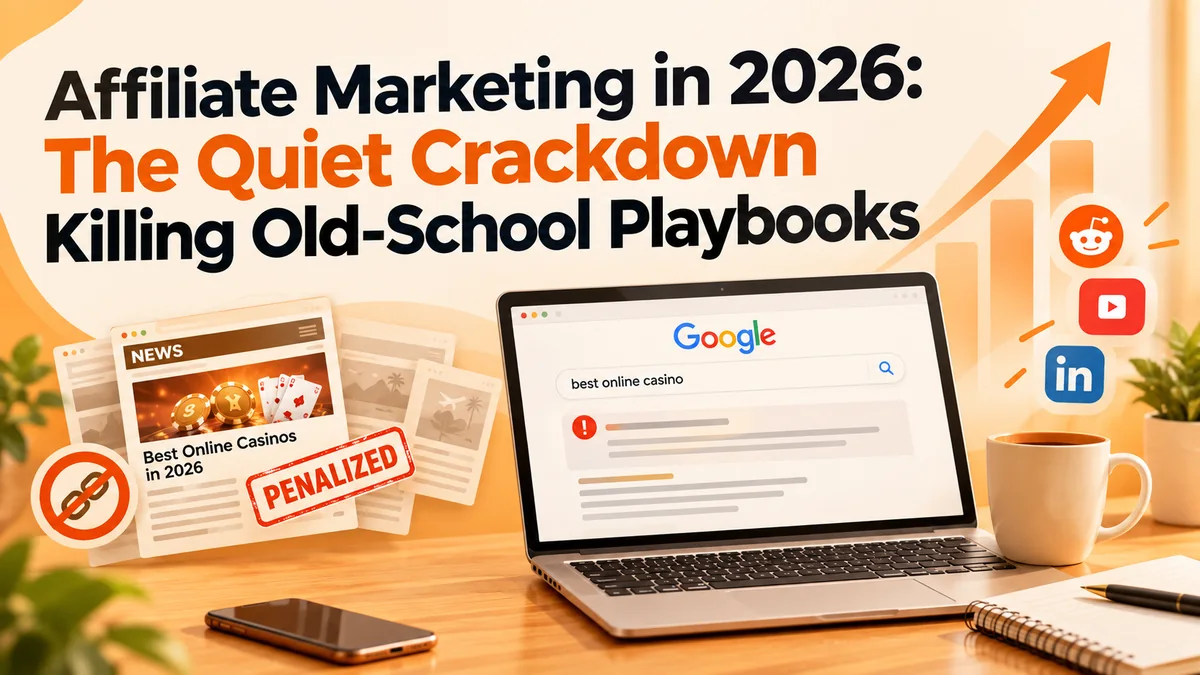
Affiliate marketing is still profitable in 2026, but the shortcut era is ending. Google's site reputation abuse crackdown is removing the advantage of rented publisher authority, while affiliates building useful content, owned audiences and compliant partnerships are still growing. In iGaming, that shift makes CPA, RevShare and Hybrid deal quality more important than raw traffic volume.
A friend running an affiliate site messaged me in a panic last year: "Traffic dropped 70% overnight, and I didn't change a single thing on my site." He hadn't done anything wrong on his own domain. The problem was where his content was hosted — a "sponsored section" on a major publisher's site that Google had just decided didn't count as that publisher's content anymore. Overnight, years of rankings vanished.
That single story explains more about affiliate marketing in 2026 than any list of "best niches" ever could. The old shortcuts are gone. What's replaced them is stricter, slower, and honestly — better for anyone building something real.
Is Affiliate Marketing Still Profitable in 2026?
Let's start with the good news: affiliate marketing isn't slowing down. Globally the industry is projected to grow at roughly 15–18% annually through the early 2030s, and India's affiliate market alone is expected to cross $465–639 million in 2026, growing faster than almost any other region. Retail, travel, fintech, and health remain the biggest categories, and mobile now drives the majority of affiliate-referred traffic.
But here's what almost nobody explains clearly when they quote those growth numbers: the way affiliates are winning that growth has completely changed in the last two years, and a lot of marketers are still running a playbook Google has quietly dismantled.
What Is Parasite SEO—and Why Is Google Cracking Down?
For over a decade, one of the most effective affiliate tactics was "parasite SEO" — paying a high-authority news site or magazine to host your affiliate content (casino reviews, "best loan" pages, coupon sections) under their domain, borrowing their trust to rank for competitive terms your own site never could. A brand-new domain had zero chance at ranking for "best online casino"; the same content hosted under a decades-old news brand ranked in weeks.
Google has spent the last two years systematically shutting this down, in stages most marketers only half-noticed:
- March 2024 — Google formally classified this as site reputation abuse for the first time, enforced initially through manual review.
- November 2024 — Google closed the biggest defense publishers used: editorial oversight. A human editor approving the content no longer makes it safe if the underlying purpose is renting out ranking power.
- August 2025 — The real turning point. Google's SpamBrain system went fully algorithmic here, meaning it no longer needs a human reviewer to catch this pattern — it detects and demotes it automatically, evaluating subfolders and subdomains independently instead of inheriting the parent site's authority.
- June 2026 — Google's spam update notably left this policy alone, which specialists reading the update interpreted as a signal that Google now considers its detection systems effective enough that manual sweeps are less necessary.
The penalties are severe and immediate: traffic drops of 60–90%, and in worse cases, pages removed from search results entirely. Major publishers' affiliate sections were among the first hit in late 2024.
Here's the part with a genuinely uncomfortable overlap with iGaming: casino and gambling affiliate content is repeatedly cited by SEO analysts as the textbook example of this exact abuse — a medical or news portal suddenly hosting "best online casino" reviews with zero topical connection to anything else on the site. If you've ever been offered a "guest post on a DR 80+ site" for casino or betting content at a price that seemed too good, that arrangement is precisely what's now being algorithmically hunted down.
What Works in Affiliate Marketing After the SEO Crackdown?
The affiliates still growing right now didn't quit content — they changed where and how they publish it:
- Community-native content is the new distribution channel. Reddit threads, LinkedIn posts, and genuine YouTube reviews are now surfacing heavily in Google's own results, because Google has explicitly said it values first-hand experience signals from real community platforms. A detailed, honest Reddit answer or a YouTube video that actually tests a product is now doing what a parasite placement used to do — except it's earned, not rented.
- The simple test that separates safe from risky: before publishing anything for placement or reach, ask, ‘Would I publish this even without the affiliate link, because it genuinely helps someone?’ If the honest answer is no, it's the exact pattern Google is now built to catch. If yes, it's ordinary content marketing.
- Owned domain authority still matters more than ever — it just takes longer to build now that there's no shortcut. New domains typically sit in a sandbox period of 6–12 months before Google trusts them with competitive rankings, which means starting early and being patient beats any workaround.
- Consolidation is real, and worth knowing about. A striking data point from recent industry analysis: 36 of the top 100 highest-traffic affiliate domains globally are now controlled by just three companies. For independent affiliates and smaller brands, that means competing directly on generic terms is harder than ever — niching down into something a giant publisher won't bother covering in depth is now a genuine advantage, not a compromise.
That shift rewards the same useful, experience-led approach behind a durable content marketing strategy in 2026: publish something worth reading before asking it to rank or convert.
How Does iGaming Affiliate Marketing Work in 2026?
If you only know affiliate marketing from e-commerce or SaaS, iGaming will look almost unrecognizable — and it's worth understanding, because it's arguably the most mature, highest-stakes version of the affiliate model that exists.
Affiliates now drive an estimated 38% of all new regulated-market depositors for online casino and sportsbook operators globally — a higher acquisition share than paid media in most markets, because gambling ad restrictions push growth budgets toward performance partners instead. Globally, affiliate-driven traffic accounts for over 30% of all iGaming transactions, a bigger share than almost any other consumer category except finance and trading.
What makes it structurally different from a typical affiliate program:
- Commissions are paid on Net Gaming Revenue (NGR), not a flat sale price. The three core models are CPA (a fixed fee per qualified depositor, typically $50–500), RevShare (20–50% of a player's ongoing losses over time), and Hybrid (a smaller CPA plus a reduced RevShare cut). For the first time in 2026, hybrid deals overtook pure RevShare as the most common new contract type — operators want affiliates rewarded for bringing quality players, not just volume, and hybrid structures are how they align that incentive.
- The average regulated-market CPA climbed roughly 12% year-over-year to around $145, reflecting how much operators are now willing to pay for a compliant, well-vetted player in a shrinking pool of clean traffic sources.
- Compliance isn't optional; it's automated and constant. Because of exactly the kind of enforcement scrutiny covered in iGaming influencer marketing versus mainstream brands, serious iGaming operators now run automated tools that scan tens of thousands of affiliate pages daily for compliance violations — checking geo-targeting, required disclaimers, and licensing claims in real time, not through occasional manual spot-checks.
- Geo and licensing rules are non-negotiable. An affiliate promoting a licensed operator to players in a jurisdiction where that operator isn't licensed is a compliance breach on both sides, which is precisely the trap a lot of the offshore betting content flagged by regulators falls into.
The takeaway for anyone building or managing an iGaming affiliate program in 2026: the operators winning aren't the ones offering the highest headline commission — they're the ones with the cleanest compliance infrastructure and the smartest hybrid deal structures, because that's what earns long-term trust from the affiliates worth keeping. For the channel fundamentals, read how iGaming affiliate marketing works in 2026, and for the operator side of the same enforcement wave, see how iGaming sites rank organically when ads are banned.
The Real Takeaway
Affiliate marketing isn't shrinking, it's sorting. The tactics that worked by renting someone else's authority are being systematically dismantled, while the strategies that build real, owned trust are getting rewarded more than ever. The affiliates still growing in 2026 aren't the ones who found a new shortcut — they're the ones who stopped looking for one.
See how I connect affiliate strategy with the wider digital marketing system in 2026, or let's make your brand more interesting with a channel mix built to last.
Let's build a stronger affiliate strategy →FAQs
Is affiliate marketing still profitable in 2026?+
Yes — the global industry is still growing at roughly 15–18% annually, and India's affiliate market alone is projected to reach $465–639 million in 2026. What's changed is which tactics still work, not whether the model works.
What is ‘parasite SEO’ and why is Google cracking down on it?+
It's the practice of publishing affiliate content on a high-authority third-party site to borrow its ranking power, rather than building authority on your own domain. Google classifies this as site reputation abuse and has made it algorithmically detectable since August 2025, with penalties including 60–90% traffic drops.
Why is casino and gambling content often mentioned in parasite SEO discussions?+
Because it's historically one of the most common categories used in this tactic — unrelated news or lifestyle sites hosting best online casino content purely to monetize borrowed authority, which is exactly the pattern Google's detection systems now target first.
What should affiliates focus on instead of parasite SEO in 2026?+
Building genuine authority through owned content, publishing honest, experience-driven material on community platforms like Reddit and YouTube where Google is actively surfacing real user content, and niching into topics too small for the largest publisher-owned affiliate networks to prioritize.
How is iGaming affiliate marketing different from regular affiliate marketing?+
iGaming affiliates are paid based on Net Gaming Revenue rather than a flat sale price, using CPA, RevShare, or Hybrid models, and affiliates now drive an estimated 38% of new depositors for regulated operators — a larger acquisition share than paid media, since gambling ad restrictions push growth budgets toward performance partnerships instead.
Is CPA or RevShare better for iGaming affiliates?+
Neither is universally better. CPA offers predictable, lower-risk payouts per qualified player, while RevShare pays a percentage of a player's ongoing losses and rewards long-term value. Hybrid deals, combining both, overtook pure RevShare as the most common new contract type in 2026 because they align affiliates with sending high-quality, not just high-volume, players.
Keep reading
Written by Likita
Digital marketing, creative strategy, content & AI — Asia, UAE & Europe.