

iGaming PPC in 2026: How Paid Ads Actually Work When Google Won't Let You Run Them
Google tightened gambling ad rules on Sept 14, 2026 — accounts suspended overnight. How iGaming PPC actually works now, and how to keep yours live.
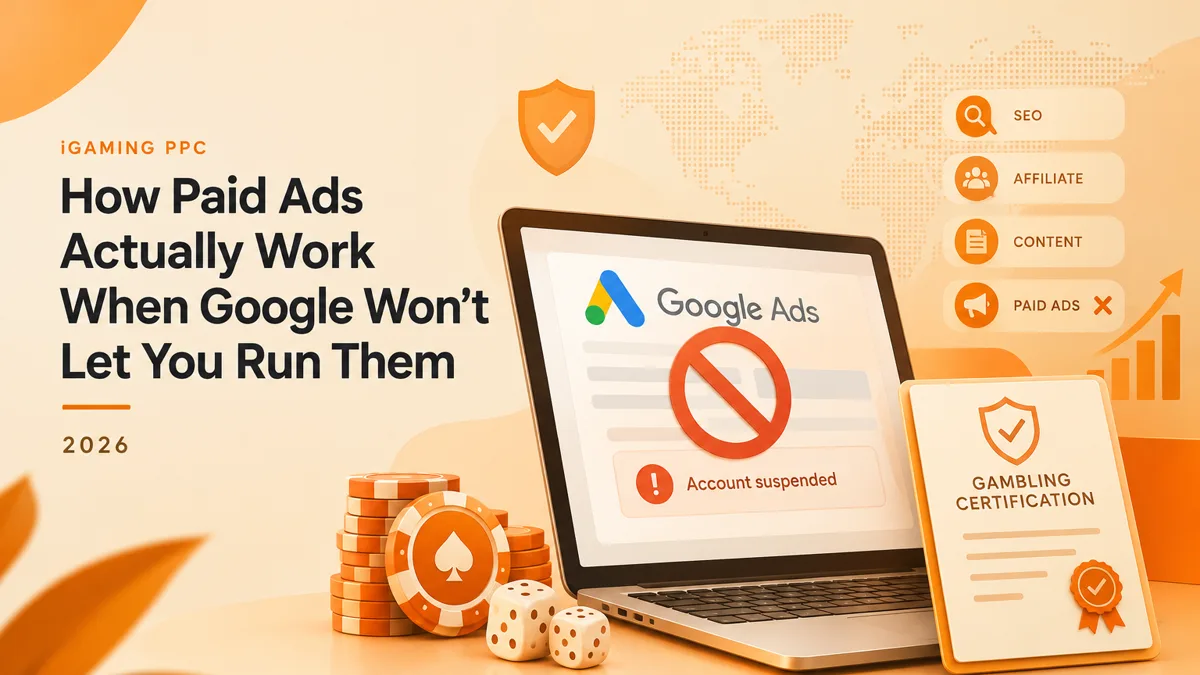
A prospective client once messaged me, "Our Google Ads account got suspended overnight, no warning, no clear reason." He wasn't new to this — he'd been running campaigns for two years. What changed wasn't his ad copy. It was Google's rulebook, again.
If you work in iGaming and think PPC "just doesn't work" for this industry, you're not wrong to be frustrated — but you're solving the wrong problem. Paid ads absolutely work in iGaming. What trips people up is treating it like a normal PPC account, when it's actually a compliance system with a marketing layer sitting on top of it.
The Restriction Isn't a Bug — It's the Whole Game
Here's the part most marketers miss: in almost every other industry, paid ads are the default growth lever and SEO is the long game. In iGaming, it's flipped. Because gambling advertising is so tightly regulated, organic search, content, and affiliate partnerships end up carrying most of the weight — paid media becomes the conditional channel, not the reliable one.
That single fact should shape your entire strategy. If you build a growth plan assuming paid ads will always be available, one policy update can wipe out your primary channel overnight. I've watched this happen to operators who had no backup plan.
What's Actually Changing Right Now
This isn't old news I'm recycling — Google just tightened the rules again. As of September 14, 2026, Google Ads expanded its "good policy health" certification requirement to cover every category under its Gambling and Games policy, not just the ones it applied to earlier in the year. In plain terms: accounts and manager accounts (MCCs) with a pattern of certificate revocations or repeated policy violations can now lose the ability to apply for any new gambling certificate — even in markets where they were previously in good standing.
There's also a domain rule worth knowing if you're setting up a new operator site: certification is not available for sites on free subdomains or third-party-hosted platforms. Your domain has to be directly owned and controlled by your business, full stop.
And this has been a running theme all year — Google updated gambling certification requirements in March, again in July, and again in August 2026, each time asking for more documentation, tighter licensing proof, and clearer separation between things like online gambling and social casino accounts. The pattern is clear: Google isn't loosening this category. It's steadily raising the bar.
The Playbook That Actually Holds Up
1. Get certified before you need to be. Certification is jurisdiction-specific — a brand licensed in five countries has to go through the process five separate times, and there's no shortcut. Waiting until a campaign is ready to launch to start this process is how launches get delayed by weeks.
2. Keep your account "clean," not just compliant. Because certification eligibility now depends on your account's policy history, a single risky campaign that gets flagged can jeopardize your ability to run ads elsewhere later. Treat every campaign as a mark on a permanent record, not an isolated bet. If a campaign does get flagged, here's why gambling ads get rejected and how to fix it before it becomes a pattern.
3. Don't build your funnel on paid alone. Given how often this policy shifts, the operators and affiliates who hold up best are the ones where paid ads are one channel among several — SEO, affiliate partnerships, and content doing the heavy lifting, with paid used to accelerate, not carry, growth. I've broken down the full mix in how digital marketing actually works for iGaming brands.
4. Watch for platform-specific quirks. Real-money casino ads need full certification; social casino products can sometimes run under lighter rules, but only if there's no cash-out and no real-money brand shown in the creative. Mixing these up is a fast way to get flagged.
5. Recertify the moment anything changes. If your licensing details, business structure, or domain setup change even slightly, you're required to recertify. Skipping this step is one of the more common — and avoidable — reasons accounts get suspended.
Why This Actually Matters for Your Growth, Not Just Your Compliance Team
I've seen brands treat certification as a legal formality to get through once and forget. That mindset is exactly what causes the "account suspended overnight" panic. The brands that treat certification as an ongoing part of their marketing strategy — reviewed as often as their ad creative — are the ones still running campaigns when a competitor's account goes dark.
This is also where working with someone who's actually navigated iGaming's paid media restrictions, across multiple markets, makes a real difference over a generalist agency guessing their way through a gambling policy page for the first time — more on that in why iGaming marketing needs a specialist, not an agency.
The Real Takeaway
iGaming PPC isn't broken — it's just a different game than the one most marketers are trained to play. The brands winning right now aren't the ones with the biggest ad budgets. They're the ones who treat compliance as part of the strategy, not a hurdle before it, and who never let paid ads become their only way to grow. That's one reason affiliates now drive a bigger share of new depositors than paid media in most regulated markets — though Google's affiliate SEO crackdown has changed which affiliate playbooks still survive.
If your ad account is your only growth channel and that thought makes you nervous, it should. Let's make your brand more interesting — and a lot harder to switch off.
Dealing with a suspension or planning iGaming campaigns? Let's talk →FAQs
Can you run Google Ads for a gambling or casino website?+
Yes, but only after completing Google's gambling certification process for each specific jurisdiction you want to target, and only in countries where Google runs a local gambling-ads program.
Why do gambling ad accounts get suspended without warning?+
Usually because of a policy violation, expired or unclear licensing documentation, or — as of September 2026 — a pattern of past certificate revocations affecting your account's overall "policy health," which can restrict future certifications even in unrelated markets.
Is affiliate marketing more reliable than paid ads for iGaming?+
It's more stable, not necessarily more effective on its own. Affiliates can rank organically for commercial keywords operators often can't bid on directly, which is why most serious iGaming growth strategies lean on affiliates, SEO, and content alongside paid ads rather than instead of them.
Do social casino games need the same certification as real-money gambling?+
No — social casino games can often run under lighter requirements, but only when there's no cash-out functionality and no real-money brand appears anywhere in the ad creative.
Keep reading
Written by Likita
Digital marketing, creative strategy, content & AI — Asia, UAE & Europe.