

iGaming Marketing 2027: Google Ads Restrictions, Meta Policies & Affiliate Strategies
How online casinos market in 2027: Google Ads gambling certification moves in-account on 19 Nov 2026, Meta permission rules, affiliate CPA vs revshare, SEO and a launch checklist.
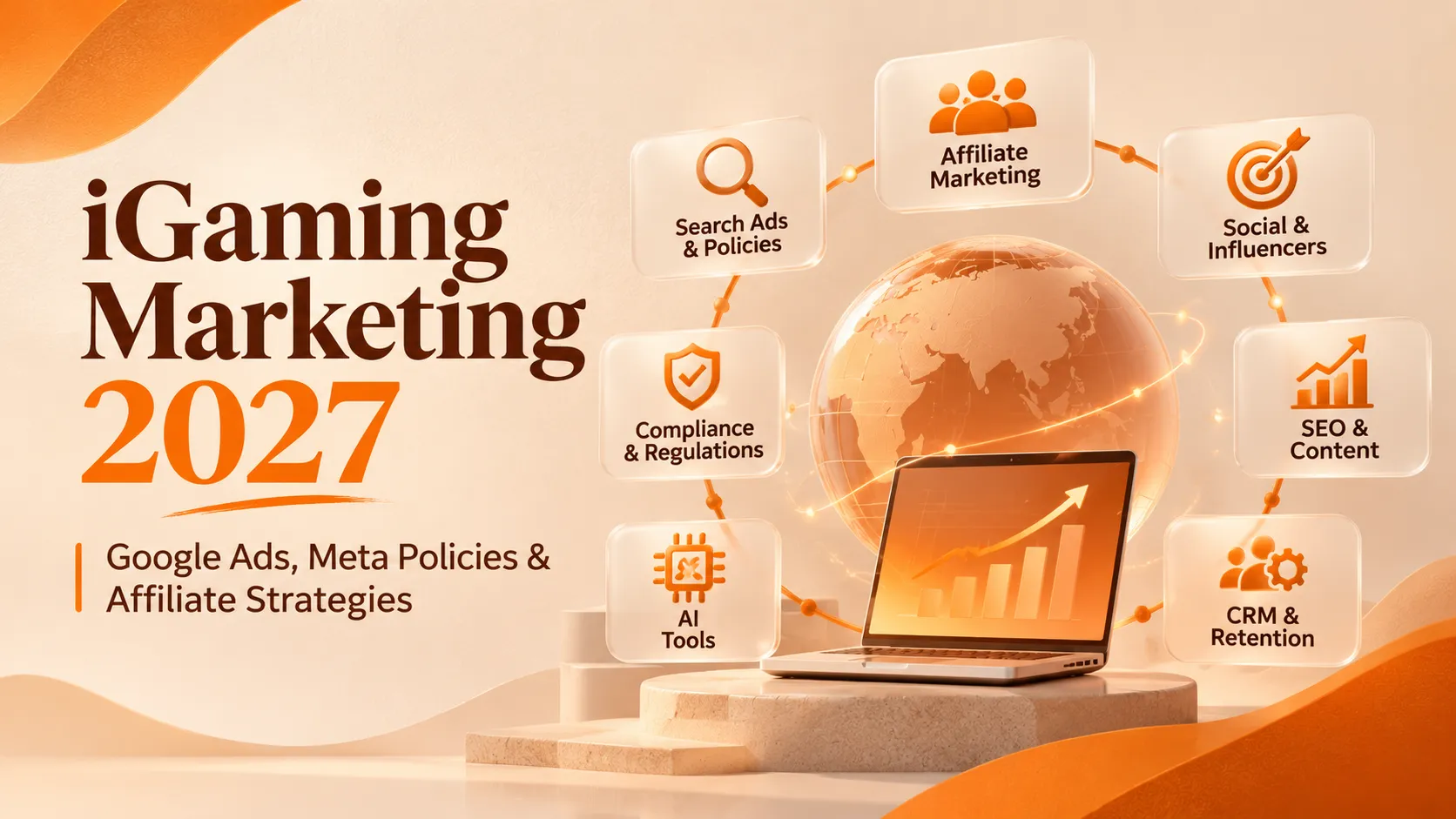
Quick answer · checked 16 November 2026: iGaming marketing in 2027 runs on affiliates, SEO, content, CRM, sponsorships and compliant paid ads only where permitted. Google allows gambling ads only in approved countries with Google Ads gambling certification — and from 19 November 2026 new online gambling certification applications move inside the Google Ads account (Admin → Policy → Account). Meta still requires prior written permission for gambling ads, and its new AI ad tools do not change that. A licence in one country never means approval on every platform or in every market.
By Likita · iGaming and performance marketing specialist, Mumbai · Last updated 16 November 2026. Practical marketing guidance, not legal advice — check current platform policies and local law before any launch.
| Question | Short answer (2027) |
|---|---|
| Can casinos run Google Ads? | Only in approved countries, with a valid local licence and Google gambling certification |
| What changes on 19 Nov 2026? | Online gambling certification applications move from the Help Center form into the Google Ads account |
| Can casinos run Facebook/Instagram ads? | Only with Meta's prior written permission, plus local law and targeting rules |
| Top acquisition channel without ads? | Affiliate marketing (CPA, revenue share or hybrid) plus SEO |
| Does a licence guarantee ad approval? | No — platform certification is a separate requirement |
| Does India allow real-money gaming promotion? | Treat as high-risk: the Online Gaming Act, 2025 applies; get current legal review |
Introduction: The Changing World of iGaming Marketing
Marketing an online casino is not the same as marketing an e-commerce brand.
In most industries, businesses can launch Google Ads, run Meta campaigns, collaborate with influencers and scale their advertising based on performance.
In iGaming, things work differently.
Gambling is a regulated industry. Advertising permissions vary by country, product type, operator licence and advertising platform. Even when an operator is legally authorised to operate in a particular market, it may still need separate approval to advertise on platforms such as Google and Meta.
So, how do online casino brands attract customers when some of the world's biggest advertising platforms restrict their promotions?
The answer is a combination of affiliate marketing, SEO, content marketing, social media, influencer partnerships, sponsorships, CRM and compliant paid advertising where permitted.
At the same time, AI-powered advertising tools and changing search behaviour are creating new opportunities for marketers.
In this guide, we'll explore how iGaming marketing works, what Google and Meta are changing, which strategies operators use and what marketers should prepare for in 2027.
1. What Makes iGaming Marketing Different?
There are several reasons why iGaming marketing requires a different approach from conventional digital marketing.
Country-specific regulations
An operator cannot assume that permission to operate or advertise in one country automatically applies to another.
A brand may be authorised in one market but prohibited from offering the same product in another. Advertising rules can also differ from the rules governing the actual operation of a gambling service.
Before launching a campaign, marketers need to understand:
- Whether the operator is licensed or otherwise authorised in the target market.
- Which gambling products can legally be promoted.
- Whether affiliates and influencers can advertise the brand.
- Which advertising platforms permit the campaign.
- What age, location and responsible-gambling restrictions apply.
- Which promotional claims and bonus terms are permitted.
Market research for an iGaming campaign must begin with regulatory research, not just audience targeting.
Advertising restrictions
Google, Meta and other advertising platforms have specific policies for gambling-related content.
Even if an operator has a valid local licence, that does not automatically mean it can advertise through every platform.
Google requires certification for eligible gambling advertising categories and only permits advertising in approved locations under specific conditions.
Meta also places gambling-related promotions within restricted advertising categories, with prior written permission required for eligible campaigns.
A different conversion journey
An ordinary e-commerce campaign may measure success through purchases.
An iGaming acquisition funnel can involve several additional steps:
- Ad or content exposure.
- Website visit.
- Account registration.
- Identity and age verification.
- Deposit, where lawful.
- First-time deposit (FTD).
- Repeat activity and retention.
A high number of registrations does not necessarily mean a campaign is profitable. Users may not complete verification, make a deposit or return to the platform.
This is why iGaming marketers need to understand the entire customer journey rather than optimise only for clicks.
Retention matters
Acquiring a new customer can be expensive, particularly in competitive markets.
As a result, operators pay close attention to onboarding, customer experience, CRM, loyalty and retention.
However, retention communication must respect local rules, user consent, responsible-gambling requirements and self-exclusion restrictions.
Trust is part of the marketing strategy
Players need to understand who operates a platform, whether it is authorised in their location, how transactions work and where to find support.
Clear terms, transparent promotions, responsible-gambling information and reliable customer service are important parts of brand credibility.
2. How Online Casinos Actually Market Their Brands
When traditional paid advertising is restricted, operators build a marketing ecosystem across several channels.
A. Affiliate Marketing: One of the Most Important Acquisition Channels
Affiliate marketing is a major part of the iGaming business model (see how iGaming affiliate marketing works in 2026).
Instead of relying entirely on their own advertising, operators work with third-party publishers, comparison websites, reviewers and other approved partners who introduce audiences to their platforms.
For example, an affiliate may publish:
- Online casino comparisons.
- Game reviews.
- Slot guides.
- Sports betting platform comparisons.
- Responsible-gambling information.
- Market-specific operator reviews.
When a user visits an operator through an affiliate link, the partnership can be tracked through an agreed attribution system.
Common affiliate payment models
| Model | How it works |
|---|---|
| CPA | The affiliate receives an agreed payment for a qualifying acquisition. |
| Revenue Share | The affiliate receives an agreed share of eligible revenue generated by referred customers. |
| Hybrid | A combination of CPA and revenue share. |
The right model depends on the market, operator economics, agreement terms and applicable regulations.
What should operators look for in affiliate partners?
- Relevant audience and target-market reach.
- Genuine traffic sources.
- Content quality and search visibility.
- Transparent reporting and attribution.
- Compliance with local advertising rules.
- Clear promotional disclosures.
- No misleading claims or unauthorised market targeting.
Affiliate partnerships should be treated as long-term business relationships, not simply a way to buy traffic.
An affiliate that understands the product, audience and local regulations can contribute more than one that only delivers high volumes of clicks.
B. SEO: Building Visibility Without Depending Entirely on Paid Ads
Search engine optimisation — covered in depth in my casino SEO guide for 2026 — is particularly valuable in iGaming because people often research platforms, games and features before making a decision.
There are two important SEO models.
Operator SEO
The operator builds organic visibility for its own brand and authorised products.
Content opportunities include:
- Game descriptions and rules.
- How-to guides.
- Responsible-gambling resources.
- Platform features.
- Payment and account information.
- Promotions and terms, where legally permitted.
- Customer support and FAQs.
Affiliate SEO
Affiliate publishers create comparison and informational content that attracts people researching gambling products.
Examples include:
- Casino platform comparisons.
- Slot game reviews.
- Game provider comparisons.
- RTP explanations.
- Volatility guides.
- Jackpot mechanics.
- Market-specific licensing information.
A useful SEO content strategy for iGaming
Instead of publishing random articles, build topic clusters around genuine search intent.
| Topic cluster | Content ideas |
|---|---|
| Slot games | How slot games work, paylines, features and mechanics |
| Game education | RTP, volatility, multipliers and progressive jackpots |
| Platform information | Account security, payment methods and support |
| Industry research | iGaming technology, operators and game providers |
| Responsible gaming | Limits, self-exclusion and support resources |
| Market information | Local regulation, licensing and advertising rules |
A strong content strategy should answer real questions, be accurate and avoid misleading claims about winning or financial returns.
Do not build every article around a promotional keyword. Educational content can help a brand develop topical authority and reach people earlier in their research journey.
C. Social Media: More Than Just Running Ads
Social media remains important for iGaming brands, even when direct gambling advertising is restricted.
It can support:
- Brand awareness and communication.
- Game and product announcements.
- Community management.
- Customer support updates.
- Employer branding.
- Industry partnerships.
- B2B networking.
- Event coverage.
However, organic posts are not automatically exempt from gambling advertising rules. A promotional post, influencer collaboration or sponsored placement may still be regulated even if no paid boost is involved.
The content strategy must reflect both local law and the platform's policies.
What can an iGaming brand focus on?
- Product and game-provider news.
- Technology updates.
- Company announcements.
- Industry event participation.
- Educational content.
- Responsible-gambling information.
- Community communication, where permitted.
The objective is to build a recognisable, credible brand without assuming that every social platform is an available acquisition channel.
D. Influencer and Streaming Partnerships
Influencer marketing in iGaming can give brands access to established audiences, but it is also one of the areas that requires careful planning.
A creator's follower count alone does not establish whether a partnership is appropriate.
Before working with an influencer, brands should evaluate:
- Audience age and geographic distribution.
- Whether the audience is legally eligible to receive the promotion.
- Authentic engagement and audience quality.
- Creator reputation and content history.
- Disclosure requirements.
- Platform-specific branded-content rules.
- Local gambling advertising restrictions.
- Contractual approval and content monitoring.
In some markets, gambling-related influencer promotions may be heavily restricted or prohibited.
A partnership should never be used to bypass advertising restrictions that apply to the operator.
Influencer marketing is not simply about finding a creator with millions of followers. It is about finding a lawful, relevant and responsible partnership.
E. Sponsorships, Events and Industry Networking
The iGaming industry has a strong B2B event ecosystem.
Events such as ICE, SiGMA, SBC and iGB Live bring together operators, affiliates, game providers, technology companies, payment partners and industry professionals.
These events help businesses:
- Build partnerships.
- Introduce new products.
- Meet affiliate partners.
- Explore new markets.
- Strengthen brand visibility.
- Understand industry developments.
- Develop relationships with technology and service providers.
For operators and suppliers, event marketing is often as much about relationship building as it is about immediate lead generation.
A well-planned event presence can also generate content for LinkedIn, company websites, PR and industry publications.
F. CRM and Lifecycle Marketing: What Happens After Registration?
Acquisition is only one part of the business.
Once a user registers, operators may need to communicate important information about their account, verification, transactions, product updates and support.
CRM can help organise these communications and improve the overall customer experience.
Common CRM activities include:
- Welcome and onboarding communication.
- Identity verification reminders.
- Transaction notifications.
- Customer support updates.
- Product education.
- Account security information.
- Responsible-gambling tools and reminders.
- Loyalty communication where permitted.
Marketing communications must be based on applicable consent and legal requirements. Operators must respect opt-outs, age restrictions, self-exclusion and other safeguards.
CRM must never be used to pressure people to gamble more, target self-excluded users or encourage harmful gambling behaviour.
3. Google Ads and iGaming: What Operators Need to Know in 2027
Google Ads is one of the most powerful advertising platforms, but gambling-related advertising is a restricted category.
Google does not provide universal permission to advertise online casinos. It allows certain gambling and gambling-promoting content in approved countries, subject to category-specific requirements and certification.
Official policy:
Google Ads: Gambling and Games Policy
Google's key requirements
Depending on the product and market, advertisers may need to:
- Hold a valid local licence where required.
- Obtain Google Ads gambling certification.
- Target only approved countries.
- Display responsible-gambling information.
- Avoid targeting minors.
- Clearly identify the relevant licensed operator.
- Meet landing-page and domain requirements.
Google also distinguishes between operators, affiliates, aggregators, social casino games and other gambling-related categories. These categories do not all have the same eligibility requirements.
Important Google updates in 2026
1. Gambling certification eligibility update — July 2026
Google announced an expansion of its certification eligibility requirements, effective 14 September 2026.
Accounts seeking certification across gambling and games categories must demonstrate good policy health.
Manager accounts with repeated gambling certificate revocations or repeated violations by accounts under their management may lose eligibility to apply for new certificates. Existing certifications may also be revoked.
Google also reiterated that:
- Free subdomains are ineligible.
- The domain must be directly owned and controlled by the business.
- Unrelated domains are not eligible for certification.
Read Google's July 2026 certification eligibility update
2. Google Ads certification application process — October 2026
Google announced a gradual rollout allowing some advertisers to apply for online gambling certification directly inside their Google Ads accounts.
The new application option is being introduced under:
Admin → Policy → Account
The rollout is incremental, so not every advertiser will see the same application process immediately. Existing certifications and pending applications are not affected by this rollout.
Read Google's October 2026 certification process update
3. From 19 November 2026: Online gambling applications move into Google Ads accounts
Google's current policy page states that online gambling certification applications will no longer be supported through the Google Ads Help Center from 19 November 2026. Applications will need to be submitted through the Google Ads account.
This is an important operational change for marketing teams and agencies managing multiple gambling accounts.
Check Google's current Gambling and Games Policy
What does this mean for iGaming marketers?
Certification should not be treated as a one-time administrative task.
Teams should maintain accurate licensing information, review landing pages, monitor account policy health and ensure that the domains being advertised meet Google's requirements.
A certified account is not permission to advertise in every country or promote every gambling product.
4. Meta Ads and iGaming: What Is Changing?
Meta's advertising ecosystem includes Facebook, Instagram and other Meta placements.
For gambling-related advertising, Meta requires prior written permission for eligible promotions and compliance with applicable laws and platform rules.
A local licence alone does not guarantee Meta approval.
Advertisers should review the relevant policies before planning campaigns:
Meta's October 2026 AI advertising updates
On 6 October 2026, Meta introduced and expanded a range of AI-powered advertising tools at Advertising Week.
Reported developments included:
- Improvements to Meta's AI Business Assistant.
- Additional creative insights and conversational guidance.
- Expanded creative tools for advertisers.
- AI-assisted video creation and variations.
- More ways to adapt creative assets.
- Further automation and campaign workflow capabilities.
These developments could help marketing teams work more efficiently, produce creative variations and manage campaign workflows.
Read about Meta's October 2026 AI advertising tools
What does this mean for iGaming brands?
AI can help teams organise creative production, analyse permitted campaign data and develop content variations.
But there is an important distinction:
AI advertising tools do not grant permission to advertise gambling.
A creative that can be generated using Meta's tools may still be prohibited from being promoted as an ad. Gambling eligibility and authorisation requirements continue to apply.
Meta pauses planned commercial terms changes — November 2026
Meta also paused planned changes to several sets of commercial terms, including its Commercial Terms, Product Catalog Terms, Self-Serve Ad Terms and Ad Creative Generative AI Terms.
The changes had been scheduled to take effect on 20 November 2026. On 6 November, Meta confirmed that the changes would not proceed on that date and that the existing terms would remain in effect until further notice.
This is a terms update, not an announcement that gambling advertising restrictions have been relaxed.
Read the report on Meta's decision
5. Google AI Search and the Future of iGaming SEO
Search behaviour is changing.
People increasingly expect search engines to understand questions, compare information and provide more conversational answers.
Google's AI Overviews and AI Mode are part of this shift.
For iGaming marketers, this creates an opportunity to rethink how content is structured and how users discover information.
For example, someone researching slot games may search for:
- What is RTP in slot games?
- What does slot volatility mean?
- How do progressive jackpots work?
- What is the difference between game providers?
- How do different game mechanics work?
These are informational searches that can be answered through clear, accurate content.
How should iGaming brands prepare?
1. Create genuinely useful content
Write explanations that answer the question directly instead of filling pages with repeated keywords.
2. Build topic authority
Develop connected articles around game mechanics, technology, platform information and responsible gaming.
3. Use clear content structure
Use descriptive headings, concise explanations, FAQs and accurate supporting information.
4. Keep content current
Review licensing details, game information, platform features and market-specific regulations regularly.
5. Strengthen brand credibility
Make it clear who publishes the content, where the information comes from and when it was last reviewed.
Google's guidance on AI search features is available here:
Google Search Central: AI Features and Your Website
One important point: appearing in AI Overviews or AI Mode is not guaranteed. Strong SEO fundamentals remain essential, and no article can promise a particular AI search placement.
6. TikTok and Other Social Platforms: An Additional Policy Check
TikTok and other social platforms have their own advertising and branded-content rules for gambling.
Eligibility can depend on the market, product, licence, approval process and campaign format.
Do not assume that permission on Google or Meta automatically applies to TikTok.
Before launching a campaign, check:
- The platform's current gambling advertising policy.
- Whether the target country is eligible.
- Whether prior approval is required.
- Whether the operator and product meet local licensing requirements.
- Whether influencer or branded content is permitted.
- Whether the content meets age and responsible-gambling requirements.
A platform policy can change, so marketing teams should verify the current rules directly before each market launch.
7. Why iGaming Marketing Must Be Localised
One of the biggest mistakes in international iGaming marketing is treating multiple countries as one market.
Different countries have different legal frameworks, advertising restrictions, consumer expectations, languages and payment environments.
A campaign that is acceptable in one country may be prohibited in another.
Here are examples of why local research matters.
Philippines
The Philippine Amusement and Gaming Corporation (PAGCOR) and the Ad Standards Council (ASC) signed an agreement in July 2025 to regulate and pre-screen gambling-related advertisements across media platforms.
The ASC subsequently identified gambling advertisements as a must-screen category.
Its October 2025 circular states that gambling advertising materials require screening before implementation and that advertisers must first secure the required PAGCOR Approval for Advertising before applying for ASC clearance.
The circular also sets out responsible-gambling tagline requirements.
Sources:
- PAGCOR: Agreement with ASC to regulate gambling advertisements
- ASC Circular 2025-010: Gambling Advertising Materials
Brazil
Brazil has strengthened requirements for advertising fixed-odds betting.
In July 2026, the Ministry of Finance announced additional advertising requirements, including mandatory warning messages in advertisements.
The prescribed warnings include statements that betting can cause addiction, that betting can lead to financial loss, and that betting is not an investment.
The government also reinforced restrictions on misleading advertising, promotions involving unauthorised operators and content directed at children and adolescents.
Sources:
- Brazilian Ministry of Finance: New requirements for betting advertising
- Brazilian Ministry of Justice: Rules to protect consumers in betting advertising
United Kingdom
The UK has a well-established gambling regulatory framework.
Operators must consider the requirements of the UK Gambling Commission, advertising rules enforced by the Advertising Standards Authority and applicable consumer-protection requirements.
Marketing teams should pay particular attention to:
- Whether the operator is authorised to provide the service.
- Rules on advertising to children and vulnerable people.
- Bonus and promotional terms.
- Affiliate and third-party marketing responsibilities.
- Responsible-gambling messaging.
- Rules governing misleading or socially irresponsible claims.
Useful sources:
India
India requires particular care (read are betting apps banned in India? for the current picture) because the legal position surrounding online money games and their promotion is not the same as in every international iGaming market.
The Promotion and Regulation of Online Gaming Act, 2025 and subsequent legal and regulatory developments need to be considered when assessing online money gaming services and promotional activity.
Do not assume that a foreign licence, an international operator's presence or a platform advertising certificate makes real-money gaming promotion lawful in India.
Any India-facing campaign should receive current legal review before publication.
The bigger lesson: A global marketing strategy needs local execution. Country-specific licensing, advertising permissions and platform policies must be checked independently.
8. The Metrics That Actually Matter in iGaming Marketing
A campaign can generate thousands of clicks and still fail to deliver meaningful business results.
That is why iGaming marketers should measure the complete funnel.
| Metric | What it tells you |
|---|---|
| Impressions | How often the content or ad was displayed |
| CTR | Percentage of impressions that resulted in clicks |
| CPC | Average cost per click |
| Registration rate | Percentage of visitors who register |
| Verification rate | Percentage completing required verification |
| FTD | First-time deposit, where lawful and relevant |
| CPA | Cost per agreed qualifying acquisition |
| NGR | Net Gaming Revenue, calculated under the operator's accounting methodology |
| Retention | Whether customers continue using the service |
| Churn | The rate at which customers stop engaging |
Why CTR is not enough
A campaign with a high CTR may attract users who are not eligible, do not complete verification or do not match the operator's intended audience.
Similarly, a campaign with fewer clicks may deliver more valuable and compliant outcomes.
Marketers should evaluate:
- Traffic quality.
- Geographic accuracy.
- Conversion quality.
- Acquisition cost.
- Customer experience.
- Retention.
- Compliance incidents.
- Responsible-gambling safeguards.
The right measurement framework depends on the market and the legal permissions under which the business operates.
9. Practical iGaming Marketing Strategies for 2027
What should operators, affiliates and marketing teams actually do?
Here are practical areas to focus on.
1. Build a market-by-market marketing plan
Do not launch one global campaign and assume it works everywhere.
Create a market matrix that includes:
- Operator licence and authorisation.
- Product eligibility.
- Advertising permissions.
- Google certification requirements.
- Meta approval requirements.
- Influencer and affiliate restrictions.
- Local language and creative requirements.
- Responsible-gambling obligations.
2. Develop a strong SEO foundation
Invest in useful, accurate content that answers real user questions.
Build topic clusters around games, mechanics, technology, platform information and responsible gaming.
Review old content regularly, especially when product information or regulations change.
3. Treat affiliates as strategic partners
Set clear expectations around traffic sources, approved markets, promotional language, disclosures and reporting.
Monitor affiliate content and links. A partner's marketing activity can create legal and reputational risks for the operator.
4. Make social media useful
Build a recognisable brand voice through company news, industry updates, product education and community communication where permitted.
Do not assume organic posts are outside advertising rules.
5. Use AI for operational efficiency
AI can support:
- Content research and drafting.
- Creative concept development.
- Translation and localisation workflows.
- Reporting and data analysis.
- Customer-service knowledge management.
- Campaign performance insights.
Human review remains essential, particularly for legal claims, promotional terms, local language and responsible-gambling communication.
6. Improve the customer experience
A complicated registration process, unclear terms or poor customer support can damage trust.
Review the full customer journey, from the first website visit to account support and responsible-gambling tools.
7. Make compliance part of campaign planning
Do not leave legal review until the creative is finished.
Build approval checkpoints into the process for:
- Market eligibility.
- Platform approval.
- Creative and copy.
- Landing pages.
- Affiliate and influencer content.
- Age and location restrictions.
- Responsible-gambling information.
8. Build a measurement framework beyond clicks
Track the quality of each channel, not just traffic volume.
Use reporting that connects acquisition, verification, customer experience, retention and compliance.
10. Common iGaming Marketing Mistakes to Avoid
Even a well-funded campaign can fail if the fundamentals are overlooked.
Mistake 1: Assuming a licence means every platform will approve the ads.
A local licence and a platform's advertising certification are separate requirements.
Mistake 2: Using one campaign across every country.
Regulations, audiences and advertising permissions vary by market.
Mistake 3: Choosing affiliates only by traffic volume.
Traffic quality, compliance and audience relevance matter just as much.
Mistake 4: Treating influencers as a workaround for ad restrictions.
Influencer content can also fall under advertising and gambling regulations.
Mistake 5: Measuring only registrations or clicks.
The full funnel and customer experience matter.
Mistake 6: Using AI-generated content without proper review.
AI can produce inaccurate game information, misleading claims or content that violates local advertising requirements.
Mistake 7: Ignoring responsible-gambling communication.
Responsible-gambling measures must be integrated into the product and marketing lifecycle, not added as an afterthought.
Mistake 8: Trying to bypass platform policies.
If an ad was already rejected, follow the gambling ad rejection fix guide. Cloaking, misleading landing pages, disguised destinations or alternate domains used to evade restrictions can lead to account suspension and create serious compliance risks.
11. What Will Shape iGaming Marketing in 2027?
Several developments are likely to influence how the industry approaches marketing.
AI-assisted advertising and creative production
AI tools are making it easier to generate creative variations, analyse performance and support campaign workflows.
The opportunity is greater efficiency, but operators still need human approval and policy checks.
Search is becoming more conversational
AI-powered search experiences may change how users discover games, operators and industry information.
Brands should invest in content that is useful, structured and trustworthy.
Affiliate partnerships will need stronger oversight
Operators will need better visibility into where their traffic comes from, how their brands are represented and whether partners follow local rules.
Compliance will become more integrated into marketing operations
As platform requirements and national regulations evolve, compliance cannot remain a separate final approval step.
Marketing, legal, compliance, product and affiliate teams need to work together.
Retention and customer experience will remain important
Acquisition costs, competition and changing consumer expectations make it essential to build a reliable customer experience.
Responsible CRM, transparent communication and effective customer support will remain important parts of the strategy.
Need a compliant, market-by-market plan? I work as an independent iGaming marketing specialist — let's make your brand more interesting.
12. The iGaming Marketing Checklist for 2027
Before launching a campaign, review the following:
- Confirm that the operator and product are authorised in the target market.
- Check whether the specific advertising platform permits the promotion.
- Obtain required platform certification or written permission.
- Verify the landing page, domain and licensing information.
- Confirm age and geographic restrictions.
- Review creative, promotional terms and responsible-gambling messages.
- Check affiliate and influencer agreements and content.
- Confirm consent, privacy and CRM requirements.
- Set up accurate attribution and conversion tracking.
- Monitor campaign quality, compliance and customer experience.
FAQs
How do online casinos market themselves without Google Ads?+
Online casino brands may use a combination of SEO, affiliate partnerships, content marketing, permitted social media communication, sponsorships, events, partnerships and CRM. The available channels depend on local laws and platform rules.
Can online casinos advertise on Google Ads?+
Google permits certain gambling-related advertising in approved countries and categories when advertisers meet local licensing requirements and obtain the necessary Google Ads certification. Not every gambling product or country is eligible.
Can online casinos run Facebook and Instagram ads?+
Meta restricts gambling-related advertising and requires prior written permission for eligible promotions. Advertisers must also follow applicable laws, platform policies and targeting restrictions.
Is affiliate marketing legal in iGaming?+
Affiliate marketing may be permitted in some markets, but the rules vary. Operators and affiliates must check local licensing, advertising, disclosure and platform requirements. In some jurisdictions, promoting unauthorised operators can create legal risk.
What is CPA in iGaming affiliate marketing?+
CPA stands for Cost Per Acquisition. Under this model, an affiliate receives an agreed payment when a referred user completes a qualifying action defined in the contract.
What is the difference between CPA and Revenue Share?+
CPA generally pays an agreed amount for a qualifying acquisition. Revenue Share pays an agreed percentage of eligible revenue generated by referred customers. Hybrid agreements combine both models.
Why is SEO important for iGaming brands?+
SEO helps operators and affiliates reach people while they research games, platforms and rules — without depending entirely on restricted paid ads. Useful, accurate, regularly reviewed content builds topical authority and can appear in Google results and AI search features, although no placement is guaranteed.
What changes in Google Ads gambling certification on 19 November 2026?+
Google's policy page says online gambling certification applications will no longer be accepted through the Google Ads Help Center from 19 November 2026; advertisers apply inside their Google Ads account under Admin → Policy → Account. Existing certifications and pending applications are not affected by the rollout.
What is FTD in iGaming marketing?+
FTD means first-time deposit — the first deposit a newly registered user makes, where lawful. It is a key quality metric because registrations alone do not show whether a campaign is profitable.
Keep reading
- iGamingProp Firm Marketing When Google and Meta Restrict Your Ads: What Actually Works8 min read
- iGamingiGaming PPC in 2026: How Paid Ads Actually Work When Google Won't Let You Run Them7 min read
- Performance MarketingMeta and Google Ads News (November 2026): 5 Changes to Check Before Black Friday9 min read
Written by Likita
Digital marketing, creative strategy, content & AI — Asia, UAE & Europe.