

GTA 6's Hidden AI Upgrade — And What It Teaches Marketers About Real-Time Personalization
While everyone talks about the GTA 6 release date, its most important upgrade is hiding in plain sight: a real-time AI system that makes every NPC driver think for themselves.
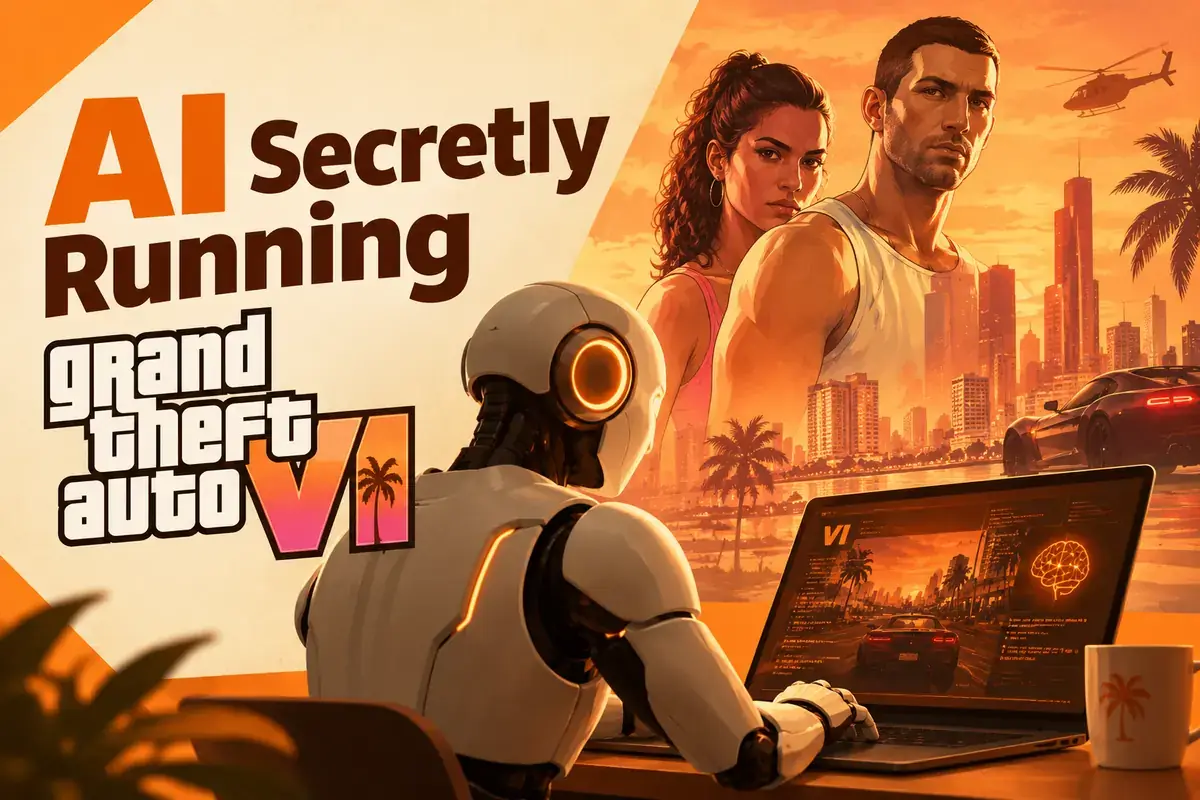
Grand Theft Auto VI is set in Leonida, a fictional recreation of Florida, and is one of the most anticipated game releases in a decade.
Most coverage focuses on the release date, price and story. But one of its biggest upgrades is largely overlooked: the AI system running the world itself.
In older GTA titles, traffic and pedestrians followed fixed scripts. Cars looped on invisible paths. Traffic jams never resolved. NPCs — the computer-controlled people in the game — reacted the same way, every time.
GTA 6 changes this at a fundamental level. And the shift is a useful case study in how AI is being applied in real, shipped products — not just theory.
The Problem Rockstar Needed to Solve
Open-world games have always faced the same limitation: a city can only feel alive if its residents behave unpredictably, like real people.
Older systems solved this with shortcuts. NPCs vanished when not in view, or repeated the same three driving patterns. Players noticed. Immersion broke.
The real problem wasn't graphics or map size. It was behaviour. And behaviour is where AI becomes interesting.
The AI Solution
According to a Rockstar-filed patent, GTA 6 assigns every NPC driver its own behavioural profile. That profile includes:
- Top speed and acceleration
- Braking distance and cornering skill
- Risk tolerance — cautious vs. reckless driving
- Reaction to hazards, including behaviour during a police chase
Instead of following a fixed route, each NPC evaluates real-time conditions — traffic density, weather, road type, nearby vehicles — and makes its own decision.
The result: two drivers placed in the same situation can behave completely differently, the same way two real people would.
The system also manages city-wide traffic density. Busy highways affect side streets. A crash on one road reroutes traffic elsewhere. During a police chase, NPCs factor the player's movement into their own decisions instead of simply reacting after the fact.
Rockstar has applied the same logic to physics. Water displaces realistically around boats and jet skis, generating individual ripples rather than a repeated animation.
Why This Matters Beyond Gaming
This is a practical example of applied AI that most non-gamers interact with without realizing it. Unlike a chatbot, which produces a single, isolated response, GTA 6's AI must manage thousands of interacting decisions simultaneously, in real time, without any two outcomes being identical.
It sits in the same conversation as AI in iGaming — another example of AI running quietly inside consumer platforms, shaping behaviour at scale.
It's also a useful reference point for anyone tracking how customers search on ChatGPT vs Google — because both stories are about the same thing: AI moving from experiments into everyday infrastructure.
For marketers, the lesson is clear. AI is no longer a research demo. It is a system millions of people will use daily, starting this November.
Key Takeaway
GTA 6 won't market itself as an AI product. But its traffic system is one of the most advanced real-time AI decision systems shipping in any consumer software this year — a detail worth watching well beyond the gaming world.
If you're thinking about how AI fits into your own marketing — from content to targeting to SEO and AI search visibility — the real question isn't whether AI will change your work. It's whether you'll notice the change before your competitors do.
What this actually teaches marketers
Strip away the game world, and Rockstar's AI system is solving a problem every marketer already knows: generic, one-size-fits-all doesn't work anymore.
Every NPC in GTA 6 gets its own behavioral profile — built from real-time signals, not a fixed script. That's the same shift happening in performance marketing right now. Static audience segments and blanket messaging are being replaced by systems that react to individual signals in real time — the same logic behind dynamic creative optimization in Meta Ads, real-time bidding in Google Ads, and AI-personalized email flows.
There's a second lesson hiding in the numbers: GTA 6's gameplay reveal pulled 3.97 million concurrent viewers — the biggest gaming stream of 2026 — without a single traditional ad. That's not luck. It's a masterclass in pre-launch hype: staged reveals, scarcity, and letting the internet do the marketing through leaks and fan speculation.
If you're building toward a launch — a product, a campaign, a brand relaunch — the takeaway isn't 'add AI.' It's this: the more your system reacts to real signals instead of running on a fixed script, the more it feels alive to the person on the other end. That's true whether the 'NPC' is a game character or a lead in your funnel. The same rule shows up in something as everyday as writing AI photo prompts: specific input, human-feeling output.
Want to build that into your brand? Work with me and we'll turn the shift into your advantage.
Let's apply AI to your marketing →FAQs
What makes GTA 6's AI different from older games?+
Instead of following fixed paths, NPC drivers in GTA 6 use individual behavioural profiles to make real-time decisions based on traffic, weather, road type and nearby events.
Is GTA 6 actually using AI, or is it just scripted behaviour?+
Rockstar's patent describes a system where each NPC evaluates conditions and chooses behaviour dynamically. That goes beyond traditional scripting, even if it isn't generative AI like a chatbot.
Why should non-gamers care about GTA 6's AI?+
It shows how AI is being deployed at scale in consumer software — managing thousands of real-time decisions — which is relevant to anyone tracking how AI is entering everyday products.
How does this relate to marketing?+
The same shift is happening in marketing: AI is moving from experiments into core infrastructure, from search behaviour to ad targeting and content strategy.
Keep reading
Written by Likita
Digital marketing, creative strategy, content & AI — Asia, UAE & Europe.