

Why Your Website Traffic Dropped: AI Overviews and the Rise of Zero-Click Search
Your rankings look fine, your content is good — and your clicks are still falling. In 2026 roughly 1 in 4 Google searches triggers an AI Overview, and the answer never leaves the results page.
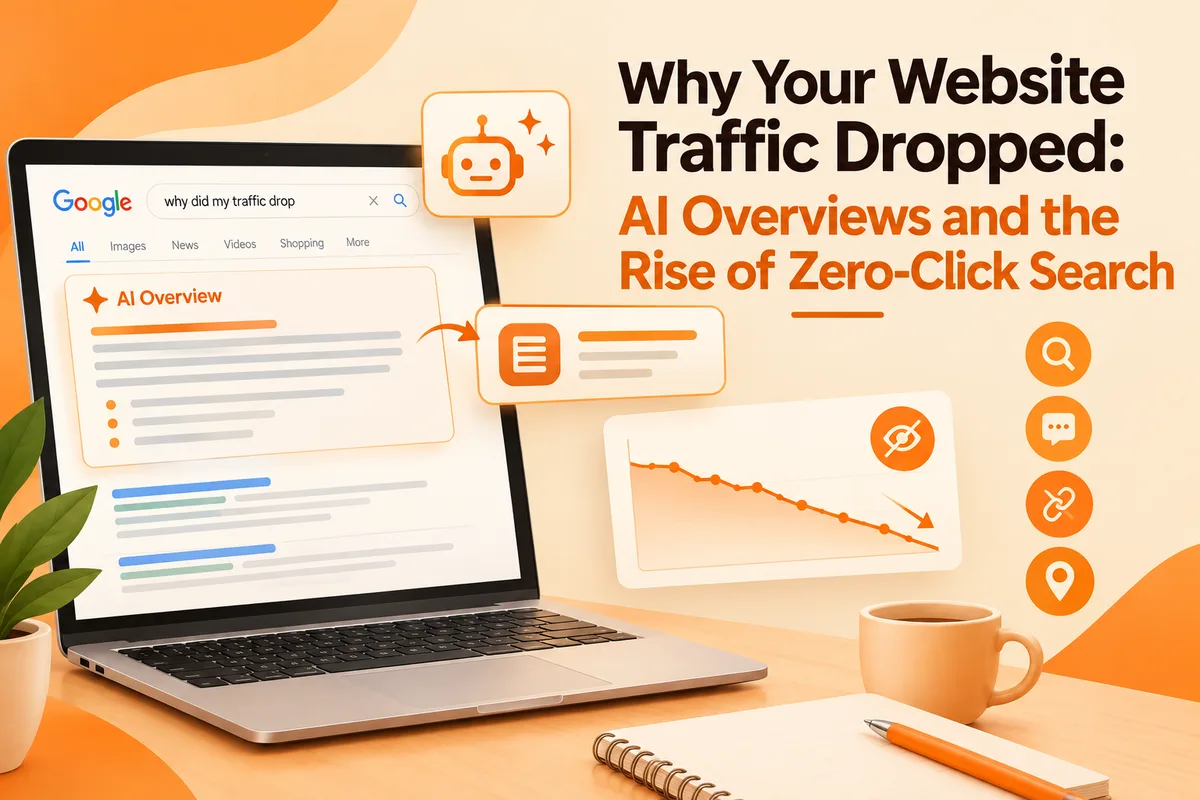
You didn't do anything wrong. Your content is good, your rankings look fine, and yet your traffic chart looks like it's sliding downhill. You're not imagining it, and you're not alone.
Here's what's actually happening.
Google Is Answering Questions Before People Even Visit Your Site
In 2026, roughly 1 in 4 Google searches now triggers an AI Overview — the AI-generated summary box at the top of the results page. It reads the top-ranking pages (sometimes including yours), pulls out the key points, and hands the user a full answer instantly.
The problem? The user gets what they wanted without ever clicking through. This is zero-click search, and it's the single biggest reason your impressions hold steady while your clicks quietly disappear. You're still ranking. You're just not being visited — the same pattern I unpacked in how AI Overviews are eating clicks for Indian businesses.
So… Is SEO Dead?
Nope. But the rules changed. Old-school SEO was built for keywords and blue links. The new game is GEO — Generative Engine Optimization — and it's about getting cited inside AI answers, not just ranked below them.
Here's the part most people don't realise: being the source an AI quotes is now more valuable than being position #1, because AI tools often link back to (or name) the source they pulled from. If you're the site the AI trusts, you stay visible even inside a zero-click world. It's also why search is splitting between Google and ChatGPT.
What Actually Helps (Backed by What's Working in 2026)
- Answer the question in the first two sentences. AI tools scan for direct, quotable answers — not long intros. Say the thing, then explain it.
- Add FAQ sections with real schema markup. It's one of the easiest ways to get picked up in AI Overviews and voice/chat answers, because it hands the AI a ready-made Q&A format.
- Write for exact phrasing, not just keywords. People now ask full questions ("why did my traffic drop") instead of typing three-word searches. Match that tone in your headers.
- Build topical depth, not just single posts. AI tools favour sites that clearly know a subject across multiple connected pages.
- Don't panic-chase rankings. A page at position #6 that gets cited by an AI Overview can outperform a page at #1 that doesn't.
The Part Nobody's Telling iGaming Sites
Here's something most general SEO blogs won't mention, because it's specific to gambling content: Google excludes gambling and betting pages from rich results. No FAQ dropdowns, no star ratings, no price markup show up for gambling queries, even if your schema is perfect. So the classic "just add FAQ schema" advice does far less for iGaming sites than it does for a regular business blog — a quirk worth reading alongside why gambling ads get rejected.
What actually moves the needle for gambling content instead:
- Keep your offers simple enough for an AI to summarise. "Free spins, no wagering" is easy to quote. A bonus buried in wagering requirements and contribution rates usually gets skipped — the AI can't confidently repeat something that complicated.
- Go local, not generic. "Best Online Casinos" competes with everyone. A page built around one market's rules, licences and payment methods (India, Malta, Ontario) is easier to rank and more trustworthy to readers and AI systems alike.
- Write reviews with real, first-hand detail — screenshots, specific numbers, actual withdrawal times. Gambling falls under Google's stricter "Your Money or Your Life" category, and thin, generic pages get filtered out fast.
iGaming Keywords Getting Real Search Volume in 2026
If you want your next few posts to have a real shot at traffic, these are worth building around — and they pair well with how AI is reshaping iGaming brands:
- online casino
- sports betting
- best online casino
- no deposit bonus codes 2026
- crypto casino
- live dealer casino
- wagering requirements explained
- Bitcoin casino instant withdrawal
Pick one, build a full page around it with real local detail, and you're playing a very different game than a generic "top trends" post.
The Real Takeaway
Traffic isn't dying — it's moving somewhere new. The businesses winning in 2026 aren't fighting zero-click search, they're writing content built to survive inside it: fast answers, clear structure, and real expertise an AI can confidently quote.
Your next blog post shouldn't just aim to rank. It should aim to be the answer.
Quick Fix: Do This on Your Next Post
- Answer the main question in your first 2 lines — no long intro.
- Add one FAQ section (for gambling pages this won't show as a rich result, but it still helps AI tools quote you).
- Use a real question as a subheading — the way people actually type it.
- Link it to 2–3 other posts you've written on the same topic.
- Check Search Console in a few weeks — impressions usually move first, clicks follow.
FAQs
Why did my website traffic drop even though my rankings didn't change?+
Most likely zero-click search. In 2026 around 1 in 4 Google searches shows an AI Overview that answers the question on the results page, so your impressions stay steady while clicks fall.
What is zero-click search?+
A search where the user gets their answer directly on the results page — from an AI Overview, featured snippet or knowledge panel — without visiting any website.
What is GEO (Generative Engine Optimization)?+
GEO is optimising your content so AI systems cite and recommend it inside their answers, rather than only ranking it in the traditional list of blue links.
Does FAQ schema help gambling and betting pages?+
Not in Google's search results — gambling pages are excluded from rich results. It still helps AI tools understand and quote your content, so it's worth adding for GEO reasons.
How do I get cited in AI Overviews?+
Answer the question in your first two sentences, use real questions as subheadings, add FAQ sections with schema, build several connected pages on the same topic, and include first-hand detail an AI can trust.
Keep reading
Written by Likita
Digital marketing, creative strategy, content & AI — Asia, UAE & Europe.