

What Does a Digital Marketing Specialist Actually Do? (2026 Guide)
Wondering what a digital marketing specialist does, what they earn, and whether you need an agency or a consultant? Here's the real, no-fluff answer for 2026.
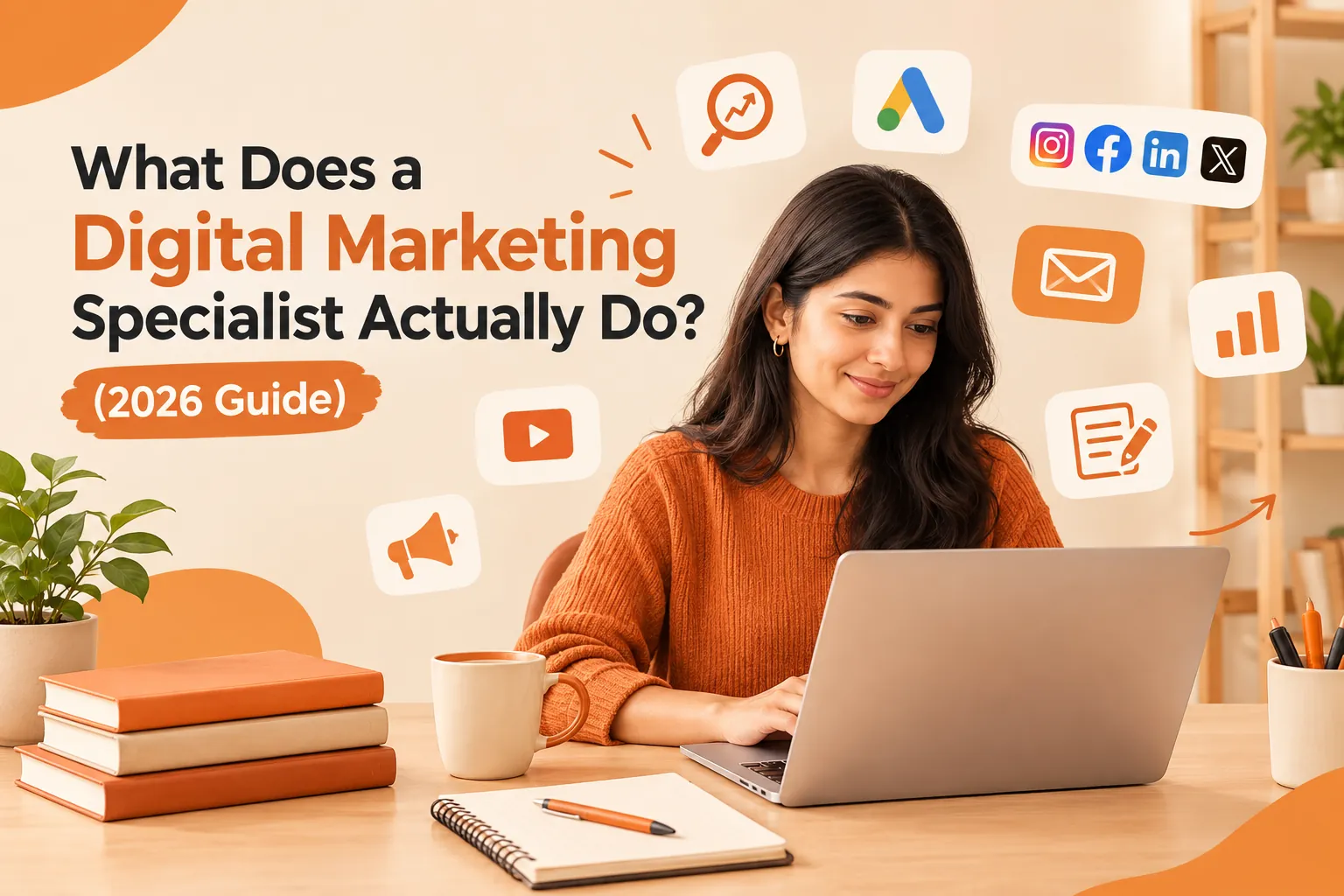
Priya runs a small skincare brand out of Jaipur. Two years ago, she was posting on Instagram whenever she remembered to, hoping something would stick. Sales were flat. Then she hired one person — a digital marketing specialist — and within six months her website traffic tripled and her ad spend finally started paying for itself.
What changed wasn't magic. It was someone whose entire job is to understand how people find, trust, and buy things online — and who does that job every single day, using data instead of guesswork.
If you've typed "digital marketing" into Google recently, chances are you're either trying to hire one of these people, become one, or figure out if you need an agency instead. Let's clear it up.
What Is a Digital Marketing Specialist?
A digital marketing specialist is a professional who plans, runs, and optimizes a brand's marketing across digital channels — search, social media, email, and paid ads. Unlike a traditional marketer who might run one big campaign and wait months to see if it worked, a specialist works with real-time data, adjusting strategy weekly, sometimes daily.
Day to day, the role usually covers:
- SEO — helping a website rank higher on Google organically
- Paid media — running ads on Google, Meta, and LinkedIn
- Content strategy — blogs, videos, and posts that actually get found
- Email and automation — nurturing leads without manual follow-ups
- Analytics — turning clicks and traffic into decisions
This is why digital marketing growth has become such a widely searched term — businesses aren't just asking "should we go digital," they're asking "how do we grow faster with what we're already spending." That question is really a strategy question, and it's the same one I work through in this 2026 digital marketing strategy guide.
Why Digital Marketing Growth Looks Different in 2026
A few things have shifted the ground under this industry:
AI has taken over the repetitive work. Writing basic ad copy or scheduling posts is now automated. What's left — strategy, judgment, reading what a campaign's numbers actually mean — is squarely human work. Employers are prioritizing people who can pair creative thinking with data literacy, not just tool operators. (If you run a small business, these AI tools are worth the hour it takes to set up.)
Search itself has changed. People don't only Google things anymore — they ask ChatGPT, Perplexity, and Google's AI Overviews directly. This is why answer engine optimization (AEO) and generative engine optimization (GEO) are now part of a specialist's job description, right alongside classic SEO. It's no longer enough to rank on page one; your content needs to be the answer an AI assistant reads out loud — which is exactly why so many sites saw their clicks fall while rankings held steady.
Budgets are tighter, but not shrinking. Global digital ad spend is still climbing toward the trillion-dollar mark, and demand for specialists, SEO experts, and growth analysts remains strong — even as hiring overall has become more selective.
Priya's experience is a small version of a much bigger pattern: businesses that hire someone dedicated to this work consistently outgrow the ones relying on scattered, part-time effort.
Digital Marketing Agency vs. Consultant vs. In-House Specialist
This is probably the most common question after "what do they do" — and there's no single right answer. I've broken the trade-offs down in more detail in freelancer vs agency vs consultant.
A digital marketing agency works well when you need multiple channels covered at once (SEO, ads, content, design) and don't want to hire five separate people. You get a team, but less individual attention on your brand specifically.
A digital marketing consultant is the right call when you already have some marketing happening but need strategy, an outside audit, or a specific fix — say, your ads are running but conversions are low. Consultants are typically project-based, not full-time.
An in-house specialist makes sense once your business is large enough that marketing needs daily, hands-on attention and deep familiarity with your product. This is usually the most expensive route, but also the most closely aligned with your long-term goals.
Priya, for context, started with a consultant for a one-month audit, then hired an in-house specialist once she saw where the gaps were. That order — diagnose first, then commit — is one of the more underrated pieces of advice in this space.
Skills That Actually Matter Right Now
If you're hiring, or trying to become one yourself, these are the skills employers are prioritizing in 2026:
- Technical SEO — site structure, crawlability, structured data (this is also what powers AEO/GEO visibility)
- Paid media fluency — Google Ads, Meta Ads, and increasingly LinkedIn for B2B
- Data tools — comfort with Google Analytics at minimum; SQL and basic AI tools are becoming a real pay differentiator
- Content that answers questions directly — the single biggest shift caused by AI search
- Conversion rate optimization (CRO) — traffic means nothing if it doesn't convert
Frequently Asked Questions
What does a digital marketing specialist do day to day? They manage campaigns across SEO, paid ads, social, and email, then analyze performance data to improve results — often adjusting strategy weekly based on what the numbers show.
Is a digital marketing agency better than hiring one specialist? An agency suits businesses needing multiple channels covered immediately. A single specialist works better once you know exactly which channel needs focus.
How much does a digital marketing consultant cost? Rates vary widely by market and scope, but consultants are usually hired project-based (like a one-time audit) rather than as a monthly retainer, which keeps costs lower than a full agency contract.
Do I need SEO and AEO, or just one? Both. SEO still drives the majority of website traffic, but AEO determines whether AI tools like ChatGPT and Google's AI Overviews mention your business when people ask questions in your category.
If you'd rather have this handled for your brand, here's how I run 2026 campaigns →. For a deeper look at how SEO, AEO, GEO, Google Ads and Meta Ads fit into one growth system, read Clicks, AI & Chaos: What Actually Drives Digital Marketing Growth in 2026.
And if you already know which number you need to move, let's make your brand more interesting — one call is usually enough to see where the gap is.
FAQs
What does a digital marketing specialist do day to day?+
They manage campaigns across SEO, paid ads, social and email, then analyse performance data to improve results — often adjusting strategy weekly based on what the numbers show.
Is a digital marketing agency better than hiring one specialist?+
An agency suits businesses needing multiple channels covered immediately. A single specialist works better once you know exactly which channel needs focus.
How much does a digital marketing consultant cost?+
Rates vary widely by market and scope, but consultants are usually hired project-based (like a one-time audit) rather than as a monthly retainer, which keeps costs lower than a full agency contract.
Do I need SEO and AEO, or just one?+
Both. SEO still drives the majority of website traffic, but AEO determines whether AI tools like ChatGPT and Google's AI Overviews mention your business when people ask questions in your category.
Keep reading
Written by Likita
Digital marketing, creative strategy, content & AI — Asia, UAE & Europe.