

iGaming in India: Under the Table (2026)
India banned online money games in 2025. In 2026, the industry simply moved underground — offshore operators, mule accounts, crypto payments and disguised ads are keeping it alive.
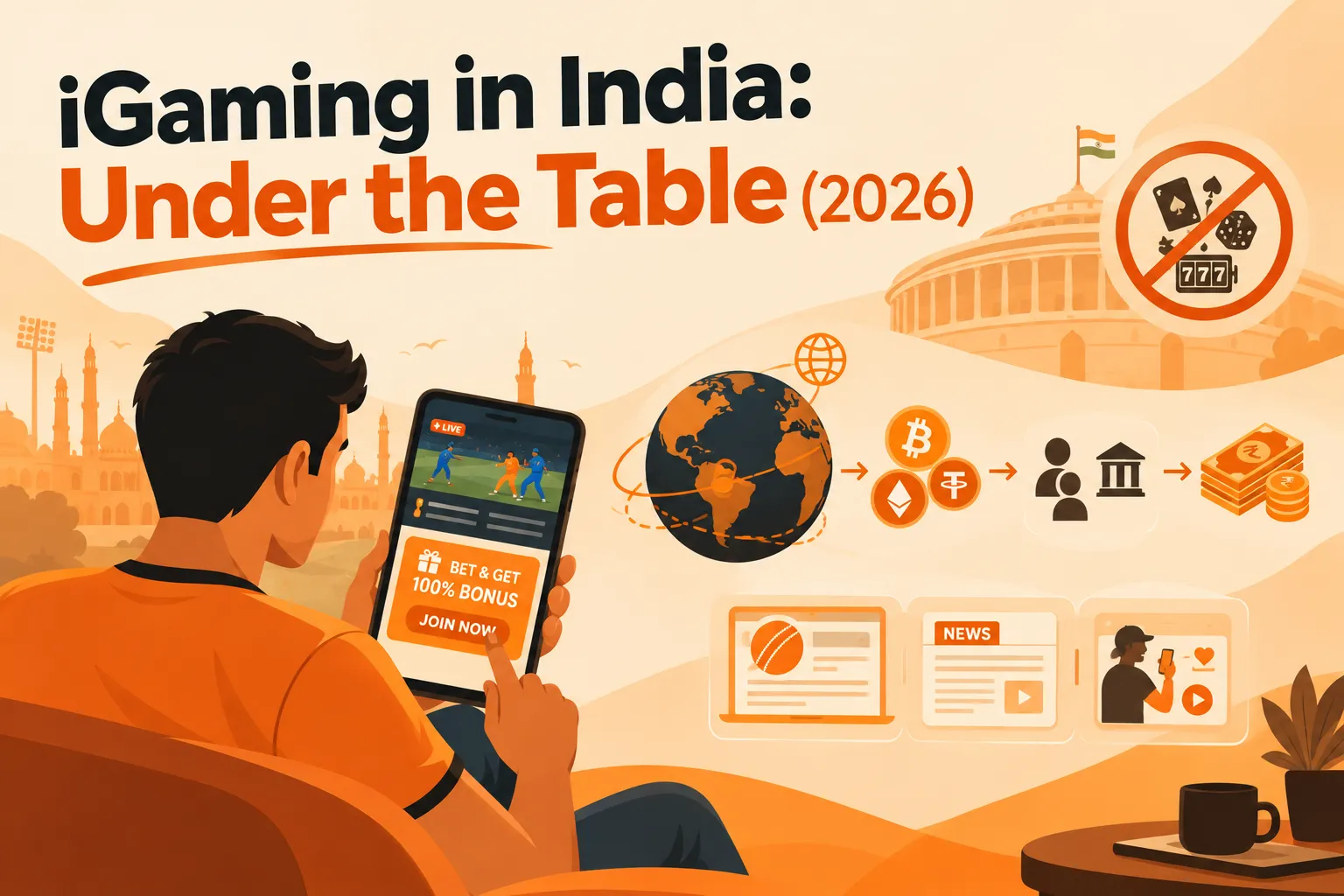
Picture a cricket fan in Lucknow, watching an IPL match on his phone. He scrolls past a sports score page, and there it is — a betting offer, bright orange, promising a bonus on his first deposit. He taps it. Ten seconds later he's on a casino site, paying in crypto, playing a game that is completely illegal in India.
That's the real story of iGaming in India in 2026. On paper, the government banned it. In real life, it just moved underground. If you're building a digital marketing plan for iGaming, this is the landscape your strategy has to survive in.
The law that was supposed to end it
In August 2025, Parliament passed a law banning "online money games" — any game, whether skill or luck, where you pay money hoping to win more back. (Wondering which apps got blocked? See betting apps banned in India: what is actually on the record.) Rummy, poker, betting, cash fantasy sports, all of it. The rules came into force on May 1, 2026, and they didn't stop at banning the games. They also banned advertising them, in any form. Banks and UPI were told to stop processing payments to these platforms too. If you're an affiliate marketer weighing what this means for you, here's how to start an iGaming affiliate site in India in 2026 — the legal and SEO reality.
For Indian companies, this law had teeth. They had offices, staff, and bank accounts the government could actually reach. Dream11, once India's biggest fantasy sports company and the front-of-shirt sponsor of the Indian cricket team, had to shut its real-money games down completely. It lost that cricket sponsorship deal — worth around $44 million — overnight. Its revenue dropped from ₹8,345 crore to ₹7,374 crore in a single year, and by some industry estimates, the ban wiped out close to 95% of its parent company's earnings once it fully kicked in. Over a hundred employees left as the company restructured into smaller units just to survive.
Dream11 didn't disappear, though. It rebuilt itself as a free-to-play sports platform — no cash prizes, just contests, stats, and content — and started earning through advertising and sponsorships instead, with brands like Swiggy and Tata Neu signing on. But by every account, that new income is nowhere close to what the old real-money model brought in. It's a company surviving on a much smaller business, not one that found a bigger one.
The companies the law couldn't touch
Here's where the story gets interesting. While Dream11 was shutting down and rebuilding, names like 1xBet, Parimatch, Stake, and BC.Game never slowed down at all.
Why? Because none of them are Indian companies. They're licensed out of places like Curaçao or Costa Rica, with no office, no local bank account, and nothing physical in India for the government to seize or shut down. You can ban a website. You can't easily ban a company that doesn't legally exist here in the first place.
So even though India has blocked over 8,376 gambling-related web addresses since the ban began, these platforms simply open a new address the same day. It's called a mirror domain — same site, same games, new URL, back online within hours.
Follow the money
The law's smartest move was cutting off Indian banks and UPI from these platforms. That should have worked. It didn't, for two reasons — and the first one is sneakier than crypto.
Even though banks aren't supposed to touch these payments, plenty of UPI transactions still go through. They just don't go into the casino's own account — they go into random people's accounts instead. These are called "mule accounts," and the setup is almost industrial. Small shop owners, vendors, and everyday people are recruited, often through Telegram, and get paid a small commission to receive gambling deposits into their personal or "merchant" bank accounts and immediately forward the money on. The Enforcement Directorate has already caught this happening at scale — in one raid tied to the app Parimatch, investigators found over ₹2,000 crore had passed through mule accounts in a single year, and seized 1,200 mule credit cards along the way. In another case involving 1xBet, the platform was found generating a fresh UPI ID for every single transaction, each one linked to a different mule account, so no single account ever showed a pattern worth flagging. Because the money is scattered across thousands of ordinary, unconnected accounts instead of sitting in one place, it's genuinely hard to trace — and by the time anyone notices, the account has usually already emptied out and moved on.
The second reason is crypto. Offshore casinos also run heavily on Bitcoin, Ethereum, and stablecoins like USDT. A player buys crypto through any exchange, sends it to the casino, and cashes out the same way — no Indian bank involved at any point.
Between mule accounts soaking up the UPI side and crypto handling the rest, the block on banks barely slows things down. The law was built to cut off rupees moving in one clean, traceable line. The industry responded by breaking that line into thousands of small, forgettable pieces instead.
How the ads keep sneaking through
Advertising these platforms is now a crime in India, so the ads stopped looking like ads. They show up as embedded links on cricket score sites, "casino review" blogs that read like journalism but are really sign-up funnels, and quiet deals with smaller influencers who never sign anything official. India's Advertising Standards Council reviewed over 11,500 flagged ads in the last financial year, and offshore betting made up 72% of every single violation they found. Not the top category. Nearly three out of every four.
This is why compliance isn't a side issue in this market — it's the whole game. I broke down exactly why gambling ads get rejected and what the September 2026 platform changes mean in this guide to gambling ad rejections.
What this means for marketers
If you're marketing in or around iGaming in India, you are not working with a normal digital playbook. This is the difference between a general digital marketer and an iGaming marketing strategist: the legal surface is shrinking, the paid-ad window is closing, and the brands that keep growing are the ones building channels they actually own — SEO, content, and affiliate partnerships. That's exactly the shift I covered in iGaming affiliate marketing in 2026: when platforms can switch you off overnight, partnerships that only get paid when they work become the safest bet.
The opportunity isn't in finding loopholes. It's in understanding the real behaviour — how people search, who they trust, how they pay, and where the attention actually is — and building marketing that works inside that reality.
Quick answer
Is iGaming really banned in India in 2026? Yes — for Indian companies offering real-money games. But offshore operators continue to reach Indian users through mirror domains, mule accounts, crypto, and disguised advertising. The ban changed who can operate legally inside India; it did not remove the demand.
Have a question about compliance, or want to talk through a campaign in this space? Work with me and we'll figure out what actually works for your market.
Let's talk iGaming strategy →FAQs
Is online gambling legal in India in 2026?+
Real-money online games — including rummy, poker, betting and cash fantasy sports — were banned under a law passed in August 2025 and enforced from May 1, 2026. Indian companies must operate free-to-play or non-cash models. Offshore platforms, however, continue to reach Indian users.
Why do offshore betting sites still work in India?+
They are licensed outside India, have no local office or bank account, and use mirror domains. When one web address is blocked, they launch another within hours.
What are mule accounts in iGaming?+
Mule accounts are ordinary bank or UPI accounts used to receive gambling deposits and forward them on, often for a small commission. This scatters the money trail and makes it harder for authorities to trace.
How do gambling ads appear if they're banned in India?+
They are disguised as embedded links on cricket score sites, casino review blogs, and informal influencer deals. India's Advertising Standards Council found offshore betting made up 72% of flagged ad violations in the last financial year.
Can Indian brands still do iGaming marketing?+
Yes, but only within strict limits. Free-to-play sports platforms, information content, and compliant affiliate models are the safer paths. Real-money advertising targeting Indian users is prohibited.
Keep reading
Written by Likita
Digital marketing, creative strategy, content & AI — Asia, UAE & Europe.