

Google AI Mode Ads Are Coming to India: What Advertisers Need to Know for Diwali 2026
Google AI Mode ads are expanding to India. Learn campaign eligibility, costs, targeting limits and six practical checks for Diwali 2026 advertising.
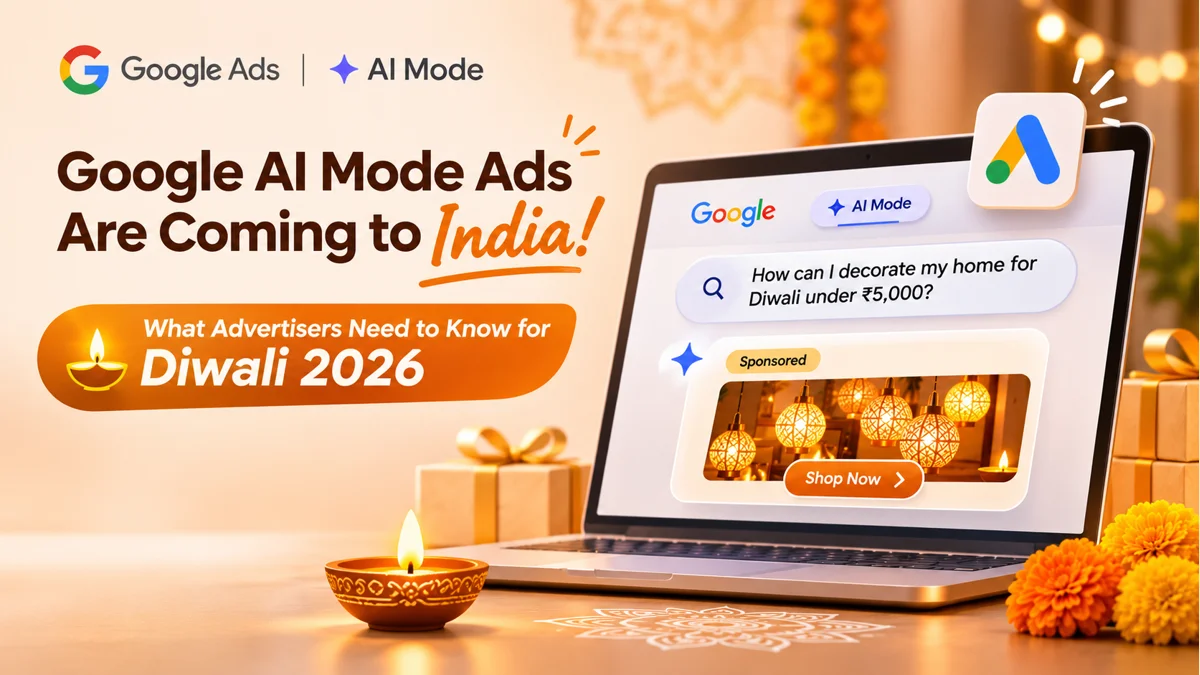
Quick answer: Google announced AI Mode ads expansion to India on October 28, 2026. Eligible Search, Shopping and Performance Max campaigns can participate without a separate campaign or budget. AI Mode cannot be targeted exclusively, and participation does not guarantee impressions, cheaper clicks or sales.
Google Ads is entering a new phase in India. On October 28, 2026, Google announced the expansion of ads in AI Mode to India and nine other countries. This means eligible advertisers may have their ads appear as the rollout reaches their accounts in Google's AI-powered search experience, where users explore questions, compare options and discover products through more conversational searches.
For advertisers preparing for Diwali, this update arrives at a crucial time. Consumers are searching for festive outfits, home décor, gifts, electronics, travel deals and special offers. But instead of typing just two or three keywords, people can ask more detailed questions about what they need.
That shift could change how businesses reach potential customers through Google Search.
The big question is no longer just how to rank for a keyword. It is how to reach the right customer when they are exploring a need, comparing solutions or preparing to make a purchase.
In this guide, we’ll explain what Google AI Mode ads are, what has changed in India, why the update could be a game changer for performance marketers, and how advertisers can prepare their campaigns for Diwali 2026.
What Is Google AI Mode?
Google AI Mode is an AI-powered search experience designed to help users explore complex questions, compare options and dig deeper into a topic.
Unlike a traditional search, where someone might type a short phrase and scan a list of links, AI Mode lets users ask detailed questions in a more conversational way.
For example, a user might search:
- Traditional search: “Diwali home décor”
- More detailed search: “How can I decorate my living room for Diwali under ₹5,000?”
- Purchase-focused search: “Which online stores offer affordable Diwali lights with fast delivery?”
These searches reveal different levels of intent. The first is broad, the second provides a budget and a specific need, and the third suggests the user may be ready to shop.
AI Mode helps users explore these questions through AI-generated responses and relevant links. Where commercial intent makes an ad relevant, a sponsored placement may appear within or alongside the AI-powered experience.
For businesses, this creates another potential opportunity to connect with customers during their decision-making journey.
Google AI Mode Ads in India: What Changed in October 2026?
On October 28, Google announced that it was expanding ads in AI Mode to 10 markets, including India, Australia, Canada, Kenya, Malaysia, New Zealand, Nigeria, Pakistan, the Philippines and Singapore.
Google also reported that queries in AI Mode are, on average, three times longer than traditional searches, based on its US research.
This matters because detailed searches can reveal more about what a person wants, their budget, their preferences and the problem they are trying to solve.
Here are the key points advertisers should know.
1. India is included in the expansion
Google has announced the expansion of ads in AI Mode to India. Google's Ads Help guidance describes English availability in select markets, with ongoing expansion; check availability for your account.
This gives eligible advertisers in India another potential way to reach people using AI-powered Search.
2. Existing campaigns can be eligible
Advertisers do not need to create a separate campaign or set up an additional budget specifically for AI Mode placements.
Eligible existing Search, Shopping and Performance Max campaigns can participate when their ads are relevant to a search.
This means businesses should review their current campaigns before assuming they need an entirely new advertising strategy.
3. Ads are labelled as sponsored
Google says ads in AI Mode and AI Overviews are clearly labelled “Sponsored” and visually distinguished from organic content.
Google also states that paid advertising does not influence the organic answers generated by its AI systems.
In other words, paying for ads does not guarantee that a brand will be recommended organically in an AI-generated response.
4. Advertisers cannot target AI Mode exclusively
At present, advertisers cannot select AI Mode as a standalone placement or opt out of it separately from Search.
Existing campaign settings and controls, including negative keywords and brand exclusions, continue to apply.
5. Reporting remains part of existing Google Ads reports
Metrics from eligible ads in AI Mode and AI Overviews are included in standard campaign reporting. Relevant queries are also included in the Search terms report.
However, advertisers should not assume they will get a separate, complete performance breakdown specifically for AI Mode placements.
Why this matters: Businesses can begin by reviewing their existing campaign setup, conversion tracking and targeting rather than treating AI Mode as an entirely separate advertising channel.
Official sources: Google’s October 28 AI Mode ads expansion announcement and Google Ads Help: ads in AI-powered Search experiences. Checked October 31, 2026; rollout and account availability can change.
Why Google AI Mode Ads Could Be a Game Changer for Advertisers
The most significant change is not simply that ads may appear in another part of Google Search. It is the opportunity to reach people who express their needs in greater detail.
Traditional keyword targeting often starts with what someone types. Conversational search can reveal more context about why they are searching.
That could create new opportunities for advertisers, particularly in categories where people compare products, prices, features and solutions before purchasing.
Let's look at three ways this could affect performance marketing.
1. From keyword matching to understanding customer intent
Imagine you sell decorative lights online.
A potential customer searches:
“How can I make my living room look festive for Diwali with decorative lights under ₹3,000?”
A traditional campaign might target keywords such as:
- Buy Diwali lights online
- Decorative lights
- Festive lighting offers
- Diwali lights under ₹3,000
In AI-powered Search, an eligible ad could also be considered when the broader question and AI-generated response make your product relevant.
This is an opportunity to connect a product with a customer's specific need, not just a short keyword.
However, an ad appearing for this type of search is not guaranteed. Eligibility depends on campaign settings, matching, auction conditions, relevance and Google's serving systems.
2. More opportunities to reach shoppers during research
Not every customer starts with a clear product name.
Someone planning a festive makeover might begin with a question about decorating a small apartment. During their research, they may discover that they need lights, curtains, cushions or other décor.
For advertisers, this kind of exploratory search could provide opportunities to reach potential customers earlier in their decision-making process.
For example, a home décor retailer could improve its chances of being relevant by ensuring its campaigns and landing pages clearly communicate:
- The products available
- Price ranges and current offers
- Product features and dimensions
- Delivery options
- Return policies
- What makes the products suitable for the customer's needs
The goal is not to insert every possible keyword into an ad. It is to make the relationship between the customer's need, the advertised product and the landing page clear.
3. A potential advantage for well-structured campaigns
The update does not mean every advertiser will automatically receive more traffic or cheaper conversions.
Businesses still need relevant campaigns, compelling ad assets, accurate conversion tracking and landing pages that make it easy for customers to take action.
Advertisers with clear product information and reliable measurement will be better equipped to evaluate whether this new search experience is delivering business results.
The real game changer is the possibility of connecting relevant ads with more detailed customer intent—not a guarantee of lower costs or higher sales.
Google AI Mode Ads vs Traditional Google Search Ads
How do these experiences differ from a marketer's perspective?
| Feature | Traditional Google Search | Google AI Mode |
|---|---|---|
| Search behaviour | Often short keyword-based searches | Can involve detailed, conversational questions |
| User intent | May be broad or specific | Can reveal additional context about needs and preferences |
| Ad relevance | Ads can match the search query | Ads can match the query directly or contextually, depending on campaign targeting |
| Campaign setup | Search campaigns and existing campaign controls | Eligible existing campaigns can participate |
| Separate budget | Campaign budgets apply | No separate AI Mode budget is required |
| Reporting | Standard Google Ads reports | Included in standard campaign reporting |
| Exclusive targeting | Search targeting options apply | AI Mode cannot be targeted exclusively |
| Performance guarantee | No guaranteed results | No guaranteed results |
One important distinction: Google's guidance says AI-powered targeting, including AI Max for Search, broad match, Shopping and Performance Max, can be eligible for both direct query matching and contextual matching.
Exact and phrase match Search keywords can be eligible when the query expresses direct commercial intent, but they are not eligible for contextual matching on broader exploratory questions.
This does not mean advertisers should automatically switch every campaign to broad match. Changes to targeting should be based on the campaign's goals, conversion data, budget and risk tolerance.
How Can Advertisers Prepare Their Google Ads Campaigns for Diwali 2026?
Diwali is a high-intent shopping period for many Indian businesses. From clothing and electronics to gifting, travel and home décor, consumers are actively exploring products and offers.
Here are six practical steps advertisers can take now. For seasonal planning beyond this placement, use our festive advertising budget guide.
Step 1: Review your existing campaign eligibility
Start by reviewing your Search, Shopping and Performance Max campaigns.
Check whether your campaign types are eligible and whether your settings, budgets, bidding strategies and creative assets align with your business objectives.
Do not create duplicate campaigns just because AI Mode ads have expanded to India. Google says eligible existing campaigns can participate without a separate campaign or budget.
Action point: Read Google's official guidance on ads in AI-powered Search experiences before changing your campaign setup.
Step 2: Review keyword matching and search intent
Think about how customers describe their needs, not just the product name.
For example, a business selling festive outfits might consider search themes such as:
- Ethnic wear for Diwali under ₹2,000
- Festive outfits for office parties
- Affordable traditional outfits for women
- Where to buy kurta sets online
These are examples of customer search language, not a promise that each query will trigger an AI Mode ad.
Review your current keyword strategy and understand how your match types work. If you test AI-powered targeting or broader matching, monitor the search terms and results carefully.
Keep negative keywords and brand exclusions relevant to your campaign goals.
Step 3: Make your ad messaging specific
Generic ad copy may not explain why your product is right for a particular customer.
Compare these examples.
Generic copy:
“Shop Diwali Collection. Great Deals Available!”
More specific copy:
“Refresh Your Home for Diwali. Explore Festive Décor for Every Budget.”
The second example tells potential customers more about the offer and the use case.
Your messaging should reflect your actual products, prices and promotions. Do not advertise discounts, delivery promises or product features that your business cannot support.
Step 4: Improve your landing pages
Getting a click is only part of the job. The landing page needs to help the customer make a decision.
For a Diwali campaign, check whether your page includes:
- Clear product descriptions
- Accurate prices and available discounts
- High-quality product images
- Delivery timelines and shipping costs
- Return and refund information
- Mobile-friendly navigation
- A visible and functional purchase button
If you run Shopping campaigns, make sure your Merchant Center product feed is accurate and up to date. Product titles, descriptions, images, prices and availability should match the landing page.
A relevant ad that leads to a confusing or outdated page can waste advertising spend.
Step 5: Check conversion tracking before increasing budgets
AI-powered advertising still depends on measurement.
Before scaling a campaign, confirm that your key conversions are being tracked correctly. Depending on your business, these might include purchases, qualified leads, calls or completed registrations.
Review:
- Conversion actions and attribution settings
- Google tag implementation
- Purchase or lead values, where applicable
- Duplicate conversion events
- Consent and privacy requirements
- The difference between reported conversions and actual business outcomes
Use reliable conversion data to guide bidding and budget decisions. Do not increase spending simply because the campaign is eligible for another placement.
Step 6: Measure results, not just impressions
Google's published guidance states that AI Mode and AI Overview performance is included in existing campaign reporting. This means advertisers should evaluate their campaigns using the available metrics while recognising that a separate AI Mode breakdown may not be available.
For Diwali campaigns, track:
- Click-through rate (CTR)
- Cost per click (CPC)
- Conversion rate
- Cost per acquisition (CPA)
- Return on ad spend (ROAS), where applicable
- Revenue or qualified leads
- Search terms and traffic quality
Compare performance against an appropriate baseline, such as the same campaign before the changes or a comparable period.
Account for changes in seasonality, competition, promotions, budget and bidding strategy. A rise in conversions does not automatically prove that AI Mode caused the improvement.
Practical Example: How a Diwali Advertiser Could Benefit
Let's imagine an Indian e-commerce brand selling festive lighting.
Business goal: Generate online sales during Diwali.
Budget: ₹50,000 for a hypothetical campaign.
Product: Decorative lights priced between ₹500 and ₹3,000.
Customer need: Affordable lighting ideas for a festive home makeover.
Traditional search approach
The advertiser might target searches such as:
- Buy decorative lights online
- Diwali lights price
- LED lights for home
- Festive lighting offers
The campaign uses relevant ad copy, accurate product information and a landing page featuring available products.
AI-powered Search opportunity
A potential customer asks:
“How can I decorate a small living room for Diwali without spending more than ₹3,000?”
If the query and AI-generated response create a relevant commercial opportunity, an eligible ad could be considered for display.
For this to work well, the advertiser should have relevant products, accurate pricing, suitable campaign targeting and a useful landing page.
What should the advertiser measure?
The advertiser should not assume the new placement will automatically generate additional sales.
Instead, the brand should monitor campaign performance, search terms, conversion rates and cost per acquisition. It should also compare results against a suitable baseline and avoid attributing every change to AI Mode.
The takeaway: AI-powered Search creates a potential new way to connect products with customer needs. Strong campaign fundamentals and accurate measurement remain essential.
Does Google AI Mode Ads Cost More?
This is one of the most important questions for advertisers.
According to Google's official Ads Help documentation, ads in AI Mode and AI Overviews use the same auction mechanism and CPC or conversion-based bidding models as standard Google Search ads. Advertisers are not charged an additional fee simply to participate in these placements.
However, this does not mean every click will cost the same as it would in a traditional Search placement.
Actual costs and performance depend on the auction, competition, targeting, bidding strategy, relevance and other factors.
Advertisers should therefore avoid assuming that AI Mode will automatically reduce CPC, improve ROAS or lower acquisition costs.
The sensible approach is to monitor actual campaign results and make budget decisions based on performance. Compare the fundamentals in our Google Ads cost in India guide.
Google AI Mode Ads: What Advertisers Still Cannot Control
The expansion creates opportunities, but there are limitations marketers need to understand.
You cannot target AI Mode exclusively. Google does not currently offer a separate targeting control that allows advertisers to serve only in AI Mode.
You cannot opt out of AI Mode independently. Existing campaign controls, including negative keywords and brand exclusions, continue to apply.
You should not expect a separate, complete AI Mode report. Performance is included in existing campaign reporting and search terms reporting.
You cannot guarantee that your ad will appear for a specific conversational question. Eligibility does not guarantee an impression or click.
You cannot pay to influence organic AI answers. Google says paid advertising does not affect the organic responses generated by its AI systems.
One more clarification: Google announced multiturn ads for follow-up queries in AI Mode in the United States. Advertisers should not assume that this specific rollout is available in India just because the broader AI Mode ads expansion includes India.
Knowing these limitations will help marketers set realistic expectations and avoid unnecessary campaign changes.
What Does This Mean for SEO and Performance Marketing?
The expansion of ads in AI Mode is another reason for marketers to understand how paid search and organic visibility work together.
SEO and paid advertising serve different purposes. Our digital marketing strategy for 2026 explains how these channels fit together.
SEO helps a website earn organic visibility through useful content, relevance, technical accessibility and other ranking factors. Paid advertising allows businesses to enter relevant auctions and pay for valid clicks or other defined outcomes, depending on the campaign.
AI-powered Search does not remove the need for either discipline.
For performance marketers, useful priorities include:
- Creating helpful, accurate website content
- Making product and service pages easy to understand
- Improving mobile user experience
- Keeping pricing and product information current
- Building relevant ad assets and landing pages
- Measuring organic and paid results separately
- Reviewing how customers discover and convert across channels
Do not confuse appearing in an AI-generated answer organically with showing a paid ad. They are different systems, and advertising spend does not guarantee organic inclusion.
For a broader look at SEO, AEO and GEO, see how Google AI Overviews affect Indian businesses.
Final Takeaway: Are Advertisers Ready for AI-Powered Search?
Google's expansion of AI Mode ads to India is an important development for the paid search industry.
It reflects a broader shift in how people discover information and explore purchasing decisions. Search queries can now include more context, preferences and constraints, creating new possibilities for relevant advertising.
For Indian advertisers preparing for Diwali 2026, the immediate priority should not be to rebuild every campaign around AI Mode. It should be to review campaign eligibility, understand keyword matching, improve landing pages, verify conversion tracking and measure results carefully.
AI-powered Search may change where ads appear and how relevance is established. But the fundamentals of performance marketing remain the same: reach the right audience, communicate a clear value proposition, deliver a useful landing-page experience and measure what actually drives business results.
The brands that approach this change with curiosity, strong fundamentals and disciplined testing will be better positioned to understand what works as Google Search continues to evolve.
Need help connecting campaign relevance, tracking and festive landing pages? Let’s make your brand more interesting.
FAQs
Are Google AI Mode ads available in India?+
Google announced on October 28, 2026, that it was expanding ads in AI Mode to India and nine other markets. Google's announcement names India; its Ads Help guidance describes English availability in select markets during the rollout.
Do advertisers need a new Google Ads campaign for AI Mode?+
No. Eligible existing Search, Shopping and Performance Max campaigns can participate. Google says advertisers do not need a separate campaign or budget specifically for these placements.
Are Google AI Mode ads more expensive?+
Google says these placements use the same auction mechanism and CPC or conversion-based bidding models as standard Search ads. There is no additional fee simply for participating. Actual advertising costs still depend on auction and campaign conditions.
Can advertisers target only Google AI Mode?+
No. Advertisers cannot target AI Mode exclusively or opt out of it separately from Search. Existing campaign settings and controls continue to apply.
Can exact-match keywords trigger AI Mode ads?+
Exact and phrase match Search keywords can be eligible when a query expresses direct commercial intent. According to Google's guidance, they are not eligible for contextual matching on broader exploratory queries. AI-powered targeting options can be eligible for both direct and contextual matching.
How can advertisers measure AI Mode ad performance?+
Performance is included in standard campaign reporting, and relevant queries are included in the Search terms report. Since there is no separate, complete AI Mode performance breakdown, advertisers should evaluate the available data alongside conversion tracking and business outcomes.
Will Google AI Mode ads replace traditional Search ads?+
There is no indication in Google's announcement that AI Mode ads are replacing traditional Search ads. Standard Search ads can continue to appear, and eligible campaigns may participate in AI-powered Search experiences as well.
Will AI Mode ads improve conversions automatically?+
No. The expansion creates another potential opportunity to reach relevant customers, but it does not guarantee more impressions, lower costs or higher conversions. Results depend on targeting, relevance, creative assets, landing pages, bidding and measurement.
Keep reading
- Google AdsYouTube Ads Cost in India (2026): The Real Numbers, Not "It Depends"8 min read
- Performance MarketingBlack Friday & Festive Season Ads in India: What Small Brands Should Actually Spend in 202612 min read
- PerformanceChatGPT Ads in India (2026): How They Work, Cost, and How to Run Your First Campaign12 min read
Written by Likita
Digital marketing, creative strategy, content & AI — Asia, UAE & Europe.