

Facebook Reach Is Being Replaced by Viewers in 2026: Meta's New Metrics Explained
Facebook Reach leaves Meta Business Suite from Oct 31, 2026. What the new Viewers metric means, Reach vs Views vs Viewers, API changes and a dashboard checklist.
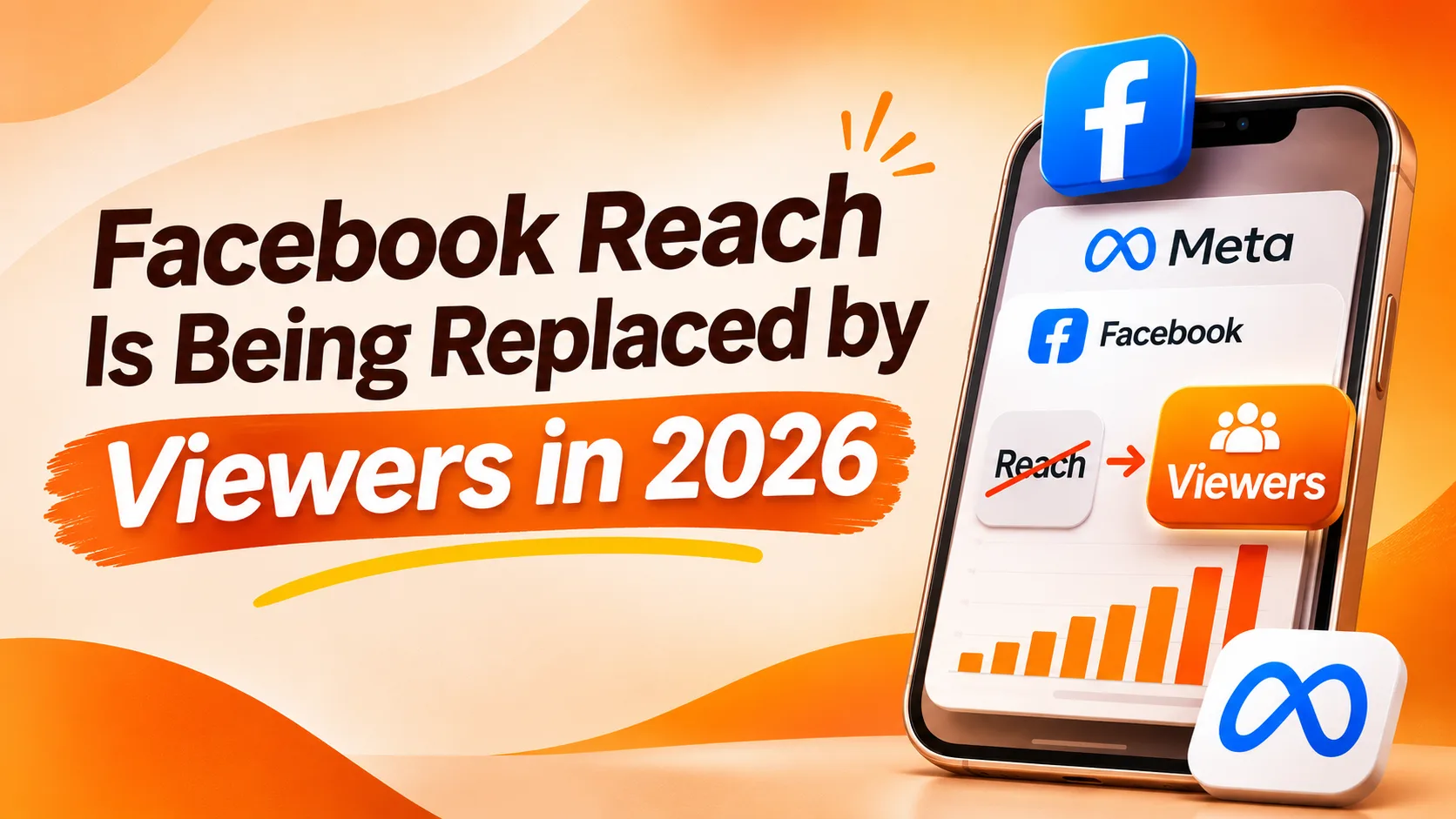
Quick answer (10 November 2026): Meta Business Suite is replacing Facebook Reach with Viewers — the number of unique Meta accounts that viewed your content at least once. Reach disappears from Business Suite from 31 October 2026, the new metric covers content published after 31 July 2025, and Reach stays in Ads Manager. Viewers is not the same as old Reach, so don’t compare the two numbers directly — export history, re-benchmark and update dashboards that use retired Insights API fields.
By Likita Kotian · Published 10 November 2026 · Sources: Meta Business Help Centre, Meta Graph API changelog and trade reporting, listed at the end.
Facebook marketers have a new metric to understand, and it could change the way businesses report social media performance.
Meta Business Suite is notifying Page managers that Facebook Reach will no longer be available in Business Suite from October 31, 2026. In its place, Meta is introducing Viewers as the primary metric for understanding how many accounts viewed Facebook content.
But there is more happening behind this update.
Meta has also been changing its Facebook Insights API, retiring older Reach and impression-related metrics and introducing view-based alternatives. These changes affect not only what Page managers see in their dashboards, but also how agencies, analytics platforms, developers and businesses collect and interpret social media data.
So, is Facebook Reach gone? Is Viewers the same as Reach? What happens to historical reports? Will organic and paid Reach still be measurable? And how should marketers calculate engagement and campaign performance now?
This guide breaks down the changes, official announcements, metric definitions, API implications, examples and practical steps businesses should take.
Quick answer: What is Meta changing about Facebook Reach in 2026?
Meta is transitioning Facebook content measurement from older impression-based Reach metrics towards a view-based measurement system.
There are two important developments:
1. Meta Business Suite update
According to the notification displayed in Meta Business Suite:
- Facebook Reach will no longer be available in Business Suite starting October 31, 2026.
- Viewers will become the primary metric for understanding how many accounts viewed Facebook content.
- The new Viewers metric applies to content published after July 31, 2025.
- Reach will remain available in Ads Manager, according to the notification.
2. Facebook Insights API update
Meta's 2026 Graph API changes affect legacy Page, Post, Video and Story Insights metrics.
The changes include:
- Replacing certain unique Reach metrics with unique media-view metrics.
- Replacing older impression-based reporting with Views.
- Removing several legacy paid, organic, viral and non-viral Reach fields.
- Changing how third-party reporting tools access Facebook performance data.
These are related changes, but they are not the same rollout or the same interface.
1. What is the new Facebook Viewers metric?
The new Viewers metric measures the number of Meta accounts that have viewed your content at least once.
Meta's documentation describes Viewers as an estimated metric that is still in development in its ad reporting guidance.
The content covered in that documentation includes:
- Facebook posts
- Reels
- Stories
- Live videos
- Ads
The important difference is that Viewers focuses on unique accounts rather than the total number of times content was viewed.
A simple example
Imagine your business publishes a Facebook Reel.
It receives the following results:
| Metric | Result |
|---|---|
| Views | 25,000 |
| Viewers | 10,000 |
| Likes | 850 |
| Comments | 120 |
| Shares | 210 |
| Saves | 95 |
What does this tell us?
25,000 Views: The content was played or displayed 25,000 times.
10,000 Viewers: 10,000 Meta accounts viewed the content at least once.
This means the content generated more viewing instances than unique viewers.
It does not mean 25,000 different people watched the Reel.
This distinction matters because businesses need to understand both the volume of content consumption and the size of the audience that consumed it.
2. Facebook Reach vs Views vs Viewers: What's the difference?
This is arguably the most important part of the entire update.
Marketers often use Reach, Views and Impressions interchangeably. They are not the same measurement.
Here is how to understand them.
| Metric | Meaning | What it helps measure |
|---|---|---|
| Reach | Legacy estimate of unique people/accounts exposed to content | Audience exposure |
| Views | Number of times content was played or displayed | Content consumption volume |
| Viewers | Number of unique Meta accounts that viewed content | Unique viewing audience |
| Impressions | Legacy measure of how many times content entered a person's screen | Content exposure events |
| Engagement | Actions such as reactions, comments and shares | Audience interaction |
Example: One post, different metrics
Let's say a clothing brand publishes a Facebook post.
- 1,000 accounts view the post.
- Those accounts collectively generate 2,500 viewing instances.
- 200 people react.
- 50 people comment.
- 30 people share it.
The reporting might look like this:
| Metric | Example result |
|---|---|
| Viewers | 1,000 |
| Views | 2,500 |
| Reactions | 200 |
| Comments | 50 |
| Shares | 30 |
The business now has two different audience signals:
- How many unique accounts viewed the content?
- How many total viewing instances did the content generate?
Important: Do not assume the new Viewers number will match historical Reach. The measurement methodology has changed.
Also, Views are not necessarily video plays. Meta's newer Views definition covers content that is played or displayed, including different content formats.
3. Why is Meta moving away from traditional Reach and Impressions?
This transition did not happen overnight.
Meta has been gradually standardising how it measures content across Facebook and Instagram.
In November 2024, Meta announced that Views would become a more consistent primary metric across content formats, including photos, text posts and videos.
Previously, different content types and reporting tools could use different metrics, including:
- Video plays
- Impressions
- Accounts reached
- Photo views
- Content interactions
The move towards Views was intended to provide a more consistent way to measure content consumption.
In August 2025, Meta continued extending this approach into its Page Insights API by deprecating additional impression-based metrics.
Then, in February 2026, Meta announced further Graph API changes.
According to Meta's announcement reported by Social Media Today, the Page Viewer metric was planned for introduction by the end of June 2026. It was intended to replace legacy Reach and provide more consistent cross-platform measurement of how many people saw a piece of content.
This is important because the shift is not simply about renaming a dashboard column.
It represents a wider change in the underlying measurement framework.
What marketers should understand: Meta is moving towards a common measurement language based on Views and unique Viewers rather than relying on several older, format-specific metrics.
4. Meta's 2026 Facebook Insights changes: The timeline explained
To understand the update properly, it helps to separate the different stages.
| Timeline | What happened |
|---|---|
| November 2024 | Meta announced a broader shift towards Views as a primary content metric |
| August 2025 | Meta continued migrating Page Insights towards Views and retiring older impression metrics |
| July 31, 2025 | The content eligibility date shown in the new Viewers notification |
| February 18, 2026 | Meta released Graph API v25.0 and announced further Insights metric deprecations |
| April 2026 | New replacement media-view fields were already available in the API ecosystem |
| June 15, 2026 | The revised Page Insights metric deprecations became live |
| June 2026 | Meta's planned Page Viewer API rollout period |
| October 31, 2026 | Facebook Reach removal from Meta Business Suite, as stated in the notification |
| November 2026 | Page managers are seeing the new notification and transition |
A useful distinction:
The June 15 API changes and the October 31 Business Suite change should not be treated as one universal deadline.
The API changes concern the metrics available to developers and reporting tools. The October notification concerns the Business Suite interface.
5. Which Facebook Insights API metrics have changed?
This is where the update becomes particularly important for agencies, developers and businesses using reporting software.
Meta's Graph API v25.0 changelog lists several metrics scheduled for deprecation as the API version transition progresses.
Some important examples include:
| Old API metric | New direction |
|---|---|
| `page_impressions_unique` | `page_total_media_view_unique` |
| `post_impressions_unique` | `post_total_media_view_unique` |
| `page_video_views_unique` | Unique media-view reporting |
| `post_video_views_unique` | Unique post media-view reporting |
| `page_impressions` | View-based reporting |
| `post_impressions` | View-based reporting |
The replacement fields are not interchangeable in every reporting situation.
For example, Meta's API changelog specifies that `page_total_media_view_unique` can be used for total unique media views at Page level, while `post_total_media_view_unique` is used for post-level unique media views.
For paid and organic breakdowns, the changelog also identifies `page_media_view` and `post_media_view` as relevant replacement fields.
Developers should check the latest Graph API reference and the supported breakdowns before migrating existing queries.
Why should marketers care about API changes?
You might be wondering why a business owner or social media manager should care about API field names.
Because most professional reporting systems depend on these fields.
For example:
- A marketing agency may automatically import Facebook data into Looker Studio.
- A business may use Supermetrics to transfer insights into Google Sheets.
- An enterprise may use BigQuery to store historical campaign performance.
- A social media team may use Sprout Social or Brandwatch to generate client reports.
When Meta removes an API metric, the third-party platform cannot continue retrieving that metric in the old way.
This can cause missing data, reporting errors or changes in dashboards.
6. What happened to Paid Reach, Organic Reach and Viral Reach?
This is one of the most significant reporting implications.
Historically, marketers could use different Reach breakdowns to understand where audience exposure came from.
For example:
- Paid Reach: Unique audience exposure attributed to advertising.
- Organic Reach: Unique audience exposure without paid promotion.
- Viral Reach: Exposure generated through social interactions and sharing.
- Non-viral Reach: Exposure not classified as viral.
However, Meta's new API transition has removed several of these legacy unique-user breakdowns.
This is not the same as removing all paid and organic reporting.
The distinction is important.
Meta's API changelog identifies `page_media_view` and `post_media_view` as alternatives for certain paid and organic media-view breakdowns.
However, third-party reporting documentation also confirms that several old unique Reach breakdowns no longer have direct replacements.
For example, Whatagraph's June 2026 documentation identifies paid, organic, viral and non-viral unique Reach breakdowns as removed fields.
What does this mean in practice?
Imagine a business runs a Facebook Page and boosts selected posts.
Previously, its report might have looked like this:
| Metric | Previous reporting |
|---|---|
| Organic Reach | 8,000 |
| Paid Reach | 12,000 |
| Viral Reach | 2,000 |
| Total Reach | 18,000 |
The business wants to know how many unique accounts were reached organically compared with paid promotion.
Under the new reporting framework, it should not assume that every previous unique Reach breakdown can be reproduced.
It may still be able to analyse certain paid and organic media-view volumes through the supported replacement fields, but these are not automatically the same as the old unique-user breakdowns.
Marketing takeaway: If your reports depend on historical paid versus organic unique Reach, preserve that data before the old fields become unavailable. Rebuild your reporting around the replacement metrics and clearly document the methodology.
7. Will my Facebook Reach numbers suddenly drop?
Not necessarily.
This is one of the most important points to communicate to clients.
A change in the measurement methodology does not mean your content distribution has suddenly decreased.
For example:
| Reporting period | Metric | Result |
|---|---|---|
| September | Old Reach | 20,000 |
| November | New Viewers | 16,000 |
It would be incorrect to automatically conclude that performance declined by 20%.
Why?
Because the two metrics may use different counting methodologies and content definitions.
The new Viewers metric is not guaranteed to produce the same number as legacy Reach.
Some third-party analytics providers have reported that new unique-view metrics can be lower than previous Reach figures. However, there is no universal conversion percentage that marketers should apply to every Page or post.
The difference can depend on content type, reporting period, metric scope and data methodology.
What should businesses do?
Create a new baseline.
For example:
- November 2026: Record the new Viewers figure.
- December 2026: Compare Viewers with November Viewers.
- January 2027: Compare Viewers with December Viewers.
This provides a more consistent basis for evaluating performance after the transition.
Keep historical Reach figures separately for reference.
8. Does the new Viewers metric affect Facebook Ads?
Meta is changing several things at once this season — see Meta's new business terms and the November 2026 Meta and Google Ads news — so keep Reach-based ad reporting and Viewers-based organic reporting clearly labelled, especially during Black Friday and festive season campaigns.
The notification in your screenshot specifically says that Reach will no longer be available in Meta Business Suite but can still be found in Ads Manager.
This is an important distinction.
Do not assume that the removal of the organic Page Reach display means advertisers have lost the Reach metric from all campaign reports.
For paid advertising, continue reviewing the metrics available in Ads Manager according to your campaign objectives.
Important advertising metrics include:
| Metric | Why it matters |
|---|---|
| Reach | Unique audience exposure |
| Impressions | Total ad exposure events |
| Frequency | Average exposure per reached account |
| CTR | Click-through performance |
| CPC | Cost per click |
| CPM | Cost per 1,000 impressions |
| Conversions | Desired actions completed |
| CPA | Cost per acquisition |
| ROAS | Revenue generated relative to ad spend |
Example: Two advertising campaigns
A company runs two campaigns with an equal budget.
| Metric | Campaign A | Campaign B |
|---|---|---|
| Impressions | 100,000 | 100,000 |
| Link clicks | 2,000 | 800 |
| CTR | 2% | 0.8% |
| Spend | ₹10,000 | ₹10,000 |
| CPC | ₹5 | ₹12.50 |
Campaign A produces more clicks at a lower cost.
Even if Campaign B has strong content-viewing numbers, that does not automatically make it the better traffic campaign.
If the objective is sales, the marketer should also examine purchases, conversion rate, CPA and ROAS.
Remember: Views and Viewers measure content exposure and consumption. They do not independently measure advertising success.
9. How should you calculate engagement rate after the Reach change?
Many social media managers calculate engagement rate using Reach as the denominator.
A common formula is:
Engagement Rate by Reach = Total Engagements ÷ Reach × 100
But what happens when the old Reach metric is replaced?
One practical approach is to calculate a new, clearly labelled engagement rate using Viewers.
Engagement Rate by Viewers = Total Engagements ÷ Viewers × 100
Let's understand with an example.
A Facebook post receives:
- Viewers: 5,000
- Reactions: 300
- Comments: 100
- Shares: 50
- Saves: 50
Total engagements = 500.
Engagement rate by Viewers:
500 ÷ 5,000 × 100 = 10%
The post has an engagement rate by Viewers of 10%.
However, this is a proposed reporting calculation, not a claim that Meta has mandated a new universal engagement-rate formula.
Also, make sure you define which engagement actions are included. Some reporting tools use different engagement formulas.
Never compare the new rate directly with historical Reach-based engagement rates without explaining the change in denominator.
10. What happens to historical Facebook Insights data?
Historical data is a major concern for agencies and analytics teams.
If you have been collecting Facebook Reach data for years, don't assume that every old data point will remain accessible indefinitely through every reporting tool.
There are two separate things to consider:
Historical data already collected: This may remain available in your own exports, data warehouse or reporting platform.
Future API data: Once a metric is deprecated, new requests for that metric may stop returning data.
Supermetrics has specifically warned users about historical data preservation in its June 2026 migration documentation.
It also highlights that backfilling data after a metric sunset can overwrite previously stored values with empty values in certain data workflows.
What should you do?
- Export historical Facebook Page and Post Insights.
- Save previous Reach and impression reports.
- Keep paid, organic and other breakdowns where available.
- Review your reporting data warehouse.
- Check automated refresh and backfill settings.
- Store the old and new metric definitions separately.
- Document the date when your reporting methodology changed.
This is particularly important for businesses that compare year-on-year performance.
Imagine comparing November 2025 with November 2026.
If you use Reach for the first period and Viewers for the second, the comparison may be misleading.
Instead, clearly label the metric change and explain that the reporting methodology is different.
11. How will this affect third-party reporting platforms?
If you use a social media analytics tool, you should review its Facebook metric mapping.
The impact depends on which API fields and reporting dimensions the platform uses.
Here are some examples of platforms and documentation worth checking:
Supermetrics
Its documentation covers changes to Facebook Insights fields, including replacement fields, deprecated metrics and data warehouse considerations.
Reference: https://docs.supermetrics.com/docs/facebook-insights-field-changes-june-30-2026
Whatagraph
Its documentation explains which Facebook Page metrics have been deprecated, which fields have replacements and how to update reports.
Reference: https://help.whatagraph.com/en/articles/15531523-why-are-some-facebook-page-metrics-showing-errors
Sprout Social
Its support documentation explains how its Facebook reporting fields are mapped following the June 2026 changes.
Reference: https://support.sproutsocial.com/hc/en-us/articles/45863997056397-Facebook-Metric-Deprecations-June-2026
Brandwatch
Its Measure documentation explains how Facebook Reach reporting is mapped to Viewers.
Reference: https://social-media-management-help.brandwatch.com/en/articles/17463549-facebook-reach-metric-changes-in-measure
Zoho Social
Its Facebook reporting documentation explains changes to Page Reach, Views and Unique Views.
Reference: https://help.zoho.com/portal/en/kb/social/analytics/social-media-reports/articles/reports-for-facebook
If your business uses a different analytics provider, ask its support team:
- Which Facebook Reach fields have been replaced?
- Are historical Reach values still available?
- Are paid and organic unique Reach breakdowns supported?
- Are Views and Viewers being imported separately?
- Will existing dashboards require manual changes?
12. What should social media managers and agencies do now? (Practical checklist)
This is the action plan I recommend for anyone managing Facebook Pages.
Step 1: Export historical data
Download available Reach, Impressions, Views, engagement and audience reports.
Do not wait until every old reporting field has disappeared.
Step 2: Review your dashboards
Check Looker Studio, Google Sheets, Power BI and any third-party reporting software.
Identify every widget or formula that uses legacy Reach.
Step 3: Map the old metrics to their replacements
For example:
| Old measurement | New reporting direction |
|---|---|
| Impressions | Views |
| Unique Reach | Unique media views / Viewers |
| Page Reach API field | Page-level unique media-view field |
| Post Reach API field | Post-level unique media-view field |
| Paid/Organic Reach | Available paid/organic media-view breakdowns, where supported |
Do not assume every old metric has a direct replacement.
Step 4: Create a new performance benchmark
Record your first full reporting period using the new measurement system.
Use that as the starting point for future comparisons.
Step 5: Update client reporting templates
Add a note explaining that Meta has changed its measurement methodology.
This prevents clients from interpreting a metric change as a sudden performance decline.
Step 6: Review engagement calculations
If your engagement rate uses Reach as its denominator, document the change before switching to Viewers.
Step 7: Connect content performance to business results
Track:
- Website visits
- Landing-page views
- Leads
- Enquiries
- Purchases
- Cost per lead
- Revenue
- Return on advertising spend
The objective is to understand whether your social media activity is creating business value.
13. What does this mean for Facebook content strategy in 2027?
The new measurement framework also creates an opportunity to improve how businesses approach organic content.
Rather than chasing one large Reach number, marketers should understand the different stages of content performance.
Consider these four questions:
1. Are people discovering your content?
Use Viewers to understand the unique audience consuming your content.
2. Are people watching or viewing repeatedly?
Use Views alongside Viewer counts to understand content consumption volume.
3. Are people interacting with your content?
Review reactions, comments, shares, saves and other available interactions.
4. Is your content driving action?
Use website analytics, conversion tracking, enquiries and sales data.
Example: A small business content strategy
Imagine a beauty salon publishes three Facebook posts.
| Content | Views | Viewers | Website clicks |
|---|---|---|---|
| Hair-care tips Reel | 12,000 | 8,000 | 60 |
| Customer testimonial | 8,000 | 6,500 | 180 |
| Promotional offer | 6,000 | 4,500 | 300 |
Which post performed best?
It depends on the objective.
The hair-care Reel generated the most viewing activity.
The testimonial generated more website clicks relative to its audience.
The promotional post generated the most clicks overall.
If the salon's goal is bookings, it should also compare the number of enquiries and completed bookings generated by each post.
This is why a single metric should never determine your entire content strategy.
15. Final takeaway: Stop measuring social media success with one number
If you want a second pair of eyes on your Facebook reporting, let's make your brand more interesting.
Facebook Reach has been one of the most familiar metrics in digital marketing for years.
But Meta's transition towards Views and Viewers shows that the way we measure content performance is changing.
For businesses, creators and marketers, this means understanding more than just how many accounts saw a post.
It means understanding:
- How many unique accounts viewed the content.
- How many total viewing instances it generated.
- Whether people interacted with it.
- Whether it generated traffic.
- Whether it delivered measurable business results.
The biggest mistake marketers can make is comparing old and new metrics as if nothing has changed.
Preserve historical data, update reporting systems, establish new benchmarks and explain the methodology to clients.
Because the future of social media marketing isn't about reporting bigger numbers. It's about understanding what those numbers actually mean.
About the author
Likita Kotian is a marketing communications strategist and digital marketing professional with experience across advertising, performance marketing, brand communication and campaign strategy.
Through Digitale by Likita, she shares practical digital marketing insights, advertising platform updates, marketing strategies and industry developments to help businesses and marketers make better decisions.
Digitale by Likita | Digital Marketing. Advertising. Strategy.
Sources and further reading
The following resources were used to research this article. Official Meta documentation should be treated as the primary reference for platform definitions and API support.
1. Meta Business Help Centre: View Your Insights Overview in Meta Business Suite
- Meta Business Help Centre: Review Ad Performance in Meta Business Suite
- Meta for Developers: Graph API v25.0 Changelog
- Meta for Developers: Page Insights API Reference
- Social Media Today: Meta Updates Marketing API to Align With Latest Ad Shifts – February 19, 2026
- Social Media Today: Meta Merges More Data Points Into Views – August 18, 2025
- Supermetrics: Facebook Insights Field Changes – June 2026
- Sprout Social: Facebook Metric Deprecations – June 2026
- Brandwatch: Facebook Reach Metric Changes in Measure
Research note: Meta's in-product notification provides the October 31, 2026 date and the July 31, 2025 content eligibility date. These dates are attributed to the notification rather than presented as independently verified universal API deadlines. API deprecation dates and reporting-tool migration dates are separate.
Need your Meta reporting rebuilt around Views and Viewers? Talk to meFAQs
Is Facebook Reach discontinued in 2026?+
According to the notification displayed in Meta Business Suite, Facebook Reach will no longer be available in Business Suite starting October 31, 2026. The notification says Reach remains available in Ads Manager.
What is replacing Facebook Reach?+
Meta is introducing Viewers as the primary metric for understanding how many accounts viewed Facebook content in Meta Business Suite. The API also provides new unique media-view metrics.
Is Viewers the same as Reach?+
No. They are conceptually related because both describe unique audience exposure, but the new measurement methodology is different. Do not assume that historical Reach and new Viewers figures will match.
What is the difference between Facebook Views and Viewers?+
Views measures how many times content was played or displayed. Viewers measures how many Meta accounts viewed content at least once.
When did Meta introduce the new Viewers metric?+
Meta announced the Page Viewer metric as part of its 2026 Graph API changes, with a planned rollout by the end of June 2026. The notification in Meta Business Suite states that the new metric applies to content published after July 31, 2025.
Why does my Facebook Page show Viewers instead of Reach?+
Meta is transitioning Facebook content reporting towards its new Viewers measurement. Your Business Suite notification is part of that change.
Can I still see Facebook Reach?+
The notification states that Reach remains available in Ads Manager. The legacy Page Insights API fields have undergone separate changes and may no longer be accessible through older API requests.
Does the Facebook Reach update affect Instagram?+
The notification discussed here is specifically about Facebook Reach in Business Suite. However, Meta's broader move towards Views and Viewers is intended to provide more consistent measurement across Facebook and Instagram.
Will my Facebook Reach decrease because of this update?+
The reporting change itself does not mean that your content is being distributed to fewer accounts. Differences between old Reach and new Viewers may reflect the updated methodology.
Does the new metric affect Facebook Ads?+
Do not confuse the Business Suite notification with the removal of Reach from all advertising reports. The notification specifically says Reach remains available in Ads Manager.
Do I need to change my Looker Studio dashboard?+
If your dashboard uses deprecated Facebook Insights API fields, you may need to replace them with supported fields. Check your data connector's migration documentation.
Should I delete my historical Reach reports?+
No. Preserve historical reports for comparison, auditing and year-on-year analysis. Clearly label old Reach figures separately from new Viewers figures.
Is Facebook Viewers a real-time metric?+
Do not assume it is real-time. Meta describes Viewers as estimated and still in development in its relevant ad reporting documentation. Check the reporting period and update frequency of the specific insights screen you use.
Does a higher Viewers number mean better engagement?+
Not necessarily. Viewers measures the unique viewing audience. Engagement must be evaluated separately through reactions, comments, shares, saves and other interaction metrics.
Keep reading
- Performance MarketingAI UGC Ads vs Real Creators: What Meta's "AI Info" Label Means for Your Brand in 20269 min read
- Performance MarketingBlack Friday & Festive Season Ads in India: What Small Brands Should Actually Spend in 202612 min read
- Performance MarketingWhatsApp Business API / Marketing Guide (2026): What Changed Two Days Ago7 min read
Written by Likita
Digital marketing, creative strategy, content & AI — Asia, UAE & Europe.