

AI UGC Ads vs Real Creators: What Meta's "AI Info" Label Means for Your Brand in 2026
Should you use AI UGC ads or real creators? Learn how Meta’s AI info label works, what to test, and the disclosure checklist brands need in 2026.
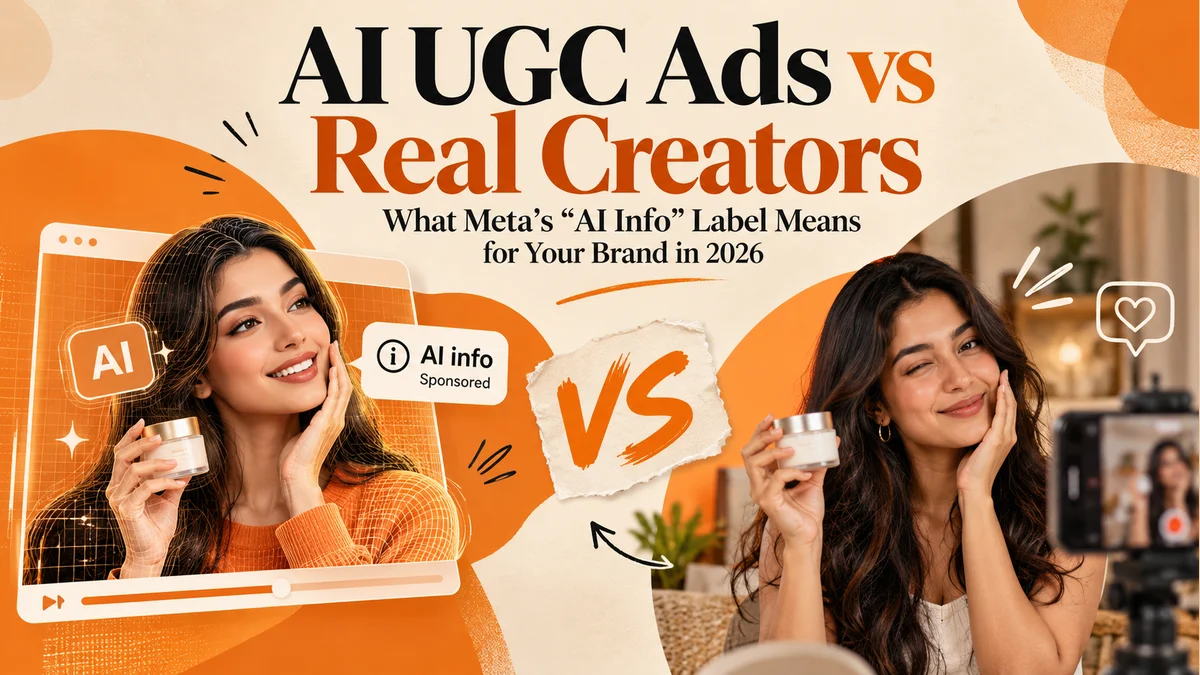
Quick answer: AI UGC ads are creator-style ads made partly or fully with AI; real UGC creators film their own content. Meta labels ads made or significantly edited with its generative AI creative tools and is beginning to detect some third-party AI ads. Its “About this ad” experience is rolling out. A hybrid workflow is worth testing, but neither AI nor human creative is a guaranteed performance winner.
TL;DR (Key Takeaways)
- Meta applies an "AI info" label to ads created or significantly edited with its own generative AI tools, and it is rolling out detection for some ads made with third-party AI tools.
- Meta describes industry-standard detection signals; detection is not universal, and a missing label does not prove that an ad is free of AI.
- Real product experience can support credible demonstrations. AI can help develop variations. Treat speed, cost and trust advantages as hypotheses to measure.
- A possible approach: AI for concept testing and variations, real creators for genuine demonstrations and testimonials.
- Check permissions, creator contracts and disclosure rules before you run any AI-made UGC-style ad.
What Are AI UGC Ads?
AI UGC ads are video or image ads that look like user-generated content (a person talking to camera, a casual review, an unboxing) but are produced with AI. That can mean an AI avatar, a synthetic voice, an AI-written script, or AI-edited footage of a real creator.
This style is also called AI-generated UGC, synthetic UGC or UGC-style AI ads. Popular tools in this space include avatar and video generators, and more arrive every month.
What Are Real UGC Creators?
A UGC content creator is a real person who films authentic-looking content for a brand: a review, a tutorial, a testimonial or a day-in-the-life clip. The brand then runs that content as paid ads (often through Meta Partnership Ads or the brand's own ad account) or posts it on its own channels.
In India and the UAE, micro-creators have become the backbone of this model because they are affordable, speak local languages and feel relatable to their communities. If you want the full creator-side picture, read my UGC creator guide for India and UAE.
What Changed on Meta: The AI Info Label Explained
Meta has been expanding transparency around AI in ads. Here is what matters for advertisers:
1. Meta’s own generative AI creative tools: Meta describes AI info labels for ads created or significantly edited with these tools. Check the actual feature and output rather than assuming every automated edit is covered.
2. Third-party AI tools: Meta says it is beginning to detect ads made with third-party tools using industry-standard signals. This is not universal detection. Its ads announcement does not specify C2PA as the sole mechanism.
3. Where users see it: Meta’s June 2026 update describes AI info in “About this ad”, reached through the three-dot menu. That experience is beginning to roll out, so availability and placement may vary.
You can read Meta's own explanation in its official announcement on GenAI transparency in ads. For the wider policy picture, see my Meta advertiser checklist.
Important: detection depends on signals in the file. If your AI tool does not write that metadata, the label may not appear automatically. That does not mean you are free from disclosure duties. Always follow Meta's ad policies and local advertising rules, and do not try to strip metadata to avoid a label.
AI UGC Ads vs Real Creators: Side-by-Side Comparison
| Factor | AI UGC Ads | Real UGC Creators |
|---|---|---|
| Production speed | Hours | Days to weeks |
| Cost per video | Lower at volume (tool subscription) | Higher (creator fee, product, revisions) |
| Trust and authenticity | Synthetic presentation may need more explanation; test audience response | Can show genuine experience; credibility depends on honest claims |
| Language and market variations | Very easy to scale | Needs a creator per language or market |
| Brand control | High and predictable | Creator's own style adds unpredictability |
| AI disclosure considerations | Check tool, edit and detection coverage | AI-assisted edits may also be relevant |
| Best for | Testing hooks, variations, low-risk products | Testimonials, hero ads, trust-heavy categories |
| Legal and permission complexity | Likeness, voice and tool licence questions | Creator contract, usage rights, disclosure |
Which Performs Better? What the Market Is Saying
Honest answer: it depends on the offer, audience and funnel stage. The points below are planning hypotheses, not independently verified performance benchmarks:
- AI creative is strong for speed, hook testing and localisation, but synthetic faces and fake-feeling testimonials tend to struggle on considered purchases such as finance, supplements or anything needing credibility.
- Many practitioners now run a two-track system: prototype with AI, then remake the proven concepts with real creators.
Treat any benchmark as a starting point only. Your own data, your audience and your offer decide the winner.
My Practical Testing Framework (Run This on Your Own Account)
Use this simple structure so the test is clean and the result is believable.
Step 1: Pick one offer and one audience. Do not change the product, landing page or targeting between variants.
Step 2: Build three creative cells.
- Cell A: Real creator video
- Cell B: AI UGC video using the same script
- Cell C: Real creator footage with light AI editing (captions, background clean-up, translation)
Step 3: Use comparable budgets, placements, timing and a predefined business metric. Where available, use Meta’s A/B test to reduce audience overlap. Plan for adequate conversion data and your budget; exiting the learning phase alone does not make a result statistically reliable.
Step 4: Track more than CTR. Compare hook rate, hold rate, CPC, cost per lead or purchase, and comments sentiment. Also check whether the "AI info" label appears on each ad (open the three-dot menu on the live ad).
Step 5: Decide the winner by business result, not vanity metrics.
Record your own results: log three-second view rate, CTR, cost per lead or purchase, qualified outcomes and comment sentiment for each variant. No campaign results are claimed in this article.
Example: A Hybrid Test for a D2C Skincare Brand
This is an illustrative scenario to show the method, not a client result.
A small Indian skincare brand wants to sell a new face serum on Instagram and Facebook. It has a modest budget and needs to learn fast without losing trust.
1. Week 1, test with AI: The team writes five hook ideas (for example, "Here is the serum’s texture and how to apply it") and makes quick AI UGC versions in Hindi and English. They check each live ad for the "AI info" label.
2. Week 2, shortlist ideas: Review engagement alongside cost per purchase or qualified lead. Three-second views and cheap clicks alone do not establish a sales winner. Continue collecting comparable data if conversions are too sparse.
3. Week 3, remake with real creators: The brand briefs three micro-creators to film the winning hook in their own words, with real product use and honest results.
4. Week 4, compare and scale: Real creator ads, the AI version and a light AI-edited creator version run side by side. Budget moves toward the best cost per purchase.
What the brand is testing: whether AI reduces production time and whether real product demonstrations improve purchase outcomes. Those are hypotheses, not reported results. Keep a record of tools, scripts and approvals for every ad.
Permissions and Disclosure Checklist for Brands
Before running AI-assisted UGC-style ads, confirm each of these:
- Likeness and voice: You have written consent for any real person's face, voice or style that is used or imitated. Never clone a creator without a contract that says so.
- Creator contracts: Usage rights, duration, platforms, paid ads rights and whether AI editing is allowed are all spelled out.
- Tool licence: The AI tool's terms allow commercial use of the avatars, voices and music you use.
- Meta AI label: You have checked live ads for the "AI info" label and you are comfortable with how it looks.
- Paid partnership and affiliate disclosure: Creator-led ads may still need branded content or affiliate disclosure even when an AI label is present.
- No fake testimonials: Do not present an AI avatar as a real customer who used your product. This is a trust and policy risk.
- Regulated categories: For finance, health, gambling and similar niches, platform and local rules are stricter, so review them first.
- Records: Keep a simple log of which tools, scripts and approvals went into each creative.
When to Use AI UGC and When to Use Real Creators
Use AI UGC when you want to:
- Test 10 to 20 hooks quickly before spending on production
- Create language variations for different Indian states or the UAE market
- Refresh fatigued creative with new openings or backgrounds
- Promote low-risk, low-consideration products
Use real creators when you want to:
- Build trust for expensive, sensitive or high-consideration products
- Show real product use, results and honest reactions
- Scale winning concepts to colder or younger audiences
- Create a long-term creator community around your brand
Best hybrid workflow: AI to find the winning idea, real creators to make the polished version, AI-assisted editing for cut-downs and translations.
What This Means for iGaming, Forex and Other Restricted Niches
If you advertise in a restricted vertical, extra transparency can also mean extra scrutiny. Keep your creative honest, avoid unrealistic claims, and do not use synthetic people to imply real winnings or real user stories. Always check each platform's policy for your category and country before launching. For the wider channel decisions, see prop firm marketing when ads are restricted. AI does not bypass legal or platform eligibility checks.
Final Takeaway
AI UGC ads versus real creators is not a fight where one side must win. Meta's AI info labels simply make the choice more visible to your audience. Brands that use AI for speed, real creators for trust, and honest disclosure for safety will be in the strongest position.
Your next three steps:
1. Check your live Meta ads today: tap the three-dot menu and look for "AI info" under "About this ad".
2. Run one split test (real creator vs AI UGC vs hybrid) on a single offer and record the results.
3. Update your creator contracts and brand checklist to cover AI editing, likeness and disclosure.
Need a UGC strategy connected to business results? Let’s make your brand more interesting. You can also reach Digitale by Likita at digitalebylikita@gmail.com.
Source checked 28 October 2026: Meta’s official ads-transparency announcement includes its June 2026 rollout update. This guide is practical analysis, not legal advice; labelling, platform policies and local disclosure obligations should be checked again before launch.
Official sources and further reading
Meta: Expanding GenAI transparency for adsASCI: influencer advertising guidelinesFAQs
What is an AI UGC ad?+
An AI UGC ad is a UGC-style advertisement made partly or fully with AI, such as an AI avatar delivering a script in a casual, creator-like format.
Does Meta label AI-generated ads?+
Meta labels ads created or significantly edited with its generative AI creative tools and is beginning to detect some third-party AI ads using industry-standard signals. Coverage is not universal.
Where does the AI info label appear on Facebook and Instagram ads?+
Meta describes AI info inside About this ad, accessed through the three-dot menu. The experience is beginning to roll out, so availability and placement can vary.
Do AI UGC ads perform better than real creator ads?+
Neither format always wins. Compare actual cost per purchase or qualified lead in a controlled test; speed, CTR and views alone do not prove better business results.
Will the AI label hurt my ad performance?+
I have not seen official data from Meta saying the label reduces performance. Test it on your own audience and compare results.
Is it legal to use AI avatars as customers in ads?+
Rules vary by country and platform, but presenting a synthetic person as a real customer can be misleading. Use clear, honest framing and check local advertising regulations.
Should small brands in India use AI UGC or real creators?+
Start with a few affordable micro-creators for trust, then use AI to create variations of what works. That keeps costs low without losing credibility.
Can I use real creator footage and edit it with AI?+
Yes, if your contract allows it. Light AI editing may or may not trigger a label depending on the tool and the edit, so check your live ads.
How do I know if my ad has an AI info label?+
Open the live ad’s three-dot menu and check About this ad where available. A missing label does not prove no AI was used or remove disclosure obligations.
What is the best strategy for UGC ads in 2026?+
A hybrid one: AI for ideas, hooks and variations, real creators for trust-building content, and a clear disclosure and permissions process.
Keep reading
- Performance MarketingBlack Friday & Festive Season Ads in India: What Small Brands Should Actually Spend in 202612 min read
- Performance MarketingWhatsApp Business API / Marketing Guide (2026): What Changed Two Days Ago7 min read
- Performance MarketingWhat Is Performance Marketing? A 2026-27 Guide for Indian Businesses8 min read
Written by Likita
Digital marketing, creative strategy, content & AI — Asia, UAE & Europe.